
Tradition Institution Buddhist traditions
Tibetan Buddhism
བོད་བརྒྱུད་ནང་བསྟན། bo 藏傳佛教 zh チベット仏教 ja
Form of Buddhism practiced in Tibet and Bhutan
- Also called Vajrayana, Sutrayana, Grand Lamaism
A path that branches,
meets and parts.
Schools and lineages

Branches · 5
Many paths. Shared histories.
5 branches recorded under Tibetan Buddhism, one step down, as the records give them.
What this means
Association and branching, in both directions. Traditions overlap, split and re-merge; this is not a single-origin family tree, and being listed under another tradition is not the same as being recognised by it.
Does not imply a clean single-origin family tree · that the parent recognises the branch
Imported from Wikidata. Nothing here has been read by an editor.
Recorded as a branch of



Traditions whose own records say they belong to it
2 traditions name Tibetan Buddhism as their own — an affiliation, so kept apart from the tree.

Deities · 1
Gods and divine figures
What this means
Records whose own statements name this tradition — 1 of them. Computed from those statements, not curated here, and ordered by how widely each is linked across Wikipedia — those at home in the tradition’s collection first, and those with a picture first among the leading few — rather than by significance to the tradition.
A god named in a tradition is a figure of its accounts; a picture of one is a work of art, not a likeness.
Imported from Wikidata. Nothing here has been read by an editor.

Not its own picture Sarvabuddha yogini — lead image of the Italian Wikipedia article
Figures · 38
Begin with a figure
What this means
Records whose own statements name this tradition — 38 of them. Computed from those statements, not curated here, and ordered by how widely each is linked across Wikipedia — those at home in the tradition’s collection first, and those with a picture first among the leading few — rather than by significance to the tradition.
An affiliation recorded on a person is a third party’s record, often of one period of a life — not that person’s belief at every point in it.
Imported from Wikidata. Nothing here has been read by an editor.
-
 Tenzin Gyatsofrom 6 July 1935 CE · 14th Dalai Lama, the spiritual and temporal leader of Tibetans
 -
 Padmasambhava717 CE – 762 CE · 8th-century Vajrayana Master
 -
 Thubten Gyatso12 February 1876 CE – 17 December 1933 CE · 13th Dalai Lama of Tibet (1876-1933)
 -
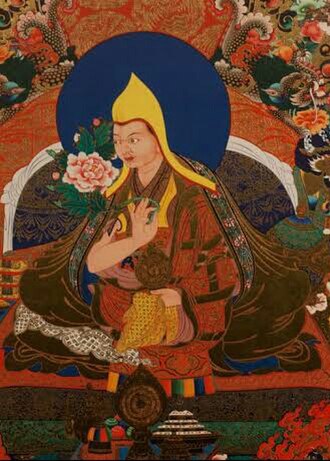 1st Dalai Lama1391 CE – 1474 CE · Dalai Lama of Tibet (1391-1474)
 -
 Tsangyang Gyatso1 March 1683 CE – 15 November 1706 CE · sixth Dalai Lama of Tibet (1683-1706)
 -
 Ngawang Lobzang Gyatso21 October 1617 CE – 2 April 1682 CE · political and religious leader of Tibet (1617–1682)
 -
 Gedun Gyatso1476 CE – 1542 CE · Dalai Lama of Tibet (1476-1542)
 -
 Trinle Gyatso26 January 1857 CE – 25 April 1875 CE · 12th Dalai Lama of Tibet (1857-1875)
 -
 Dalai Lama 09 Lungtok Gyatso1 December 1805 CE – 26 March 1815 CE · 9th Dalai Lama (1805-1815)
 -
 Dalai Lama 11 Khedrub Gyatso1 November 1838 CE – 31 January 1856 CE · 11th Dalai Lama (1838–1856)
 -
 Tsongkhapa21 November 1357 CE – 21 November 1419 CE · Tibetan Buddhist monk, philosopher, and guru (c. 1357–1419)
 -
 Dalai Lama 10 Tsultrim Gyatso25 April 1816 CE – 30 September 1837 CE · 10th Dalai Lama of Tibet (1816-1837)
Show 26 more
-
 Figure Bogd Khan Great Khan of Outer Mongolia (1869–1924)
 -
 Figure Kelzang Gyatso 7th Dalai Lama
 -
 Figure Shabdrung Ngawang Namgyal Bhutanese Lama (1594-1651)
 -
 Figure Matthieu Ricard French writer and Buddhist monk
 -
 Figure Gampopa Sonam Rinchen Tibetan Buddhist teacher, monk and philosopher (1079–1153)
 -
 Figure Naropa Indian Buddhist Mahasiddha
 -
 Figure Galdan Boshugtu Khan Khong Tayiji or khan of the Dzungaria in the 17th century
 -
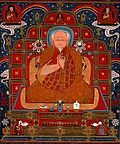 Figure Pakpa Lodro Gyeltsen Tibetan Lama (1235-1280)
 -
.jpg/120px-SR_for_wiki_(cropped).jpg) Figure Sogyal Rinpoche Tibetan Dzogchen lama of the Nyingma tradition
Figure Sogyal Rinpoche Tibetan Dzogchen lama of the Nyingma tradition -
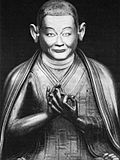 Figure Düsum Khyenpa, 1st Karmapa Lama Tibetan Lama
 -
 Figure Longchenpa Tibetan Buddhist
 -
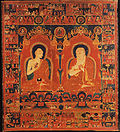 Figure Buton Rinchen Drub Tibetan Buddhist leader and Sakya master (1290–1364)
 -
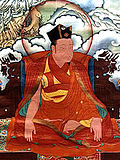 Figure Karma Pakshi Tibetan Buddhist religious figure (1204–1283)
 -
 Figure Rangjung Dorje, 3rd Karmapa Lama Third Karmapa, an important figure in the history of Tibetan Buddhism
 -
 Figure Lobsang Chökyi Gyaltsen, 4th Panchen Lama Fourth Panchen Lama of Tibet, 1570–1662
 -
 Figure Lobsang Yeshe, Fifth Panchen Lama Panchen Lama
 -
 Figure Ensapa Lobsang Döndrup, 3rd Panchen Lama Tibetan Buddhist religious leader
 - Figure Erdeni Batur Oirats' Choros prince and founder of Dzungar Khanate
-
 Figure Khedrubje Gelek Pelzang Tibetan Buddhist leader (1385–1438)
 -
_d.jpg/120px-Tangka_imp%C3%A9rial_de_Changkya_Hutuktu_Rolpai_Dorje_(1717-1786)_d.jpg) Figure Changkya Rölpé Dorjé Important Buddhist teacher in the Qing court
Figure Changkya Rölpé Dorjé Important Buddhist teacher in the Qing court -
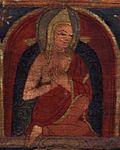 Figure Dromton Gyelwa Jungne Tibetan Buddhist lama
 -
 Figure Drukpa Kunle Buddhist master
 -
 Figure Deshin Shekpa, 5th Karmapa Lama Karmapa Lama
 -
.jpg/120px-Dolpopa_Sherab_Gyaltsen_with_Snow_Lions_supporting_his_lotus_throne_detail%2C_from-_Dolpopa_(cropped).jpg) Figure Dolpopa Sherab Gyeltsen Nepalese philosopher
Figure Dolpopa Sherab Gyeltsen Nepalese philosopher - Figure Tai Situ Changchub Gyaltsen Tibetan Lama
-
 Figure Thubten Zopa Rinpoche Buddhist lama from Khumbu, Nepal
Places · 10
Places and sites
What this means
Records whose own statements name this tradition — 10 of them. Computed from those statements, not curated here, and ordered by how widely each is linked across Wikipedia — those at home in the tradition’s collection first, and those with a picture first among the leading few — rather than by significance to the tradition.
A place that names a tradition may be a temple or a whole province. Either way it is not a count of believers, and not evidence of practice in every period.
Imported from Wikidata. Nothing here has been read by an editor.
-
.jpg/330px-Kee_monastery_Spiti_Valley_(edited).jpg)
Key Monastery
Buddhist monastery in Spiti, Himachal Pradesh, India -

Miaoying Temple
Tibetan Buddhist temple in Beijing -

Milarepa's Cave
Cave and monastery in Nyalam County, Tibet -

Thikse Monastery
Monastery -

Alchi Monastery
Buddhist monastery in Ladakh, India -
.jpg/330px-Monasterio_de_Dang_Shang_Kagyu_(Panillo%2C_Uesca%2C_Arag%C3%B3n).jpg)
Dag Shang Kagyü
Tibetan Buddhist monastery in Panillo, Spain -

Kagyu-Dzong
Buddhist temple located in Paris, France -

Baldan Bereeven Monastery
Monastery in Ömnödelger, Khentii, Mongolia
Show 2 more

Festivals and practices · 1
Festivals, holy days and practices
What this means
Records whose own statements name this tradition — 1 of them. Computed from those statements, not curated here, and ordered by how widely each is linked across Wikipedia — those at home in the tradition’s collection first, and those with a picture first among the leading few — rather than by significance to the tradition.
A holy day’s day is the one its record states it is observed on. A festival recurs, so it has no date on the historical clock, and one named here is not evidence of when or where it was kept.
Imported from Wikidata. Nothing here has been read by an editor.

The Buddhist traditions collection holds 34 festivals and practices in all; 33 of them do not name Tibetan Buddhism on their own records. See them in the collection
Institutions · 4
Offices
What this means
Records whose own statements name this tradition — 4 of them. Computed from those statements, not curated here, and ordered by how widely each is linked across Wikipedia — those at home in the tradition’s collection first, and those with a picture first among the leading few — rather than by significance to the tradition.
A ruling house that names a tradition is a family’s recorded affiliation, not its subjects’ practice; an office is a line of holders, not a family.
Imported from Wikidata. Nothing here has been read by an editor.


Connections
How Tibetan Buddhism connects
Grouped by the kind of relationship, because a successor is not a son and a shared symbol is not an influence.
Affiliation 1
What this means
Association with a tradition or school. Traditions branch, overlap and re-merge; this is not a clean single-origin tree.
Does not imply personal belief at every point in a life · the practice of a population
Imported from Wikidata unless a tile says otherwise. Nothing here has been read by an editor.
Sources
Sources and evidence
Where every statement on this page comes from, and how each one stands.
2 statements on this record
- 2 Imported Taken from Wikidata as it stands. Nobody here has read it.
Only this record’s own statements. What other records say about it is counted on theirs.
Three layers, three licences
- Text
- Wikipedia · CC BY-SA 4.0, quoted, not merged
- Pictures
- Wikimedia Commons · each file’s own terms
Review
Not yet read by an editor here. Every relationship on this page is an import.
Disagreements are kept, not resolved, and a count of sources is not a confidence score.


Keep exploring
More from Buddhist traditions
Theravāda, Mahāyāna and Vajrayāna, their figures, sutras, lineages and monasteries.