
_in_Amritsar%2C_India.jpg/960px-Sikh_pilgrim_at_the_Golden_Temple_(Harmandir_Sahib)_in_Amritsar%2C_India.jpg)
Tradition Institution South Asian traditions
Sikhism
सिक्खमतम् sa सिखमत hi சீக்கியம் ta
Monotheistic Indian religion
- Dated from 1469 CE
- Also called Sikhi, Sikh, Gurmat
A path that branches,
meets and parts.
Schools and lineages
Branches and affiliations
Many paths. Shared histories.
What this means
Association and branching, in both directions. Traditions overlap, split and re-merge; this is not a single-origin family tree, and being listed under another tradition is not the same as being recognised by it.
Does not imply a clean single-origin family tree · that the parent recognises the branch
Imported from Wikidata. Nothing here has been read by an editor.
Recorded as a branch of

_in_Amritsar%2C_India.jpg/120px-Sikh_pilgrim_at_the_Golden_Temple_(Harmandir_Sahib)_in_Amritsar%2C_India.jpg)
Traditions whose own records say they belong to it
4 traditions name Sikhism as their own — an affiliation, so kept apart from the tree.
- Belongs to it
Akali movement
Movement within Sikhism religion -
 Belongs to it
Nirmala
Sikh religious sect of ascetics from India - Belongs to it
Bhakti movement
Religious movement during the Medieval period of the Indian Subcontinent -
.jpg/250px-La_conversi%C3%B3n_de_san_Pablo_(Murillo).jpg) Belongs to it
Belongs to itConversion of Paul the Apostle
Event that led Paul to cease persecuting early Christians and to become an apostle of Jesus
Attributed founding
Whom the records name as founder
What this means
An attribution, and a contested one in most traditions: it does not mean the tradition began fully formed, nor that later adherents accept the attribution.
Does not imply that the tradition began fully formed · that later adherents accept the attribution
Imported from Wikidata. Nothing here has been read by an editor.
Figures · 5
Begin with a figure
What this means
Records whose own statements name this tradition — 5 of them. Computed from those statements, not curated here, and ordered by how widely each is linked across Wikipedia — those at home in the tradition’s collection first, and those with a picture first among the leading few — rather than by significance to the tradition.
An affiliation recorded on a person is a third party’s record, often of one period of a life — not that person’s belief at every point in it.
Imported from Wikidata. Nothing here has been read by an editor.
-
 Guru Nanak15 April 1469 CE – 22 September 1539 CE · First Sikh Guru and founder of Sikhism
 -
 Guru Tegh Bahadur1 April 1621 CE – 11 November 1675 CE · the ninth Guru of Sikhism (1621–1675)
 -
 Guru Har Krishan7 July 1656 CE – 30 March 1664 CE · the eighth Sikh Guru
 -
 Bebe Nanaki1464 CE – 1518 CE · elder sister of Guru Nanak
 -
 Sri Chand8 September 1494 CE – 13 January 1629 CE (Old Style) · Guru Nanak's son
Not its own picture Sri Chand — lead image of the English Wikipedia article
Texts · 2
Texts and teachings
What this means
Records whose own statements name this tradition — 2 of them. Computed from those statements, not curated here, and ordered by how widely each is linked across Wikipedia — those at home in the tradition’s collection first, and those with a picture first among the leading few — rather than by significance to the tradition.
Where a date is shown it is when the text was written — the source’s clock, never the time of what it tells.
Imported from Wikidata. Nothing here has been read by an editor.

Places · 5
Places and sites
What this means
Records whose own statements name this tradition — 5 of them. Computed from those statements, not curated here, and ordered by how widely each is linked across Wikipedia — those at home in the tradition’s collection first, and those with a picture first among the leading few — rather than by significance to the tradition.
A place that names a tradition may be a temple or a whole province. Either way it is not a count of believers, and not evidence of practice in every period.
Imported from Wikidata. Nothing here has been read by an editor.
-
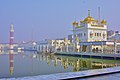
.jpg/330px-Hamandir_Sahib_(Golden_Temple).jpg)
Harmandir Sahib
Sikh religious site in Amritsar, Punjab, India -

Gurdwara Baba Atal
Gurdwara in Amritsar, India -

Gurdwara Panja Sahib
Gurdwara in Pakistan -

Gurdwara Fatehgarh Sahib
Building in India
Show 1 more
Festivals and practices · 1
Festivals, holy days and practices
What this means
Records whose own statements name this tradition — 1 of them. Computed from those statements, not curated here, and ordered by how widely each is linked across Wikipedia — those at home in the tradition’s collection first, and those with a picture first among the leading few — rather than by significance to the tradition.
A holy day’s day is the one its record states it is observed on. A festival recurs, so it has no date on the historical clock, and one named here is not evidence of when or where it was kept.
Imported from Wikidata. Nothing here has been read by an editor.

The South Asian traditions collection holds 46 festivals and practices in all; 45 of them do not name Sikhism on their own records. See them in the collection
Connections
How Sikhism connects
Grouped by the kind of relationship, because a successor is not a son and a shared symbol is not an influence.
Affiliation 1
What this means
Association with a tradition or school. Traditions branch, overlap and re-merge; this is not a clean single-origin tree.
Does not imply a fixed roster · that every account of the tradition knows this figure
Imported from Wikidata unless a tile says otherwise. Nothing here has been read by an editor.
Identification 1
What this means
One figure treated as another in some context. Not literal identity in all contexts, and usually a claim by a third party.
Does not imply literal identity in all contexts · that either tradition made the identification
Imported from Wikidata unless a tile says otherwise. Nothing here has been read by an editor.
Documented influence 1
What this means
A transmission argued from evidence. Not shared symbols, and not a short path through a database.
Does not imply shared symbols as evidence · a short path through a database
Imported from Wikidata unless a tile says otherwise. Nothing here has been read by an editor.
Sources
Sources and evidence
Where every statement on this page comes from, and how each one stands.
5 statements on this record
- 5 Imported Taken from Wikidata as it stands. Nobody here has read it.
Only this record’s own statements. What other records say about it is counted on theirs.
Three layers, three licences
- Text
- Wikipedia · CC BY-SA 4.0, quoted, not merged
- Pictures
- Wikimedia Commons · each file’s own terms
Review
Not yet read by an editor here. Every relationship on this page is an import.
Disagreements are kept, not resolved, and a count of sources is not a confidence score.
.jpeg/960px-UgrataraTemple2_(cropped).jpeg)
.jpeg)
Keep exploring
More from South Asian traditions
Hinduism and its schools, Jainism, Sikhism, and the Vedic material behind them.