

Tradition Institution Christianity
Russian Orthodox Church
Ecclesia Orthodoxa Russica la
Autocephalous Eastern Orthodox church
- Dated from 15 December 1448 CE
A path that branches,
meets and parts.
Schools and lineages
Affiliations · 3
Traditions that name it as theirs
3 traditions name Russian Orthodox Church as their own — an affiliation read from their records, not a branch.
What this means
Association and branching, in both directions. Traditions overlap, split and re-merge; this is not a single-origin family tree, and being listed under another tradition is not the same as being recognised by it.
Does not imply a clean single-origin family tree · that the parent recognises the branch
Imported from Wikidata. Nothing here has been read by an editor.


Attributed founding
Whom the records name as founder
What this means
An attribution, and a contested one in most traditions: it does not mean the tradition began fully formed, nor that later adherents accept the attribution.
Does not imply that the tradition began fully formed · that later adherents accept the attribution
Imported from Wikidata. Nothing here has been read by an editor.
-
 Andrew the Apostletraditionally c. 6 BCE – 30 November 60 CE · religious figure of the Christian faith
 -
 Nicholas II of Constantinopleuntil 12 October 991 CE · Patriarch of Constantinople
 -
 Photios I of Constantinoplec. 827 CE – 9th century CE · 9th Century Ecumenical Patriarch of Constantinople
 -
 Vladimir the Greatc. 956 CE – 15 July 1015 CE · Grand Prince of Kiev
Figures · 15
Begin with a figure
What this means
Records whose own statements name this tradition — 15 of them. Computed from those statements, not curated here, and ordered by how widely each is linked across Wikipedia — those at home in the tradition’s collection first, and those with a picture first among the leading few — rather than by significance to the tradition.
An affiliation recorded on a person is a third party’s record, often of one period of a life — not that person’s belief at every point in it.
Imported from Wikidata. Nothing here has been read by an editor.
-
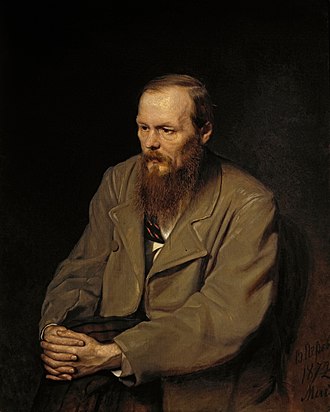 Fyodor Dostoyevsky30 October 1821 CE (Old Style) – 28 January 1881 CE (Old Style) · Russian novelist (1821–1881)
 -
.jpg/330px-Inconnu_d'apr%C3%A8s_J.-M._Nattier%2C_Portrait_de_Pierre_Ier_(mus%C3%A9e_de_l%E2%80%99Ermitage).jpg) Peter the Great30 May 1672 CE (Old Style) – 28 January 1725 CE (Old Style) · Tsar/Emperor of Russia from 1682 to 1725
Peter the Great30 May 1672 CE (Old Style) – 28 January 1725 CE (Old Style) · Tsar/Emperor of Russia from 1682 to 1725 -
 Nicholas II of Russia18 May 1868 CE – 17 July 1918 CE · 14th and last Emperor of Russia (1894–1917)
 -
 Peter III of Russia10 February 1728 CE (Old Style) – 6 July 1762 CE (Old Style) · The seventh Emperor of Russia (1762)
 -
 Alexandra Feodorovna (Alix of Hesse)6 June 1872 CE – 17 July 1918 CE · Empress consort of Russia (1872–1918)
 -
 Grand Duchess Anastasia Nikolaevna of Russia18 June 1901 CE – 17 July 1918 CE · Grand Duchess of Russia (1901–1918); fourth child and youngest daughter of Nicholas II and Alexandra Feodorovna (Alix of Hesse)
 -
.jpg/330px-Feodor_I_of_Russia_(parsuna%2C_1630s%2C_Moscow_History_museum).jpg) Feodor I of Russia31 May 1557 CE – 7 January 1598 CE (Old Style) · Tsar of Russia (1584–1598)
Feodor I of Russia31 May 1557 CE – 7 January 1598 CE (Old Style) · Tsar of Russia (1584–1598) -
 Patriarch Alexius II23 February 1929 CE – 5 December 2008 CE · 15th Patriarch of Moscow and all the Rus', the primate of the Russian Orthodox Church (1929–2008)
 -
 Grand Duchess Maria Nikolaevna of Russia26 June 1899 CE – 17 July 1918 CE · Grand Duchess of Russia (1899–1918); third daughter of Nicholas II and Alexandra Feodorovna (Alix of Hesse)
 -
 Grand Duchess Olga Nikolaevna of Russia3 November 1895 CE (Old Style) – 17 July 1918 CE · Grand Duchess of Russia (1895–1918); eldest child of Nicholas II and Alexandra Feodorovna (Alix of Hesse)
 -
 Alexei Nikolaevich, Tsarevich of Russia12 August 1904 CE – 17 July 1918 CE · Last Russian tsesarevich and heir apparent of the Russian Empire (1904–1918); youngest child of Nicholas II and Alexandra Feodorovna (Alix of Hesse)
 -
 Grand Duchess Tatiana Nikolaevna of Russia10 June 1897 CE – 17 July 1918 CE · Grand Duchess of Russia (1897–1918); second daughter of Nicholas II and Alexandra Feodorovna (Alix of Hesse)
Show 3 more
-
 Figure Princess Alice of Battenberg Member of the House of Battenberg (1885–1969)
 -
 Figure Fyodor Ushakov Russian Saint and Admiral (1745-1817)
 -
 Figure Grand Duke Dmitri Pavlovich of Russia Russian grand duke (1891-1942); grandson of Alexander II, son of Grand Duke Paul Alexandrovich of Russia and Princess Alexandra of Greece and Denmark
Places · 6
Places and sites
What this means
Records whose own statements name this tradition — 6 of them. Computed from those statements, not curated here, and ordered by how widely each is linked across Wikipedia — those at home in the tradition’s collection first, and those with a picture first among the leading few — rather than by significance to the tradition.
A place that names a tradition may be a temple or a whole province. Either way it is not a count of believers, and not evidence of practice in every period.
Imported from Wikidata. Nothing here has been read by an editor.
-

Trinity Lavra of St. Sergius
Russian monastery and the spiritual centre of the Russian Orthodox Church -
.jpg/330px-%D0%A5%D1%80%D0%B0%D0%BC_%D0%B2%D0%BE_%D0%B8%D0%BC%D1%8F_%D1%81%D0%B2%D1%8F%D1%82%D0%B8%D1%82%D0%B5%D0%BB%D1%8F_%D0%94%D0%B5%D0%BC%D0%B8%D1%82%D1%80%D0%B8%D1%8F%2C_%D0%9C%D0%B8%D1%82%D1%80%D0%BE%D0%BF%D0%BE%D0%BB%D0%B8%D1%82%D0%B0_%D0%A0%D0%BE%D1%81%D1%82%D0%BE%D0%B2%D1%81%D0%BA%D0%BE%D0%B3%D0%BE_(%D0%A0%D0%BE%D1%81%D1%82%D0%BE%D0%B2-%D0%BD%D0%B0-%D0%94%D0%BE%D0%BD%D1%83).jpg)
church of St Dimitry of Rostov
Orthodox church in Rostov-on-Don -

Berlin-Tegel Russian Orthodox Cemetery
Cemetery in Berlin, Germany -

Transfiguration Monastery, Staraya Russa
Monastery in Staraya Russa, Russia
Show 2 more


Institutions · 3
Institutions
What this means
Records whose own statements name this tradition — 3 of them. Computed from those statements, not curated here, and ordered by how widely each is linked across Wikipedia — those at home in the tradition’s collection first, and those with a picture first among the leading few — rather than by significance to the tradition.
A ruling house that names a tradition is a family’s recorded affiliation, not its subjects’ practice; an office is a line of holders, not a family.
Imported from Wikidata. Nothing here has been read by an editor.
-
 Institution
Russian Orthodox Church Outside of Russia
Semi-autonomous part of the Russian Orthodox Church -
 Institution
Most Holy Synod
Highest governing body of the Russian Orthodox Church starting in 1721; abolished in 1917 when the Patriarchate was reinstated - Institution
Holy Synod of the Russian Orthodox Church
Governing body of the Russian Orthodox Church
Connections
How Russian Orthodox Church connects
Grouped by the kind of relationship, because a successor is not a son and a shared symbol is not an influence.
Affiliation 2
What this means
Association with a tradition or school. Traditions branch, overlap and re-merge; this is not a clean single-origin tree.
Does not imply a fixed roster · that every account of the tradition knows this figure · personal belief at every point in a life · the practice of a population
Imported from Wikidata unless a tile says otherwise. Nothing here has been read by an editor.

Recorded events and days 2
What this means
Events Wikidata records in a subject’s history, and the day a festival is kept. Not a complete history, and the day a festival falls on is not when it began.
Does not imply that these are all the events in its history · that Wikidata ranks the events by importance
Imported from Wikidata unless a tile says otherwise. Nothing here has been read by an editor.
_33.jpg/120px-Working_visit_of_the_President_of_Ukraine_Petro_Poroshenko_to_the_Turkish_Republic_(2019-01-05)_33.jpg)
Sources
Sources and evidence
Where every statement on this page comes from, and how each one stands.
8 statements on this record
- 1 Has references The statement cites something outside Wikimedia. That citation has not been checked here.
- 7 Imported Taken from Wikidata as it stands. Nobody here has read it. 1 of them cite only Wikipedia: one source, counted once.
Only this record’s own statements. What other records say about it is counted on theirs.
Three layers, three licences
- Text
- Wikipedia · CC BY-SA 4.0, quoted, not merged
- Pictures
- Wikimedia Commons · each file’s own terms
Review
Not yet read by an editor here. Every relationship on this page is an import.
Disagreements are kept, not resolved, and a count of sources is not a confidence score.


Keep exploring
More from Christianity
Its branches, councils, saints, offices and buildings — and where they stopped recognising each other.