
Tradition Institution Christianity
Pietism
Pietismus la
Movement christian
- Also called Pietists, Pietist
A path that branches,
meets and parts.
Schools and lineages
Branches · 1
Many paths. Shared histories.
What this means
Association and branching, in both directions. Traditions overlap, split and re-merge; this is not a single-origin family tree, and being listed under another tradition is not the same as being recognised by it.
Does not imply a clean single-origin family tree · that the parent recognises the branch
Imported from Wikidata. Nothing here has been read by an editor.
Traditions whose own records say they belong to it
1 tradition names Pietism as its own — an affiliation, so kept apart from the tree.
Attributed founding
Whom the records name as founder
What this means
An attribution, and a contested one in most traditions: it does not mean the tradition began fully formed, nor that later adherents accept the attribution.
Does not imply that the tradition began fully formed · that later adherents accept the attribution
Imported from Wikidata. Nothing here has been read by an editor.
.jpg/330px-Philipp_Jacob_Spener_(8166014).jpg)
Figures · 1
Begin with a figure
What this means
Records whose own statements name this tradition — 1 of them. Computed from those statements, not curated here, and ordered by how widely each is linked across Wikipedia — those at home in the tradition’s collection first, and those with a picture first among the leading few — rather than by significance to the tradition.
An affiliation recorded on a person is a third party’s record, often of one period of a life — not that person’s belief at every point in it.
Imported from Wikidata. Nothing here has been read by an editor.

Connections
How Pietism connects
Grouped by the kind of relationship, because a successor is not a son and a shared symbol is not an influence.
Affiliation 1
What this means
Association with a tradition or school. Traditions branch, overlap and re-merge; this is not a clean single-origin tree.
Does not imply personal belief at every point in a life · the practice of a population
Imported from Wikidata unless a tile says otherwise. Nothing here has been read by an editor.

Documented influence 4
What this means
A transmission argued from evidence. Not shared symbols, and not a short path through a database.
Does not imply shared symbols as evidence · a short path through a database
Imported from Wikidata unless a tile says otherwise. Nothing here has been read by an editor.
-
 was influenced by Jakob Böhme German Christian mystic and theologian (1575-1624)
 - influenced Evangelical Christians-Baptists Protestant movement active predominantly in Ukraine, Russia, Moldova, Belarus and Kazakhstan, and historically different from other Evangelical, Baptist and Pentecostal churches
-
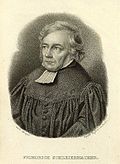 influenced Friedrich Schleiermacher German theologian, philosopher, and biblical scholar (1768-1834)
 - influenced Unity of the Brethren Christian denomination in the Czech Republic; province of the Moravian Church
Sources
Sources and evidence
Where every statement on this page comes from, and how each one stands.
3 statements on this record
- 1 Has references The statement cites something outside Wikimedia. That citation has not been checked here.
- 2 Imported Taken from Wikidata as it stands. Nobody here has read it.
Only this record’s own statements. What other records say about it is counted on theirs.
Three layers, three licences
- Text
- Wikipedia · CC BY-SA 4.0, quoted, not merged
Review
Not yet read by an editor here. Every relationship on this page is an import.
Disagreements are kept, not resolved, and a count of sources is not a confidence score.


Keep exploring
More from Christianity
Its branches, councils, saints, offices and buildings — and where they stopped recognising each other.