

Tradition Institution
paganism
Polytheistic religious groups
- Also called heathenism, heathenry
A path that branches,
meets and parts.
Schools and lineages
Branches · 8
Many paths. Shared histories.
8 branches recorded under paganism, one step down, as the records give them.
What this means
Association and branching, in both directions. Traditions overlap, split and re-merge; this is not a single-origin family tree, and being listed under another tradition is not the same as being recognised by it.
Does not imply a clean single-origin family tree · that the parent recognises the branch
Imported from Wikidata. Nothing here has been read by an editor.
Recorded as a branch of

-
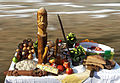 modern paganism Group of contemporary religious movements based on ancient European and Middle Eastern religions 31 branches of its own
 - Germanic paganism Ethnic religion practiced by the Germanic peoples from the Iron Age until Christianisation 2 branches of its own
- Slavic religion Historical polytheistic religion of the Slavs
-
 Sanamahism Religious or philosophical tradition of Meetei origin 1 branch of its own
 - Illyrian religion The body of myths belonging to the Illyrian peoples
- Circassian paganism Ethnic religion of the Circassian people
- Paganism in Middle-earth Paganism in the literature of Tolkien
- Stregoneria
Traditions whose own records say they belong to it
1 tradition names paganism as its own — an affiliation, so kept apart from the tree.

Figures · 9
Begin with a figure
What this means
Records whose own statements name this tradition — 9 of them. Computed from those statements, not curated here, and ordered by how widely each is linked across Wikipedia — those at home in the tradition’s collection first, and those with a picture first among the leading few — rather than by significance to the tradition.
An affiliation recorded on a person is a third party’s record, often of one period of a life — not that person’s belief at every point in it.
Imported from Wikidata. Nothing here has been read by an editor.
-
 Herod the Greattraditionally c. 74 BCE – c. 4 BCE · king of Judea from 37/6 BCE to 4/1 BCE
 -
 Rurik830 CE – 879 CE · Varangian chieftain (c. 830-879)
 -
 Goliathtraditionally 11th century BCE – c. 1023 BCE · giant Philistine warrior
 -
 Oleg the Wise845 CE – 912 CE · prince of Kiev
 -
 Vytautasc. 1350 CE – 27 October 1430 CE · Grand Duke of Lithuania
 -
 Libaniusc. 314 CE – 393 CE · Greek rhetorician (4th century AD)
 -
 Algirdas1296 CE – 24 May 1377 CE · Grand Duke of Lithuania (1345–1377)
 -
 Kęstutis1297 CE – 15 August 1382 CE · Grand Duke of Lithuania (1381–1382)
 -
.jpg/330px-Svitrigaila_1578_(99260282).jpg) Švitrigaila / Svidrigielloc. 1370 CE – 10 February 1452 CE · Grand Duke of Lituania
Švitrigaila / Svidrigielloc. 1370 CE – 10 February 1452 CE · Grand Duke of Lituania
Institutions · 1
Houses
What this means
Records whose own statements name this tradition — 1 of them. Computed from those statements, not curated here, and ordered by how widely each is linked across Wikipedia — those at home in the tradition’s collection first, and those with a picture first among the leading few — rather than by significance to the tradition.
A ruling house that names a tradition is a family’s recorded affiliation, not its subjects’ practice; an office is a line of holders, not a family.
Imported from Wikidata. Nothing here has been read by an editor.
Connections
How paganism connects
Grouped by the kind of relationship, because a successor is not a son and a shared symbol is not an influence.
Identification 1
What this means
One figure treated as another in some context. Not literal identity in all contexts, and usually a claim by a third party.
Does not imply literal identity in all contexts · that either tradition made the identification
Imported from Wikidata unless a tile says otherwise. Nothing here has been read by an editor.
Sources
Sources and evidence
Where every statement on this page comes from, and how each one stands.
2 statements on this record
- 2 Imported Taken from Wikidata as it stands. Nobody here has read it.
Only this record’s own statements. What other records say about it is counted on theirs.
Three layers, three licences
- Text
- Wikipedia · CC BY-SA 4.0, quoted, not merged
- Pictures
- Wikimedia Commons · each file’s own terms
Review
Not yet read by an editor here. Every relationship on this page is an import.
Disagreements are kept, not resolved, and a count of sources is not a confidence score.
_and_Cautes_(right)%2C_from_the_Mithraeum_at_Sidon_(Colonia_Aurelia_Pia%2C_Syria)%2C_Louvre_Museum_(9365068428).jpg/960px-Statutory_group_depicting_the_cult_of_Mithras%2C_Mithras_slaying_the_bull_accompagnied_by_his_two_torchbeares_Cautopates_(left)_and_Cautes_(right)%2C_from_the_Mithraeum_at_Sidon_(Colonia_Aurelia_Pia%2C_Syria)%2C_Louvre_Museum_(9365068428).jpg)
_and_Cautes_(right)%2C_from_the_Mithraeum_at_Sidon_(Colonia_Aurelia_Pia%2C_Syria)%2C_Louvre_Museum_(9365068428).jpg)
Keep exploring
More traditions, tradition by tradition
The directory lists every one on record, most widely recorded first.
Paths that branch,
meet and part.