

Tradition Institution Buddhist traditions
Nyingma
རྙིང་མ་པ། bo 宁玛派 zh ニンマ派 ja
School of Tibetan Buddhism
- Also called Old School
A path that branches,
meets and parts.
Schools and lineages
Branches and affiliations
Many paths. Shared histories.
What this means
Association and branching, in both directions. Traditions overlap, split and re-merge; this is not a single-origin family tree, and being listed under another tradition is not the same as being recognised by it.
Does not imply a clean single-origin family tree · that the parent recognises the branch
Imported from Wikidata. Nothing here has been read by an editor.
Recorded as a branch of


Figures · 4
Begin with a figure
What this means
Records whose own statements name this tradition — 4 of them. Computed from those statements, not curated here, and ordered by how widely each is linked across Wikipedia — those at home in the tradition’s collection first, and those with a picture first among the leading few — rather than by significance to the tradition.
An affiliation recorded on a person is a third party’s record, often of one period of a life — not that person’s belief at every point in it.
Imported from Wikidata. Nothing here has been read by an editor.
-
 Chögyam Trungpa5 March 1939 CE – 4 April 1987 CE · Tibetan Buddhist lama and writer (1939-1987)
 -
 Patrul Orgyen Jigme Chokyi Wangpo1808 CE – 8 June 1887 CE · 1808-87, Tibetan Buddhist teacher (Nyingma school)
 -
 Dilgo Khyentse Tashi Peljor1910 CE – 27 September 1991 CE · Buddhist Vajrayana master, scholar, poet, and teacher (1910–1991)
 -
 Mipam Gyatso1846 CE – 1912 CE · master of the Nyingma lineage of Tibetan Buddhism and leader of Ri-me movement
Places · 16
Places and sites
What this means
Records whose own statements name this tradition — 16 of them. Computed from those statements, not curated here, and ordered by how widely each is linked across Wikipedia — those at home in the tradition’s collection first, and those with a picture first among the leading few — rather than by significance to the tradition.
A place that names a tradition may be a temple or a whole province. Either way it is not a count of believers, and not evidence of practice in every period.
Imported from Wikidata. Nothing here has been read by an editor.
-
.jpg/330px-Paro_Taktsang%2C_Bhutan_(edited).jpg)
Paro Taktsang
Temple complex in Bhutan -

Samye
Buddhist monastery in Samye, Zhanang, Shannan, Tibet, China -

Rongbuk Monastery
Buddhist monastery in Tingri county Shigatse, Tibet, China -

Nechung
Monastery in Lhasa, Tıbet, China -

Mindroling Monastery
Buddhist monastery in Chaqi, Zhanang County, Tibetan Autonomous Region, China -

Gangteng Monastery
Buddhist monastery in Bhutan -

Namdroling Monastery
Tibetan Buddhist monastery in Bylkuppe, Karnataka, India -

Shechen Monastery
Tibetan Buddhist monastery in Kathmandu, Nepal (formerly Langduo, Sichuan, China)
Show 8 more
- Place Dorje Drak Monastery in Chênggo, Gonggar, Shannan, Tibet, China
-
 Place Dzogchen Monastery Tibetan Buddhist monastery in Dêgê, Garzê, Sichuan, China
 -
 Place Katok Monastery Tibetan monastery in Baiyü, Garzê, Sichuan, China
 -
 Place Palyul Tibetan Buddhist monastery in Baiyü, Garzê, Sichuan, China
 -
 Place Kyichu Lhakhang Himalayan Buddhist temple
 -
.jpg/120px-Larung_Gar_Five_Sciences_Buddhist_Academy_2014_(14660043083).jpg) Place Larung Gar Buddhist Academy In Tibet
Place Larung Gar Buddhist Academy In Tibet -
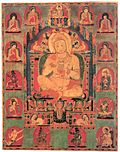 Place Riwoche Monastery Monastery
 -
 Place Lamaling Monastery Monastery in Tibet, China
Festivals and practices · 1
Festivals, holy days and practices
What this means
Records whose own statements name this tradition — 1 of them. Computed from those statements, not curated here, and ordered by how widely each is linked across Wikipedia — those at home in the tradition’s collection first, and those with a picture first among the leading few — rather than by significance to the tradition.
A holy day’s day is the one its record states it is observed on. A festival recurs, so it has no date on the historical clock, and one named here is not evidence of when or where it was kept.
Imported from Wikidata. Nothing here has been read by an editor.
Sources
Sources and evidence
Where every statement on this page comes from, and how each one stands.
1 statement on this record
- 1 Imported Taken from Wikidata as it stands. Nobody here has read it.
Only this record’s own statements. What other records say about it is counted on theirs.
Three layers, three licences
- Text
- Wikipedia · CC BY-SA 4.0, quoted, not merged
- Pictures
- Wikimedia Commons · each file’s own terms
Review
Not yet read by an editor here. Every relationship on this page is an import.
Disagreements are kept, not resolved, and a count of sources is not a confidence score.


Keep exploring
More from Buddhist traditions
Theravāda, Mahāyāna and Vajrayāna, their figures, sutras, lineages and monasteries.