
Tradition Institution Christianity
Chalcedonian Christianity
Christian demoninations that accept the Fourth Ecumenical Council
- Also called calcedonian christianity
A path that branches,
meets and parts.
Schools and lineages
Branches · 3
Many paths. Shared histories.
3 branches recorded under Chalcedonian Christianity, one step down, as the records give them.
What this means
Association and branching, in both directions. Traditions overlap, split and re-merge; this is not a single-origin family tree, and being listed under another tradition is not the same as being recognised by it.
Does not imply a clean single-origin family tree · that the parent recognises the branch
Imported from Wikidata. Nothing here has been read by an editor.
Recorded as a branch of

-
 Catholicism Christian doctrine professed by the Catholic Church 7 branches of its own
 -
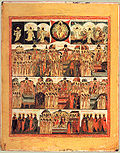 Eastern Orthodoxy Christian denominational family 6 branches of its own
 -
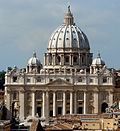 Western Christianity Christianity originating from the tradition of the Western Roman Empire, with its capital in Rome. consists of the Latin Church of the Catholic Church and its derivatives 3 branches of its own
Figures · 12
Begin with a figure
What this means
Records whose own statements name this tradition — 12 of them. Computed from those statements, not curated here, and ordered by how widely each is linked across Wikipedia — those at home in the tradition’s collection first, and those with a picture first among the leading few — rather than by significance to the tradition.
An affiliation recorded on a person is a third party’s record, often of one period of a life — not that person’s belief at every point in it.
Imported from Wikidata. Nothing here has been read by an editor.
-
.jpg/330px-Mosaic_of_Justinianus_I_-_Basilica_San_Vitale_(Ravenna).jpg) Justinian I11 May 482 CE – 14 November 565 CE · Eastern Roman Emperor who ruled from 527 to 565 (482-565)
Justinian I11 May 482 CE – 14 November 565 CE · Eastern Roman Emperor who ruled from 527 to 565 (482-565) -
 Æthelstanc. 895 CE – 27 October 939 CE · King of Wessex and first king of England (r. 924-939)
 -
 Maurice539 CE – 27 November 602 CE · Byzantine Emperor (539-602)
 -
 Æthelred the Unreadyc. 967 CE – 23 April 1016 CE · King of England
 -
 Edmund II of Englandc. 988 CE – 30 November 1016 CE · King of the English, Wessex dynasty
 -
 Edred of England923 CE – 23 November 955 CE · King of England (r. 946–955)
 -
 Maximus the Confessor579 CE – 13 August 662 CE · Christian monk, theologian, scholar and saint (c. 580 - 662)
 -
.jpg/330px-Tiberios_II_(obverse).jpg) Tiberius II Constantinec. 520 CE – 14 August 582 CE · Byzantine Emperor (520-582)
Tiberius II Constantinec. 520 CE – 14 August 582 CE · Byzantine Emperor (520-582) -
.jpg/330px-Hagia_Sophia_Constantinople_(cropped).jpg) Ignatius of Constantinoplec. 797 CE – 23 October 877 CE · 9th century Patriarch of Constantinople
Ignatius of Constantinoplec. 797 CE – 23 October 877 CE · 9th century Patriarch of Constantinople -
 Edwin of Northumbriac. 586 CE – 12 October 633 CE · King of Deira and Bernicia
 - Ælfweard of Wessex904 CE – 2 August 924 CE · West Saxon monarch
- Theodore of Mopsuestiac. 350 CE – 428 CE · Christian theologian
Events · 1
Events
What this means
Records whose own statements name this tradition — 1 of them. Computed from those statements, not curated here, and ordered by how widely each is linked across Wikipedia — those at home in the tradition’s collection first, and those with a picture first among the leading few — rather than by significance to the tradition.
Each is set out by its own date on the historical clock. An event that names a tradition — a council, a schism, a persecution — says who took part or was affected, not what every adherent held.
Imported from Wikidata. Nothing here has been read by an editor.

Sources
Sources and evidence
Where every statement on this page comes from, and how each one stands.
1 statement on this record
- 1 Imported Taken from Wikidata as it stands. Nobody here has read it.
Only this record’s own statements. What other records say about it is counted on theirs.
Three layers, three licences
- Text
- Wikipedia · CC BY-SA 4.0, quoted, not merged
Review
Not yet read by an editor here. Every relationship on this page is an import.
Disagreements are kept, not resolved, and a count of sources is not a confidence score.


Keep exploring
More from Christianity
Its branches, councils, saints, offices and buildings — and where they stopped recognising each other.