
Tradition Institution Greek and Roman
ancient Roman religion
Religio Romana la
Form of Indo-European polytheism practised in the Roman civilization
- Also called Roman religion, Religio Romana, Roman polytheism
A path that branches,
meets and parts.
Schools and lineages
Deities · 12
Gods and divine figures
What this means
Records whose own statements name this tradition — 12 of them. Computed from those statements, not curated here, and ordered by how widely each is linked across Wikipedia — those at home in the tradition’s collection first, and those with a picture first among the leading few — rather than by significance to the tradition.
A god named in a tradition is a figure of its accounts; a picture of one is a work of art, not a likeness.
Imported from Wikidata. Nothing here has been read by an editor.
-
 MercuryRoman god of trade, merchants, thieves and travel
 -
 CybeleAnatolian mother goddess
 -
 Bona DeaRoman deity of chastity, fertility, and healing; brought from Magna Græcia during the early/middle Republic; her rites let women use strong wine and do blood-sacrifice (things otherwise forbidden to women); men were barred from her mysteries
 -
 Anna Perennadeity of the circle of the year in Ancient Rome, legendary sister of queen Dido
 -
 Aeternitaspersonification of eternity in Roman religion
 -
 CloacinaRoman goddess or attribute of Venus, whose image was found in the Cloaca Maxima
 -
 ClementiaRoman goddess of forgiveness and mercy
 - Aius LocutiusAncient Roman deity
- Falacerancient Italic god
- Rediculusancient Roman divinity
- ApotropaeiGreek deities averting evil, and divine epithet
- Necessitaspersonification of inevitability, compulsion and necessity in ancient Roman mythology
Not its own picture Clementia — Allegory of Graciousness (Clementia)., painting
Figures · 11
Begin with a figure
What this means
Records whose own statements name this tradition — 11 of them. Computed from those statements, not curated here, and ordered by how widely each is linked across Wikipedia — those at home in the tradition’s collection first, and those with a picture first among the leading few — rather than by significance to the tradition.
An affiliation recorded on a person is a third party’s record, often of one period of a life — not that person’s belief at every point in it.
Imported from Wikidata. Nothing here has been read by an editor.
-
_-_Palazzo_Nuovo_-_Musei_Capitolini_-_Rome_2016.jpg/330px-Bust_of_Cicero_(1st-cent._BC)_-_Palazzo_Nuovo_-_Musei_Capitolini_-_Rome_2016.jpg) Cicero3 January 106 BCE – 7 December 43 BCE · Roman statesman, lawyer, orator, and philosopher (106–43 BC)
Cicero3 January 106 BCE – 7 December 43 BCE · Roman statesman, lawyer, orator, and philosopher (106–43 BC) -
 Septimius Severus146 CE – 4 February 211 CE · Roman emperor from 193 to 211
 -
 Caracalla4 April 188 CE – 8 April 217 CE · Roman emperor from 198 to 217
 -
_01.jpg/330px-Aulus_Vitellius_(MRABASF_Matritum)_01.jpg) Vitellius24 September 15 CE – 22 December 69 CE · eighth Roman Emperor (69)
Vitellius24 September 15 CE – 22 December 69 CE · eighth Roman Emperor (69) -
 Constantius Chlorus250 CE – 25 July 306 CE · Roman emperor (250-306)
 -
 Geta7 March 189 CE – 26 December 211 CE · Roman emperor from 209 to 211
 -
.jpg/330px-MSR_-_T%C3%AAte_de_l'empreur_Maximien_Hercule_-_Inv_34_b_(cropped).jpg) Maximian240 CE – July 310 CE · Roman emperor
Maximian240 CE – July 310 CE · Roman emperor -
 Maxentius278 CE – 28 October 312 CE · Roman emperor (r. 306–312)
 -
.jpg/330px-Numa_Pompilio_(Ritratto).jpg) Numa Pompiliustraditionally 21 April 753 BCE – 671 BCE · legendary second king of Rome, succeeding Romulus
Numa Pompiliustraditionally 21 April 753 BCE – 671 BCE · legendary second king of Rome, succeeding Romulus -
 Constantine the Greatc. 27 February 272 CE – 22 May 337 CE · Roman emperor from 306 to 337 and first to convert to Christianity (272–337)
 -
.jpg/330px-Evesham_All_Saints'_church%2C_window_detail_(24562029498).jpg) Saint Alban3rd century CE – c. 305 CE · British protomartyr
Saint Alban3rd century CE – c. 305 CE · British protomartyr
Texts · 1
Texts and teachings
What this means
Records whose own statements name this tradition — 1 of them. Computed from those statements, not curated here, and ordered by how widely each is linked across Wikipedia — those at home in the tradition’s collection first, and those with a picture first among the leading few — rather than by significance to the tradition.
Where a date is shown it is when the text was written — the source’s clock, never the time of what it tells.
Imported from Wikidata. Nothing here has been read by an editor.

Places · 2
Places and sites
What this means
Records whose own statements name this tradition — 2 of them. Computed from those statements, not curated here, and ordered by how widely each is linked across Wikipedia — those at home in the tradition’s collection first, and those with a picture first among the leading few — rather than by significance to the tradition.
A place that names a tradition may be a temple or a whole province. Either way it is not a count of believers, and not evidence of practice in every period.
Imported from Wikidata. Nothing here has been read by an editor.
-
.jpg/330px-Maison_Carree_in_Nimes_(16).jpg)
Maison Carrée
Ancient Roman temple in Nîmes, southern France -

Temple of Augustus
Roman temple in Pula, Croatia
Festivals and practices · 7
Festivals, holy days and practices
What this means
Records whose own statements name this tradition — 7 of them. Computed from those statements, not curated here, and ordered by how widely each is linked across Wikipedia — those at home in the tradition’s collection first, and those with a picture first among the leading few — rather than by significance to the tradition.
A holy day’s day is the one its record states it is observed on. A festival recurs, so it has no date on the historical clock, and one named here is not evidence of when or where it was kept.
Imported from Wikidata. Nothing here has been read by an editor.
Holy days and festivals · 5, each with the day its record gives
.jpg/330px-Chariot_racing_bas-relief_-_Mus%C3%A9e_gallo-romain_de_Fourvi%C3%A8re_(Lyon).jpg)
Rites and practices · 2, with no day on record
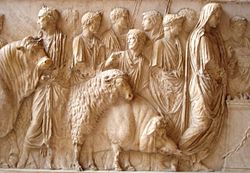

The Greek and Roman collection holds 37 festivals and practices in all; 30 of them do not name ancient Roman religion on their own records. See them in the collection
Connections
How ancient Roman religion connects
Grouped by the kind of relationship, because a successor is not a son and a shared symbol is not an influence.
Affiliation 1
What this means
Association with a tradition or school. Traditions branch, overlap and re-merge; this is not a clean single-origin tree.
Does not imply a fixed roster · that every account of the tradition knows this figure
Imported from Wikidata unless a tile says otherwise. Nothing here has been read by an editor.

Documented influence 1
What this means
A transmission argued from evidence. Not shared symbols, and not a short path through a database.
Does not imply shared symbols as evidence · a short path through a database
Imported from Wikidata unless a tile says otherwise. Nothing here has been read by an editor.
_and_Cautes_(right)%2C_from_the_Mithraeum_at_Sidon_(Colonia_Aurelia_Pia%2C_Syria)%2C_Louvre_Museum_(9365068428).jpg/120px-Statutory_group_depicting_the_cult_of_Mithras%2C_Mithras_slaying_the_bull_accompagnied_by_his_two_torchbeares_Cautopates_(left)_and_Cautes_(right)%2C_from_the_Mithraeum_at_Sidon_(Colonia_Aurelia_Pia%2C_Syria)%2C_Louvre_Museum_(9365068428).jpg)
Sources
Sources and evidence
Where every statement on this page comes from, and how each one stands.
1 statement on this record
- 1 Imported Taken from Wikidata as it stands. Nobody here has read it.
Only this record’s own statements. What other records say about it is counted on theirs.
Three layers, three licences
- Text
- Wikipedia · CC BY-SA 4.0, quoted, not merged
Review
Not yet read by an editor here. Every relationship on this page is an import.
Disagreements are kept, not resolved, and a count of sources is not a confidence score.


Keep exploring
More from Greek and Roman
The Olympians and their Roman equivalents, the mystery cults, and the poets whose accounts disagree.