
A discipline,
as the records
describe it.
Rites and disciplines
Overview
From Wikipedia, quoted unmodified under CC BY-SA 4.0; the article’s history is its list of authors.
More
More practices in Islam
The practices this collection holds that are most widely recorded.
What this means
Listed because they are practices in Islam, as this one is — not because either record names the other. Being on the same shelf is not a connection, an influence or a sequence.
-
.jpg/250px-Ramadan_montage_(cropped).jpg)
Ramadan
holy month of fasting for Muslims, observed on the ninth month of the Islamic calendar -

Hajj
Islamic pilgrimage to Mecca -
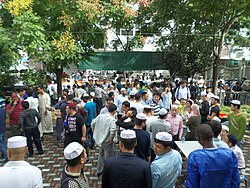 Kept 10 Dhu'l-Hijja
Eid al-Adha
Islamic holiday on the tenth day of Dhu al-Hijja -
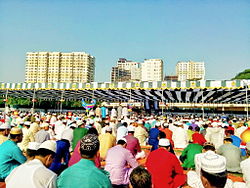 Kept 1 and 2 Shawwal
Eid al-Fitr
Islamic holiday on the first of Shawwal -

fasting in Islam
fasting regulated by Islamic jurisprudence -
.jpg/250px-Maulidur_Rasul_(8413657269).jpg) Kept 12 Rabi I
Kept 12 Rabi IMawlid
birthday of Muhammad
Connections
How Muraqaba connects
Grouped by the kind of relationship, because a successor is not a son and a shared symbol is not an influence.
Identification 3
What this means
One figure treated as another in some context. Not literal identity in all contexts, and usually a claim by a third party.
Does not imply literal identity in all contexts · that either tradition made the identification
Imported from Wikidata unless a tile says otherwise. Nothing here has been read by an editor.
Sources
Sources and evidence
Where every statement on this page comes from, and how each one stands.
5 statements on this record
- 5 Imported Taken from Wikidata as it stands. Nobody here has read it.
Only this record’s own statements. What other records say about it is counted on theirs.
Three layers, three licences
- Text
- Wikipedia · CC BY-SA 4.0, quoted, not merged
Review
Not yet read by an editor here. Every relationship on this page is an import.
Disagreements are kept, not resolved, and a count of sources is not a confidence score.


Keep exploring
More from Islam
Schools of law and theology, the scholars who transmitted them, and the places they taught.