
Practice Greek and Roman
Liberalia
Roman religious festival celebrating Liber and Libera
- Also called The Liberalia
A discipline,
as the records
describe it.
Rites and disciplines
Overview
From Wikipedia, quoted unmodified under CC BY-SA 4.0; the article’s history is its list of authors.
Calendar
When it is kept
The days in the year its record gives. A day, not a date: it says nothing about when the observance began.
What this means
The days in the year Wikidata records for Liberalia, each in the calendar it names: a month of another calendar is shown as recorded and never converted. Two days are two statements — often two traditions’ days — and are not joined into a span. It does not imply when the festival began, or that every tradition keeping it keeps this day.
- March 17
More
More practices in Greek and Roman
The practices this collection holds that are most widely recorded.
What this means
Listed because they are practices in Greek and Roman, as this one is — not because either record names the other. Being on the same shelf is not a connection, an influence or a sequence.
-

ancient Olympic Games
athletic competitions in ancient Greece -
Isthmian Games
ancient panhellenic festival to Isthmian Poseidon in Greece -

Nemean Games
One of the four Panhellenic Games, in honor of Nemean Zeus -
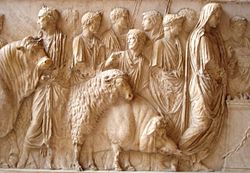
Suovetaurilia
Ancient Roman sacrifice -
Thargelia
ancient Athenian religious festival -
Apaturia
religious festival in ancient Athens
Sources
Sources and evidence
Where every statement on this page comes from, and how each one stands.
3 statements on this record
- 3 Imported Taken from Wikidata as it stands. Nobody here has read it.
Only this record’s own statements. What other records say about it is counted on theirs.
Three layers, three licences
- Text
- Wikipedia · CC BY-SA 4.0, quoted, not merged
Review
Not yet read by an editor here. Every relationship on this page is an import.
Disagreements are kept, not resolved, and a count of sources is not a confidence score.


Keep exploring
More from Greek and Roman
The Olympians and their Roman equivalents, the mystery cults, and the poets whose accounts disagree.