

Place Christianity
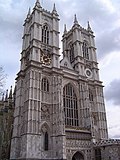
Westminster Abbey
Abbatia Westmonasteriensis la
Gothic abbey church in London, England, UK
- Dated from 10th century CE
- Also called Collegiate Church of St Peter at Westminster
A place,
and the traditions
recorded there.
Sites, not believers
Site history & evidence
What is documented here
Each kind of evidence on its own row, because they do not add up.
| Evidence | On record | What it shows |
|---|---|---|
| Site date | Dated from 10th century CE On the timeline | A date for the site as recorded — not the start of worship, and not a floor on the tradition here. |
| Location | Recorded to the site On the atlas | A coordinate for the place. It locates the site; it does not draw its extent. |
| Dated activity | None recorded | A pin is a place, not an event. What happened at Westminster Abbey, and when, is a separate claim, and this import holds none: it carries site locations, not dated activity. |
Nearby
Places nearby
The nearest this collection holds, measured between recorded coordinates.
What this means
Computed from coordinates, not stated by any source. Nearness is geometry, not a connection: two sites a kilometre apart may never have shared a worshipper, a tradition or a century. Where either coordinate is recorded only to a district, the distance is rounded and says “about”.
-
 under 1 km away
Henry VII Chapel
chapel within Westminster Abbey, England -
.jpg/330px-St-Margaret's-_Westminster.P1130954-PS_(cropped).jpg) under 1 km away
under 1 km awaySt Margaret's Church, Westminster
church in Westminster, London, United Kingdom -
 under 1 km away
Lambeth Palace
official London residence of the Archbishop of Canterbury -
 under 1 km away
Westminster Cathedral
Catholic cathedral in London, England, UK -
 1.1 km away
St Martin-in-the-Fields
church in London -
 1.2 km away
St James’s Church, Piccadilly
church in City of Westminster, London, England, UK -
 1.5 km away
Our Lady of the Assumption Roman Catholic Church
Roman Catholic church in Soho, London -
 1.8 km away
St George's, Hanover Square
church in the City of Westminster, London, England, UK
History
Recorded events
What Westminster Abbey’s own record names in its history, in the order of the dates on the statements.
What this means
Events Wikidata records in a subject’s history, and the day a festival is kept. Not a complete history, and the day a festival falls on is not when it began. Each date is the one on the statement itself; an event with none is named after the line. It does not imply that these are all the events in its history, or that Wikidata ranks the events by importance.
- 20 November 1947 CE Wedding of Princess Elizabeth and Philip Mountbatten ↗
- 14 November 1973 CE Wedding of Princess Anne and Mark Philips ↗
- 23 July 1986 CE Wedding of Prince Andrew and Sarah Ferguson ↗
- 29 April 2011 CE Wedding of Prince William and Catherine Middleton ↗
Also recorded, with no date on the statement
Connections
How Westminster Abbey connects
Grouped by the kind of relationship, because a successor is not a son and a shared symbol is not an influence.
Affiliation 3
What this means
Association with a tradition or school. Traditions branch, overlap and re-merge; this is not a clean single-origin tree.
Does not imply a fixed roster · that every account of the tradition knows this figure · that no other tradition uses the site · use in every period
Imported from Wikidata unless a tile says otherwise. Nothing here has been read by an editor.


Sources
Sources and evidence
Where every statement on this page comes from, and how each one stands.
9 statements on this record
- 1 Has references The statement cites something outside Wikimedia. That citation has not been checked here.
- 8 Imported Taken from Wikidata as it stands. Nobody here has read it. 1 of them cite only Wikipedia: one source, counted once.
Only this record’s own statements. What other records say about it is counted on theirs.
Three layers, three licences
- Text
- Wikipedia · CC BY-SA 4.0, quoted, not merged
- Pictures
- Wikimedia Commons · each file’s own terms
Review
Not yet read by an editor here. Every relationship on this page is an import.
Disagreements are kept, not resolved, and a count of sources is not a confidence score.


Keep exploring
More from Christianity
Its branches, councils, saints, offices and buildings — and where they stopped recognising each other.