

Archaeological site Mesopotamia and the Levant
Khafajah
Archaeological site in Iraq
- Also called Tell Khafajah
A place,
and the traditions
recorded there.
Sites, not believers
Overview
From Wikipedia, quoted unmodified under CC BY-SA 4.0; the article’s history is its list of authors.
Site history & evidence
What is documented here
Each kind of evidence on its own row, because they do not add up.
| Evidence | On record | What it shows |
|---|---|---|
| Site date | None recorded | The import holds no date for the site itself. |
| Location | Recorded to the site On the atlas | A coordinate for the place. It locates the site; it does not draw its extent. |
| Dated activity | None recorded | A pin is a place, not an event. What happened at Khafajah, and when, is a separate claim, and this import holds none: it carries site locations, not dated activity. |
Nearby
Places nearby
The nearest this collection holds, measured between recorded coordinates.
What this means
Computed from coordinates, not stated by any source. Nearness is geometry, not a connection: two sites a kilometre apart may never have shared a worshipper, a tradition or a century. Where either coordinate is recorded only to a district, the distance is rounded and says “about”.
-
 54 km away
Alasifia school
old Iraqi School and mosque built in the Ottoman Empire in 1608 -
 56 km away
Abu Hanifa Mosque
mosque -
 56 km away
Sheikh Abdul Qader al-Jilani Mosque
The tomb of Sheikh Abdul Qader al-Gilani in Baghdad -
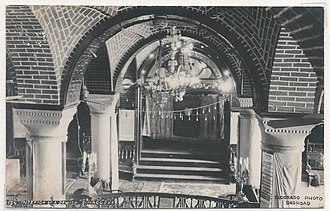 56 km away
Great Synagogue of Baghdad
ancient building in present-day Iraq -
.jpg/330px-%D8%A7%D9%84%D8%B9%D8%AA%D8%A8%D8%A9_%D8%A7%D9%84%D9%83%D8%A7%D8%B8%D9%85%D9%8A%D8%A9_(4).jpg) 56 km away
56 km awayAl-Kadhimiya Mosque
mosque in Iraq -
 56 km away
AlKhulafa Mosque
mosque in Baghdad, Iraq -
 56 km away
Haydar-Khana Mosque
old Iraqi mosque built in the Ottoman Empire in Baghdad in 1819 -
 56 km away
Mosque of Ahmadiyah
old Iraqi mosque and school built in the Ottoman Empire in 1796
Sources
Sources and evidence
Where every statement on this page comes from, and how each one stands.
2 statements on this record
- 2 Imported Taken from Wikidata as it stands. Nobody here has read it. 2 of them cite only Wikipedia: one source, counted once.
Only this record’s own statements. What other records say about it is counted on theirs.
Three layers, three licences
- Text
- Wikipedia · CC BY-SA 4.0, quoted, not merged
- Pictures
- Wikimedia Commons · each file’s own terms
Review
Not yet read by an editor here. Every relationship on this page is an import.
Disagreements are kept, not resolved, and a count of sources is not a confidence score.


Keep exploring
More from Mesopotamia and the Levant
Sumerian, Akkadian, Babylonian, Assyrian, Hittite-adjacent and Canaanite gods, and the texts that carry them.