

Archaeological site Greek and Roman
Ephesus
Ἔφεσος grc
Ancient Greek city in Anatolia
- Dated from 10th century BCE
- Also called Efes, Ephesos, ephesus
Figures
Associated figures
Gods and people named with this place — as its founders, or in their own records.
What this means
Founders are named by this place's own record, and a founding is an attribution, often contested. The rest are read from the other end, computed from their records rather than this one. Being named with a place is not being documented there in any given year.
Within the site
Inside Ephesus
6 recorded places within the site, from their own records.
What this means
A place listed here names this site as its whole or its location in its own record; the build reads that from the place’s end, so the row is computed rather than stated by the site. It does not imply that the site as a whole was a place of worship, that its parts were in use at the same time, or that these are all the places it held.
-
 Located here
Temple of Ephesian Artemis
temple in Ephesus, one of the Seven Wonders of the Ancient World -
 Located here
Basilica of St. John
church building located on the Ayasoluk by Ephesus -
 Located here
Church of Mary
very large church complex and adjoining buildings in Ephesus -
 Located here
Temple of Hadrian
small temple-like monument along the Curetes Street in Ephesus
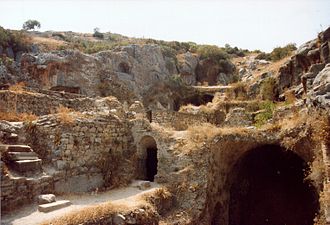

Site history & evidence
What is documented here
Each kind of evidence on its own row, because they do not add up.
| Evidence | On record | What it shows |
|---|---|---|
| Site date | Dated from 10th century BCE On the timeline | A date for the site as recorded — not a date of worship there. |
| Location | Recorded to the site On the atlas | A coordinate for the place. It locates the site; it does not draw its extent. |
| Dated activity | First Council of Ephesus, Second Council of Ephesus, Third Council of Ephesus | A pin is a place, not an event: each is a record of its own, with its own dates, located here by that record. |
Also recorded as located here: Seven Sleepers
Nearby
Places nearby
The nearest this collection holds, measured between recorded coordinates.
What this means
Computed from coordinates, not stated by any source. Nearness is geometry, not a connection: two sites a kilometre apart may never have shared a worshipper, a tradition or a century. Where either coordinate is recorded only to a district, the distance is rounded and says “about”.
-
 2.1 km away
İsa Bey Mosque
mosque in İzmir, western Turkey -
 3.4 km away
House of the Virgin Mary
Catholic and Muslim shrine located on Mt. Koressos -
 18 km away
Temple of Artemis in Magnesia on the Maeander
ancient Greek temple in Turkey -
 18 km away
Magnesia on the Maeander
ancient city of Ionia, in modern-day Turkey -
 26 km away
Panionium
Ancient sanctuary and settlement of the Ionians -
 31 km away
Priene
ancient city of Ionia, in modern-day Turkey -
 32 km away
Temple of Athena (Priene)
Greek temple in Priene, Turkey -
 32 km away
Priene Synagogue
ancient synagogue in Priene, Turkey
Connections
How Ephesus connects
Grouped by the kind of relationship, because a successor is not a son and a shared symbol is not an influence.
Place 1
What this means
Where something is, or is documented. A location is not by itself evidence of activity.
Does not imply that anything is documented to have happened there
Imported from Wikidata unless a tile says otherwise. Nothing here has been read by an editor.
Sources
Sources and evidence
Where every statement on this page comes from, and how each one stands.
11 statements on this record
- 5 Imported Taken from Wikidata as it stands. Nobody here has read it.
Only this record’s own statements. What other records say about it is counted on theirs.
Three layers, three licences
- Text
- Wikipedia · CC BY-SA 4.0, quoted, not merged
- Pictures
- Wikimedia Commons · each file’s own terms
Review
Not yet read by an editor here. Every relationship on this page is an import.
Computed Worked out here, not stated by any source: 6 recorded places within it. Each is marked where it is shown.
Disagreements are kept, not resolved, and a count of sources is not a confidence score.


Keep exploring
More from Greek and Roman
The Olympians and their Roman equivalents, the mystery cults, and the poets whose accounts disagree.