

Archaeological site Buddhist traditions
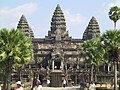
Angkor
吳哥古蹟 zh アンコール遺跡 ja अंकोर hi
Former capital city; region of Cambodia
A place,
and the traditions
recorded there.
Sites, not believers
Within the site
Inside Angkor
7 recorded places within the site, from their own records.
What this means
A place listed here names this site as its whole or its location in its own record; the build reads that from the place’s end, so the row is computed rather than stated by the site. It does not imply that the site as a whole was a place of worship, that its parts were in use at the same time, or that these are all the places it held.
Placed in these collections by the 7 places recorded in it or its districts: Computed
- Buddhist traditions 3 of 7
- South Asian traditions 2 of 7


Site history & evidence
What is documented here
Each kind of evidence on its own row, because they do not add up.
| Evidence | On record | What it shows |
|---|---|---|
| Site date | None recorded | The import holds no date for the site itself. |
| Location | Recorded On the atlas | A coordinate for the place. It locates the site; it does not draw its extent. |
| Dated activity | None recorded | A pin is a place, not an event. What happened at Angkor, and when, is a separate claim, and this import holds none: it carries site locations, not dated activity. |
Nearby
Places nearby
The nearest this collection holds, measured between recorded coordinates.
What this means
Computed from coordinates, not stated by any source. Nearness is geometry, not a connection: two sites a kilometre apart may never have shared a worshipper, a tradition or a century. Where either coordinate is recorded only to a district, the distance is rounded and says “about”.
-
 2.9 km away
Bayon
Khmer temple in Cambodia -
.jpg/330px-Tep_Prenam%2C_Angkor_Thom_(9725648467).jpg) 3.1 km away
3.1 km awayTep Pranam
Buddhist temple in Siem Reap, Cambodia -
 5.0 km away
Chau Say Tevoda
archaeological site in Cambodia -
 5.4 km away
Ta Keo
monastery in Cambodia -
 6.0 km away
Ta Prohm
Buddhist temple in Siem Reap, Cambodia -
 14 km away
Banteay Samré
temple -
 18 km away
Preah Ko
archaeological site in Siem Reap, Cambodia -
.jpg/330px-Roluos_(4457989967).jpg) 18 km away
18 km awayRoluos
group of Temples in Cambodia
Connections
How Angkor connects
Grouped by the kind of relationship, because a successor is not a son and a shared symbol is not an influence.
Affiliation 3
What this means
Association with a tradition or school. Traditions branch, overlap and re-merge; this is not a clean single-origin tree.
Does not imply a fixed roster · that every account of the tradition knows this figure
Imported from Wikidata unless a tile says otherwise. Nothing here has been read by an editor.

Recorded events and days 2
What this means
Events Wikidata records in a subject’s history, and the day a festival is kept. Not a complete history, and the day a festival falls on is not when it began.
Does not imply that these are all the events in its history · that Wikidata ranks the events by importance
Imported from Wikidata unless a tile says otherwise. Nothing here has been read by an editor.
Sources
Sources and evidence
Where every statement on this page comes from, and how each one stands.
8 statements on this record
- 4 Imported Taken from Wikidata as it stands. Nobody here has read it. 1 of them cite only Wikipedia: one source, counted once.
Only this record’s own statements. What other records say about it is counted on theirs.
Three layers, three licences
- Text
- Wikipedia · CC BY-SA 4.0, quoted, not merged
- Pictures
- Wikimedia Commons · each file’s own terms
Review
Not yet read by an editor here. Every relationship on this page is an import.
Computed Worked out here, not stated by any source: 2 collection memberships and 4 recorded places within it. Each is marked where it is shown.
Disagreements are kept, not resolved, and a count of sources is not a confidence score.


Keep exploring
More from Buddhist traditions
Theravāda, Mahāyāna and Vajrayāna, their figures, sutras, lineages and monasteries.