
Pantheon Irish mythology
Tuatha Dé Danann
Supernatural race in Irish mythology and pantheon of pre-Christian Ireland
- Members 11 on record
- Generations 3, as the accounts give them
- Tradition Irish mythology


Pictures: Wikimedia Commons, credited on each page
The members
A family photograph
Each row stands a generation below the row above it, as the accounts give their kinship. Membership is what the records say.
What this means
11 records name this as the whole they are part of. That is what makes it a pantheon here — no class on Wikidata says so consistently, and nobody publishes a machine-readable roster.
So the list is complete in one direction only: a god whose record does not name this pantheon is missing even if every account places them in it — a gap in the data, not in the tradition. Accounts disagree about who belongs, too; the Twelve Olympians are twelve in some lists and fourteen in others.
The rows are counted from the kinship among the members themselves, as the accounts give it: a member whose parent is also a member stands a row below that parent. This is kinship inside the accounts — what the myths and the texts say, not a documented family — and where they disagree, every recorded parent is counted. Where the accounts loop — Gaia is Uranus’s mother and his consort — the loop is cut, not resolved. A documented human family is not drawn here, and neither is a member with no account kinship to another; both are listed below.
Kinship as the accounts give it,
not a documented family.
-
I Eldest on record
-
II A generation below
-
III A generation below
_(14566173909).jpg/330px-Heroes_of_the_dawn_(1914)_(14566173909).jpg)

Members · 11
Everyone it counts
Gods first, then people — including those the photograph leaves out.
-
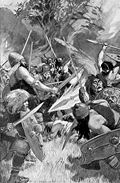 Lugh Irish mythological character and probable deity
 -
 Brigid Celtic deity
 -
 The Morrígan Deity
 - The Dagda Deity
-
_(14566173909).jpg/120px-Heroes_of_the_dawn_(1914)_(14566173909).jpg) Aengus Irish deity of love and sex
Aengus Irish deity of love and sex -
.jpg/120px-Manann%C3%A1n_mac_Lir_sculpture%2C_Gortmore_(geograph_4107287).jpg) Manannán mac Lir Sea god in Irish mythology
Manannán mac Lir Sea god in Irish mythology - Bres Deity
- Dian Cecht Irish mythological god of healing
- Cian Mythical character
- Goibniu Irish deity of smithing and hospitality
-
 Nuada Airgetlám Legendary figure
Connections
How Tuatha Dé Danann connects
Grouped by the kind of relationship, because a successor is not a son and a shared symbol is not an influence.
Affiliation 2
What this means
Association with a tradition or school. Traditions branch, overlap and re-merge; this is not a clean single-origin tree.
Does not imply a fixed roster · that every account of the tradition knows this figure · personal belief at every point in a life · the practice of a population
Imported from Wikidata unless a tile says otherwise. Nothing here has been read by an editor.
.jpg/120px-Riders_of_th_Sidhe_(big).jpg)
Sources
Sources and evidence
Where every statement on this page comes from, and how each one stands.
2 statements on this record
- 2 Imported Taken from Wikidata as it stands. Nobody here has read it.
Only this record’s own statements. What other records say about it is counted on theirs.
Three layers, three licences
- Text
- Wikipedia · CC BY-SA 4.0, quoted, not merged
- Pictures
- Wikimedia Commons · each file’s own terms
Review
Not yet read by an editor here. Every relationship on this page is an import.
Disagreements are kept, not resolved, and a count of sources is not a confidence score.
.jpg/960px-Gundestrupkedlen-_00054_(cropped).jpg)
.jpg)
Keep exploring
More from Celtic, Slavic and Baltic
Traditions recorded mostly by outsiders, or after conversion, or from folklore.