

Pantheon Greek and Roman
Roman mythology
Mythologia Romana la
Traditional stories pertaining to ancient Rome's legendary origins and religious system
- Members 48 on record
- Generations 3, as the accounts give them
Gods in company,
as the records
count them.
Not a fixed roster
The members
A family photograph
Each row stands a generation below the row above it, as the accounts give their kinship. Membership is what the records say.
What this means
48 records name this as the whole they are part of. That is what makes it a pantheon here — no class on Wikidata says so consistently, and nobody publishes a machine-readable roster.
So the list is complete in one direction only: a god whose record does not name this pantheon is missing even if every account places them in it — a gap in the data, not in the tradition. Accounts disagree about who belongs, too; the Twelve Olympians are twelve in some lists and fourteen in others.
The rows are counted from the kinship among the members themselves, as the accounts give it: a member whose parent is also a member stands a row below that parent. This is kinship inside the accounts — what the myths and the texts say, not a documented family — and where they disagree, every recorded parent is counted. Where the accounts loop — Gaia is Uranus’s mother and his consort — the loop is cut, not resolved. A documented human family is not drawn here, and neither is a member with no account kinship to another; both are listed below.
Kinship as the accounts give it,
not a documented family.
-
I Eldest on record
-
II A generation below
-
III A generation below


_-_Siena_2016.jpg/330px-Rhea_Silvia_by_Jacopo_della_Quercia_-_Santa_Maria_della_Scalla_(from_Fonte_Gaia)_-_Siena_2016.jpg)


Members · 44
Everyone it counts
Gods first, then people — including those the photograph leaves out.
-
 Hercules Roman adaptation of the Greek divine hero Heracles
 -
 Flora Goddess of prosperity in Roman mythology
 -
_Vol._IV.1_Dea_Roma.jpg/120px-D.G.U._(1831)_Vol._IV.1_Dea_Roma.jpg) Roma Female deity in ancient Roman religion
Roma Female deity in ancient Roman religion -
 Liber Roman god of wine and fertility
 -
.jpg/120px-Statue_of_the_goddess_Pax_(Pavlovsk_Garden%2C_St_Petersburg%2C_Russia).jpg) Pax Roman goddess of peace
Pax Roman goddess of peace -
 Juturna Goddess of fountains, wells and springs, and the mother of Fontus by Janus
 -
%2C_RP-P-1986-363.jpg/120px-Pales_Godinnen_en_nimfen_(serietitel)%2C_RP-P-1986-363.jpg) Pales Roman divinity
Pales Roman divinity -
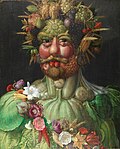 Vertumnus In Roman mythology, is the god of seasons, change and plant growth, as well as gardens and fruit trees
 -
 Agdistis Deity of Greek, Roman and Anatolian mythology
 -
 Tiberinus Roman water deity
 -
 Anna Perenna Deity of the circle of the year in Ancient Rome, legendary sister of queen Dido
 -
 Abellio God worshipped in Gallia Aquitania
Show 32 more
- Caca Roman mythical character
-
 Libera Goddess of Roman mythology
 -
 Annona Roman divinity of grain supply to the city of Rome
 -
 Voluptas Roman deity, personification of pleasure
 - Antevorta Roman goddess of the future
- Anextiomarus Ancient Celtic deity
- Deverra Roman childbirth goddess
- Robigus Ancient Roman god of crops
- Aquilon Roman god of the north wind
-
 Cissonius Deity
 - Suadela Goddess of persuasion, particularly in romance, seduction and love
-
_-_Day_(1884).jpg/120px-William-Adolphe_Bouguereau_(1825-1905)_-_Day_(1884).jpg) Dies Personification of day, and the Roman counterpart of the Greek goddess Hemera
Dies Personification of day, and the Roman counterpart of the Greek goddess Hemera - Disciplina Minor deity in Roman mythology
- Mellona Ancient Roman goddess
- Deiopea Nymph in Roman mythology
- Auster Roman personification of the sirocco south wind
-
._Engraving_by_G.H._Frezza%2C_1704%2C_Wellcome_V0035916.jpg/120px-Lucifer_(the_morning_star)._Engraving_by_G.H._Frezza%2C_1704%2C_Wellcome_V0035916.jpg) Lucifer "Morning star" (the planet Venus) in ancient Roman mythology
Lucifer "Morning star" (the planet Venus) in ancient Roman mythology - Edusa
-
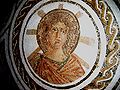 Apollo God in Roman mythology
 - Forculus Roman deity
-
 landlord god Chinese tutelary god for specific buildings, especially homes
 - Pavor Deity in Roman mythology
- Garamantis
-
_-_Siena_2016.jpg/120px-Rhea_Silvia_by_Jacopo_della_Quercia_-_Santa_Maria_della_Scalla_(from_Fonte_Gaia)_-_Siena_2016.jpg) Rhea Silvia Mother of Romulus and Remus
Rhea Silvia Mother of Romulus and Remus -
 Ascanius Legendary founder of Alba Longa
 -
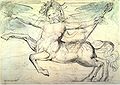 Cacus Fire breathing giant in Roman mythology
 -
 Lavinia Wife of Aeneas in Roman mythology
 -
 Latinus King in Greek and Roman mythology
 -
 Numitor King of Alba Longa, son of Procas in Roman mythology
 -
.png/120px-Owl_of_Athena_and_Patron_(from_ancient_coin).png) Owl of Athena Owl that traditionally represents or accompanies Athena
Owl of Athena Owl that traditionally represents or accompanies Athena - Capys Son of Assaracus in Greek mythology
-
 Ocnus Figure in Greek mythology, punished in the underworld for sloth or hesitation
Other records · 4
What else names it
Traditions and stories whose own records name Roman mythology.


Connections
How Roman mythology connects
Grouped by the kind of relationship, because a successor is not a son and a shared symbol is not an influence.
Affiliation 3
What this means
Association with a tradition or school. Traditions branch, overlap and re-merge; this is not a clean single-origin tree.
Does not imply that the culture was religiously uniform · a fixed roster · that every account of the tradition knows this figure · that no other tradition uses the site · use in every period
Imported from Wikidata unless a tile says otherwise. Nothing here has been read by an editor.

Text 1
What this means
A work, its editions and its witnesses are distinct; their dates are not interchangeable.
Does not imply that the work is the only account · that the work is contemporary with what it describes
Imported from Wikidata unless a tile says otherwise. Nothing here has been read by an editor.

Sources
Sources and evidence
Where every statement on this page comes from, and how each one stands.
2 statements on this record
- 2 Imported Taken from Wikidata as it stands. Nobody here has read it.
Only this record’s own statements. What other records say about it is counted on theirs.
Three layers, three licences
- Text
- Wikipedia · CC BY-SA 4.0, quoted, not merged
- Pictures
- Wikimedia Commons · each file’s own terms
Review
Not yet read by an editor here. Every relationship on this page is an import.
Disagreements are kept, not resolved, and a count of sources is not a confidence score.


Keep exploring
More from Greek and Roman
The Olympians and their Roman equivalents, the mystery cults, and the poets whose accounts disagree.