

A seat,
and those
who held it.
Holders in order
Overview
From Wikipedia, quoted unmodified under CC BY-SA 4.0; the article’s history is its list of authors.
Succession in office
Who held it, in order
A sequence of office-holders, not a family genealogy.
- 29 holders
- 28 undated
What this means
Who held an office after whom. Not parentage, not discipleship, and not universally recognised — offices are contested.
Does not imply recognition by every tradition · an uncontested claim · parentage · discipleship · an explanation of why the succession happened
Holding an office after someone says nothing about being related to them or taught by them. Where a line is also a family, both are on the holders’ own pages as separate sections.
A gap is a vacancy, an interregnum or a hole in the record; an overlap is rival claims or an office held by more than one at once. The records do not say which, so neither is resolved here. A gap shorter than two years sits inside the precision of year-dated records and is not marked.
Why a succession happened is a historical argument. Where sources make one, it belongs in a reviewed connection with its citations — not in this order, and not in a predecessor field.
Recognition is never universal. Where a card names no recognising body, none is recorded — which is not the same as none.
Imported from Wikidata unless a card says otherwise. Nothing here has been read by an editor.
-
.jpg/120px-Spas_vsederzhitel_sinay_(cropped1).jpg) from 30 CE Jesus Christ central figure of Christianity (c. 6 or 4 BC – AD 30 or 33)
from 30 CE Jesus Christ central figure of Christianity (c. 6 or 4 BC – AD 30 or 33)
No dates recorded 28
-
 Dates unrecorded John the Baptist 1st-century Jewish itinerant preacher (Bible)
 -
 Dates unrecorded David king of Israel and Judah
 -
 Dates unrecorded Elijah Biblical prophet
 -
.jpg/120px-Seleznikha_church_-_prophet_Moses_(18_c.).jpg) Dates unrecorded Moses Abrahamic prophet said to have led the Israelites out of Egypt Has references
Dates unrecorded Moses Abrahamic prophet said to have led the Israelites out of Egypt Has references -
 Dates unrecorded Abraham foundational legendary figure among adherents of the eponymous Abrahamic religions
 -
 Dates unrecorded Jacob in Genesis, a son of Isaac, also known as Israel; the patriarch of the Israelites
 -
 Dates unrecorded Joseph Biblical figure, son of Jacob and Rachel and governor of Egypt during the late Hyksos dynasty
 -
 Dates unrecorded Solomon king of Israel and son of David
 -
.jpg/120px-Mus%C3%A9e_Unterlinden_-_chapiteau_de_l'%C3%A9glise_abbatiale_d'Alspach_-_les_Justes_dans_le_sein_d'Abraham_(XIIe_si%C3%A8cle).jpg) Dates unrecorded Isaac Biblical character; son of Abraham
Dates unrecorded Isaac Biblical character; son of Abraham -
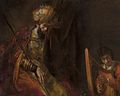 Dates unrecorded Saul first king of the United Kingdom of Israel
 -
 Dates unrecorded Esau in Genesis, the older son of Isaac and the brother of Jacob
 -
 Dates unrecorded Jeremiah biblical character; prophet
Show 16 more
-
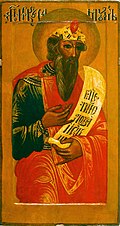 Dates unrecorded Samuel Biblical prophet and main figure of the First Book of Samuel
 -
 Dates unrecorded Rachel Biblical matriarch
 -
 Dates unrecorded Isaiah biblical character
 -
 Dates unrecorded Joshua figure in the Torah, successor of Moses
 -
 Dates unrecorded Leah Biblical matriarch
 -
 Dates unrecorded Ezekiel biblical prophet and main figure of the Book of Ezekiel
 -
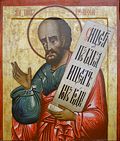 Dates unrecorded Elisha Biblical Prophet who came after Elijah
 -
 Dates unrecorded Gideon Judge in the Biblical Book of Judges
 -
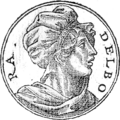 Dates unrecorded Deborah fourth judge of Israel
 -
 Dates unrecorded Jethro Biblical character, father-in-law of Moses
 -
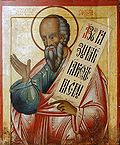 Dates unrecorded Zephaniah biblical prophet associated with the Book of Zephaniah
 -
 Dates unrecorded Balaam Biblical prophet
 -
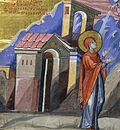 Dates unrecorded Hannah biblical character mentioned in the Books of Samuel
 - Dates unrecorded Judas Barsabbas male human biblical figure in Acts 15:22, early Christian prophet and leader based in Jerusalem
-
.jpg/120px-Michael_V%C3%A1clav_Halbax_-_St_Paul_and_Silas_in_Prison_-_O_2303_-_National_Gallery_Prague_(cropped).jpg) Dates unrecorded Silas ancient Roman saint and bishop
Dates unrecorded Silas ancient Roman saint and bishop
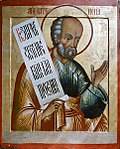
Connections
How prophet connects
Grouped by the kind of relationship, because a successor is not a son and a shared symbol is not an influence.
Affiliation 1
What this means
Association with a tradition or school. Traditions branch, overlap and re-merge; this is not a clean single-origin tree.
Does not imply a fixed roster · that every account of the tradition knows this figure
Imported from Wikidata unless a tile says otherwise. Nothing here has been read by an editor.
Veneration 1
What this means
A figure is venerated somewhere or by someone. Not a claim about how many people did, or when they stopped.
Does not imply recognition by any other church or tradition · a judgement about the historicity of the life · the same status in every branch of the church that confers it
Imported from Wikidata unless a tile says otherwise. Nothing here has been read by an editor.

Sources
Sources and evidence
Where every statement on this page comes from, and how each one stands.
0 statements on this record
This record makes no statements of its own yet, so there is nothing here to weigh.
Only this record’s own statements. What other records say about it is counted on theirs.
Three layers, three licences
- Text
- Wikipedia · CC BY-SA 4.0, quoted, not merged
- Pictures
- Wikimedia Commons · each file’s own terms
Review
Not yet read by an editor here. Every relationship on this page is an import.
Disagreements are kept, not resolved, and a count of sources is not a confidence score.


Keep exploring
More offices, tradition by tradition
The directory lists every one on record, most widely recorded first.
A seat outlasts
whoever sits in it.