
Office Christianity
Cardinal Secretary of State
Cardinalis Secretarius Status la
Presides over Secretariat of State of the Holy See
- Dated from 20 November 1551 CE
- Also called Secretary of State of His Holiness The Pope
A seat,
and those
who held it.
Holders in order
Overview
From Wikipedia, quoted unmodified under CC BY-SA 4.0; the article’s history is its list of authors.
Succession in office
Who held it, in order
A sequence of office-holders, not a family genealogy.
- 21 holders
- 6 gaps
- 6 steps named in the records
- 7 undated
What this means
Who held an office after whom. Not parentage, not discipleship, and not universally recognised — offices are contested.
Does not imply recognition by every tradition · an uncontested claim · parentage · discipleship · an explanation of why the succession happened
Holding an office after someone says nothing about being related to them or taught by them. Where a line is also a family, both are on the holders’ own pages as separate sections.
A gap is a vacancy, an interregnum or a hole in the record; an overlap is rival claims or an office held by more than one at once. The records do not say which, so neither is resolved here. A gap shorter than two years sits inside the precision of year-dated records and is not marked.
Why a succession happened is a historical argument. Where sources make one, it belongs in a reviewed connection with its citations — not in this order, and not in a predecessor field.
Recognition is never universal. Where a card names no recognising body, none is recorded — which is not the same as none.
Imported from Wikidata unless a card says otherwise. Nothing here has been read by an editor.
-
 1560 CE – 1584 CE Charles Borromeo Italian Catholic prelate (1538–1584)
 -
Gap about 21 years with no holder recorded
.jpg/120px-Portrait_of_Cardinal_Scipione_Borghese_(by_Ottavio_Leoni).jpg) 1605 CE – 1621 CE Scipione Borghese 17th-century Catholic cardinal (1576-1633)
1605 CE – 1621 CE Scipione Borghese 17th-century Catholic cardinal (1576-1633) -
Gap about 79 years with no holder recorded
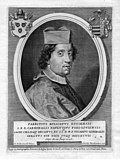 1700 CE – 1721 CE Fabrizio Paolucci Catholic cardinal (1651-1726)
 -
Gap about 3 years with no holder recorded
1724 CE – 1726 CE Fabrizio Paolucci Catholic cardinal (1651-1726) -
Gap about 63 years with no holder recorded
 14 October 1789 CE – 1 August 1796 CE Francesco Saverio de Zelada Spanish cardinal (1717-1801) Has references
 -
Gap about 107 years with no holder recorded
 12 November 1903 CE – 20 August 1914 CE Rafael Merry del Val Spanish cardinal and diplomat. (1865–1930) Has references
 -
 13 October 1914 CE – 22 January 1922 CE Pietro Gasparri cardinal of the Catholic Church (1852–1934)
 - 6 February 1922 CE – 7 February 1930 CE Pietro Gasparri cardinal of the Catholic Church (1852–1934)
-
.jpg/120px-Pius_XII_with_tabard%2C_by_Michael_Pitcairn%2C_1951_(retouched).jpg) 7 February 1930 CE – 2 March 1939 CE Pius XII pope of the Catholic Church from 1939 to 1958 Has references
7 February 1930 CE – 2 March 1939 CE Pius XII pope of the Catholic Church from 1939 to 1958 Has references -
Gap about 22 years with no holder recorded
.jpg/120px-CICOGNANI_AMLETO_GIOVANNI_(%2B1973).jpg) 12 August 1961 CE – 30 April 1969 CE Amleto Giovanni Cicognani Italian catholic cardinal (1883-1973)
12 August 1961 CE – 30 April 1969 CE Amleto Giovanni Cicognani Italian catholic cardinal (1883-1973) -
 2 May 1969 CE – 9 March 1979 CE Jean-Marie Villot Roman Catholic cardinal (1905–1979)
 -
.jpg/120px-Agostino_Casaroli_-_S_M_de_Medellin_(cropped).jpg) 1 July 1979 CE – 1 December 1990 CE Agostino Casaroli Catholic cardinal (1914-1998)
1 July 1979 CE – 1 December 1990 CE Agostino Casaroli Catholic cardinal (1914-1998) -
.jpg/120px-Angelo_Cardinal_Sodano_in_2016_(cropped).jpg) 29 June 1991 CE – 15 September 2006 CE Angelo Sodano cardinal of the Catholic Church
29 June 1991 CE – 15 September 2006 CE Angelo Sodano cardinal of the Catholic Church -
.jpg/120px-Kardinalom_Tarcisiem_Bertonejem_2013_(cropped).jpg) 15 September 2006 CE – 15 October 2013 CE Tarcisio Bertone cardinal of the Catholic Church Has references
15 September 2006 CE – 15 October 2013 CE Tarcisio Bertone cardinal of the Catholic Church Has references
No dates recorded 7
-
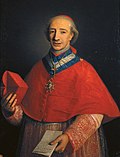 Dates unrecorded Giuseppe Doria Pamphili Catholic cardinal
 -
 Dates unrecorded Giulio Maria della Somaglia Catholic cardinal
 -
.jpg/120px-Portrait_of_Pope_Alexander_VII_Chigi_(by_Giovanni_Battista_Gaulli_-_Baciccio).jpg) Dates unrecorded Alexander VII pope of the Catholic Church from 1655 to 1667
Dates unrecorded Alexander VII pope of the Catholic Church from 1655 to 1667 -
.jpg/120px-Alessandro_Franchi_(cropped).jpg) Dates unrecorded Alessandro Franchi Italian cardinal in the Roman Catholic Church (1819-1878)
Dates unrecorded Alessandro Franchi Italian cardinal in the Roman Catholic Church (1819-1878) -
 Dates unrecorded Clement IX pope from 1667, lived 1600-1669
 -
 Dates unrecorded Francesco Nerli der Jüngere Italian cardinal
 -
 Dates unrecorded Mariano Rampolla Italian cardinal (1843–1913)
Chronology is not a full explanation
Why one holder followed another takes evidence beyond the order of their dates.
Sources
Sources and evidence
Where every statement on this page comes from, and how each one stands.
0 statements on this record
This record makes no statements of its own yet, so there is nothing here to weigh.
Only this record’s own statements. What other records say about it is counted on theirs.
Three layers, three licences
- Text
- Wikipedia · CC BY-SA 4.0, quoted, not merged
Review
Not yet read by an editor here. Every relationship on this page is an import.
Disagreements are kept, not resolved, and a count of sources is not a confidence score.


Keep exploring
More from Christianity
Its branches, councils, saints, offices and buildings — and where they stopped recognising each other.