

Office Christianity
abbess
abbatissa la
Female superior of a community of nuns, often an abbey
A seat,
and those
who held it.
Holders in order
Overview
From Wikipedia, quoted unmodified under CC BY-SA 4.0; the article’s history is its list of authors.
Succession in office
Everyone recorded as holding it
Its tenures overlap throughout — a roll of holders, not a line.
- 77 holders
- 38 overlapping pairs
- 62 undated
What this means
Who held an office after whom. Not parentage, not discipleship, and not universally recognised — offices are contested.
Does not imply recognition by every tradition · an uncontested claim · parentage · discipleship · an explanation of why the succession happened
Holding an office after someone says nothing about being related to them or taught by them. Where a line is also a family, both are on the holders’ own pages as separate sections.
A gap is a vacancy, an interregnum or a hole in the record; an overlap is rival claims or an office held by more than one at once. The records do not say which, so neither is resolved here. A gap shorter than two years sits inside the precision of year-dated records and is not marked. This office’s tenures overlap throughout, so it is listed as a roll in order of start rather than drawn as a line.
Why a succession happened is a historical argument. Where sources make one, it belongs in a reviewed connection with its citations — not in this order, and not in a predecessor field.
Recognition is never universal. Where a card names no recognising body, none is recorded — which is not the same as none.
Imported from Wikidata unless a card says otherwise. Nothing here has been read by an editor.
-
 the 670s CE – 693 CE Begga Christian saint
 -
 800 CE – 810 CE Gisela, Abbess of Chelles Roman Catholic nun and abbess
 -
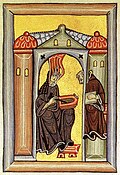 1136 CE – 1179 CE Hildegard of Bingen German Benedictine abbess, polymath, mystic and Doctor of Church (1098–1179) Has references
 -
 1184 CE – 1203 CE Agnes II Princess-Abbess of Quedlinburg, House of Wettin member (1139–1203) Has references
 -
 1565 CE – 1571 CE Charlotte of Bourbon French noblewoman (1546-1582); third wife of William the Silent (1546-1582)
 -
 from 25 July 1605 CE Countess Charlotte Flandrina of Nassau Countess of Nassau
 -
 August 1664 CE – 1709 CE Louise Hollandine of the Palatinate German artist (1622-1709)
 -
 6 June 1719 CE – 10 February 1743 CE Louise Adélaïde d'Orléans French abbess (1698-1743) Has references
 -
 1733 CE – 1772 CE Henriette Louise de Bourbon French abbess (1703-1772)
 -
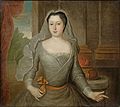 1738 CE – 1773 CE Princess Anne Charlotte of Lorraine French royal (1714-1773)
 -
.jpg/120px-Maurice_Quentin_de_La_Tour%2C_Princesse_Marie-Christine_de_Saxe_(c._1762-1763).jpg) 1773 CE – 1782 CE Princess Maria Christina of Saxony Princess of Saxony and an Abbess (1735-1782)
1773 CE – 1782 CE Princess Maria Christina of Saxony Princess of Saxony and an Abbess (1735-1782)

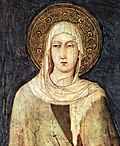
No dates recorded 62
-
.jpg/120px-Brigid_of_Kildare%2C_Vitrall%2C_1903_(Macon%2C_Georgia%2C_St._Joseph_Parish_Church).jpg) Dates unrecorded Brigid of Kildare Irish abbess and saint (c. 451 – 525)
Dates unrecorded Brigid of Kildare Irish abbess and saint (c. 451 – 525) -
 Dates unrecorded Héloïse d’Argenteuil 12th-century French nun, philosopher and writer
 -
.jpg/120px-%D0%A5%D0%B8%D0%BB%D1%8C%D0%B4%D0%B0_%D0%A3%D0%B8%D1%82%D0%B1%D0%B8%D0%B9%D1%81%D0%BA%D0%B0%D1%8F_(%D0%B8%D0%BA%D0%BE%D0%BD%D0%B0).jpg) Dates unrecorded Hilda Christian saint and the founding abbess of the monastery at Whitby, England
Dates unrecorded Hilda Christian saint and the founding abbess of the monastery at Whitby, England -
 Dates unrecorded Agnes of Bohemia princess who became a nun and saint (1211-1282)
 -
 Dates unrecorded Sibylla of Anhalt Duchess consort of Württemberg.
 -
 Dates unrecorded Mildthryth Anglo-Saxon Abbess
 -
 Dates unrecorded Archduchess Maria Elisabeth of Austria princess (1743-1808)
 -
 Dates unrecorded Æthelthryth Abbess of Ely
 -
 Dates unrecorded Archduchess Maria Anna of Austria (1738-1789)
 -
 Dates unrecorded Princess Elisabeth of Hesse and by Rhine Grand Duchess of Russia (1864–1918)
 -
 Dates unrecorded Aldegund Frankish saint and abbess (639-684)
 -
 Dates unrecorded Dorothea Maria of Anhalt Duchess consort of Saxe-Weimar
Show 50 more
-
 Dates unrecorded Archduchess Maria Anna of Austria Austrian archduchess
 -
.png/120px-D._Sancha_de_Portugal_-_The_Portuguese_Genealogy_(Genealogia_dos_Reis_de_Portugal).png) Dates unrecorded Sancha of Portugal Portuguese princess, nun and blessed, Lady of Alenquer
Dates unrecorded Sancha of Portugal Portuguese princess, nun and blessed, Lady of Alenquer -
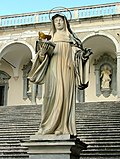 Dates unrecorded Scholastica Italian saint
 -
 Dates unrecorded Cynethryth Queen of Mercia and wife of King Offa
 -
 Dates unrecorded Macrina the Younger 4th-century Roman nun
 -
 Dates unrecorded Irmina of Oeren Frankish noble
 -
 Dates unrecorded Adela Catholic saint and royal princess
 -
 Dates unrecorded Kunigunde of Bohemia Czech princess
 -
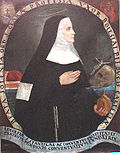 Dates unrecorded Yolanda of Poland Princess of Hungary and Duchess of Poland, later abbess
 - Dates unrecorded Eanflæd Kentish princess
-
 Dates unrecorded Gertrude of Austria Austrian noble
 -
.jpg/120px-Saint_Mechtildis_(cropped).jpg) Dates unrecorded Mechtilde Saxon Christian saint
Dates unrecorded Mechtilde Saxon Christian saint -
%2C_*~1255%2C_%E2%80%A0vor_1323_.jpg/120px-Elisabeth_von_Ungarn_(die_Selige)%2C_*~1255%2C_%E2%80%A0vor_1323_.jpg) Dates unrecorded Elizabeth of Hungary, Queen of Serbia Queen of Serbia
Dates unrecorded Elizabeth of Hungary, Queen of Serbia Queen of Serbia - Dates unrecorded Itta of Metz Frankish Saint
-
 Dates unrecorded Maria Amalia of Saxony, Duchess of Zweibrücken Saxon Royal
 -
_St.Peter23.JPG/120px-Vilich(Bonn)_St.Peter23.JPG) Dates unrecorded Adelaide, Abbess of Vilich Abbess of Vilich and Christian saint (c.970-c.1015)
Dates unrecorded Adelaide, Abbess of Vilich Abbess of Vilich and Christian saint (c.970-c.1015) -
 Dates unrecorded Marie Gabrielle Éléonore de Bourbon French noble (1690-1760)
 -
 Dates unrecorded Rictrude Merovingian saint
 -
 Dates unrecorded Agnes of Montepulciano Dominican nun, wonderworker and saint
 -
 Dates unrecorded Juliana of Liège Premonstratensian canoness, saint and mystic
 -
 Dates unrecorded Clare of Montefalco Augustinian nun and abbess
 -
_wird_zu_Jutta_von_Sponheim_(Mitte_rechts)_auf_den_Disibodenberg_gebracht.jpg/120px-JDie_achtj%C3%A4hrige_Hildegard_von_Bingen_(Mitte)_wird_zu_Jutta_von_Sponheim_(Mitte_rechts)_auf_den_Disibodenberg_gebracht.jpg) Dates unrecorded Jutta von Sponheim German noble and nun
Dates unrecorded Jutta von Sponheim German noble and nun -
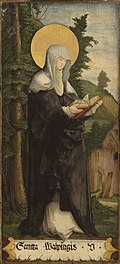 Dates unrecorded Saint Walpurga West Saxon saint
 -
 Dates unrecorded Waltrude Belgian saint (612-688)
 -
 Dates unrecorded Agnes of Poitiers 6th-century French saint and abbess
 -
 Dates unrecorded Agnes Hedwig of Anhalt Abbess of Gernrode, Electress of Saxony, Duchess of Schleswig-Holstein-Sonderburg
 -
 Dates unrecorded Seaxburh of Ely queen of King Eorcenberht of Kent, abbess, and saint of the Christian Church (640-699)
 -
 Dates unrecorded Archduchess Magdalena of Austria Member of the House of Habsburg (1532-1590)
 -
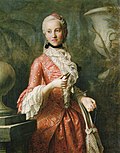 Dates unrecorded Maria Kunigunde of Saxony Princess of Saxony and Poland, abbess of Essen and Thorn (1740–1826)
 -
 Dates unrecorded Gisela of Hungary German princess, Hungarian queen consort and Roman Catholic blessed
 -
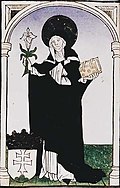 Dates unrecorded Margaret of Hungary Hungarian princess and saint (1242-1270)
 -
 Dates unrecorded Æthelburh of Kent second wife of Edwin of Northumbria
 -
_effigy_1905.jpg/120px-Catherine_of_Sweden_(1244)_effigy_1905.jpg) Dates unrecorded Katarina Sunesdotter Swedish queen
Dates unrecorded Katarina Sunesdotter Swedish queen -
 Dates unrecorded Matilda of Ringelheim German queen consort and duchess consort of Saxony (895-968)
 -
 Dates unrecorded Matilda of Scotland Queen consort of England
 -
 Dates unrecorded Princess Alexandra of Bavaria Bavarian princess (1826–1875)
 -
 Dates unrecorded Gisela Frankish noble, daughter of Louis the Pious
 -
 Dates unrecorded Marie Elisabeth, Abbess of Quedlinburg German abbess (1678-1755)
 -
 Dates unrecorded Maria, Abbess of Quedlinburg German abbess
 -
 Dates unrecorded Mathilda of Essen abbess of Essen Abbey from 973 to her death
 -
 Dates unrecorded Joan of Valois, Countess of Hainaut sister of King Philip VI of France and the mother-in-law of Edward III
 -
 Dates unrecorded Gryfina of Halych Polish queen
 -
 Dates unrecorded Richardis Holy Roman Empress from 881 to 888, Catholic saint
 -
 Dates unrecorded Richardis of Bavaria German noblewoman, Countess consort of Guelders
 -
.jpg/120px-Statue_of_St_Winefride%2C_19th_century_(cropped).jpg) Dates unrecorded Winifred 7th-century Welsh saint
Dates unrecorded Winifred 7th-century Welsh saint -
 Dates unrecorded Milica Hrebeljanović poet (1335-1405)
 -
 Dates unrecorded Joan of Valois French queen who entered religious life, became a nun and later an abbess who founded the Sisters of the Annunciation of Mary (canonized 1950)

_-_Saint_Catherine_of_Bologna_-_Google_Art_Project_(cropped).jpg/120px-Guglielmo_Giraldi_(Italian%2C_active_1445_-_1489)_-_Saint_Catherine_of_Bologna_-_Google_Art_Project_(cropped).jpg)

Sources
Sources and evidence
Where every statement on this page comes from, and how each one stands.
0 statements on this record
This record makes no statements of its own yet, so there is nothing here to weigh.
Only this record’s own statements. What other records say about it is counted on theirs.
Three layers, three licences
- Text
- Wikipedia · CC BY-SA 4.0, quoted, not merged
- Pictures
- Wikimedia Commons · each file’s own terms
Review
Not yet read by an editor here. Every relationship on this page is an import.
Disagreements are kept, not resolved, and a count of sources is not a confidence score.


Keep exploring
More from Christianity
Its branches, councils, saints, offices and buildings — and where they stopped recognising each other.