

Object Christianity
Saint Jerome Writing
Painting by Caravaggio (Valletta)
- Dated from c. the 1600s CE
A made thing,
and what is said of it.
Objects on the record
Overview
From Wikipedia, quoted unmodified under CC BY-SA 4.0; the article’s history is its list of authors.
Where
Located in
The places its record gives — a location, not a claim about what happened there.
Nearby
Places nearby
The nearest this collection holds, measured between recorded coordinates.
What this means
Computed from coordinates, not stated by any source. Nearness is geometry, not a connection: two sites a kilometre apart may never have shared a worshipper, a tradition or a century. Where either coordinate is recorded only to a district, the distance is rounded and says “about”.
-
 under 1 km away
St. John's Co-Cathedral
cathedral in Valletta, Malta -
 2.5 km away
Mariam Al-Batool Mosque
mosque in Paola, Malta -
 9.4 km away
Tal-Qadi Temple
Megalithic temple in Malta -
 9.9 km away
St. Paul's Cathedral, Mdina
cathedral in Mdina, Malta -
 10 km away
Temple of Proserpina
Roman temple in Mtarfa, Malta -
 11 km away
Buġibba Temple
Megalithic temple ruins in Malta
More
More objects in Christianity
The objects this collection holds nearest in date, in their order.
What this means
Listed because they are objects in Christianity, as this one is, dated close to it — not because either record names the other. Being on the same shelf is not a connection, an influence or a sequence.
-
_-_The_Last_Supper_(1495-1498).jpg/250px-Leonardo_da_Vinci_(1452-1519)_-_The_Last_Supper_(1495-1498).jpg) from the 1490s CE
from the 1490s CEThe Last Supper
mural painting by Leonardo da Vinci -
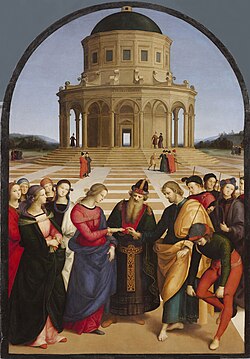 from 1504 CE
The Marriage of the Virgin
1504 painting by Raphael -
 from the 1500s CE
Saint Mark Preaching in Alexandria
painting by Gentile and Giovanni Bellini -
 from c. the 1510s CE
Sistine Madonna
painting by Raphael -
 from 1608 CE
The Beheading of Saint John the Baptist
painting by Caravaggio -
 from 1658 CE
The Flight into Egypt
painting by Nicolas Poussin
Sources
Sources and evidence
Where every statement on this page comes from, and how each one stands.
2 statements on this record
- 1 Has references The statement cites something outside Wikimedia. That citation has not been checked here.
- 1 Imported Taken from Wikidata as it stands. Nobody here has read it.
Only this record’s own statements. What other records say about it is counted on theirs.
Three layers, three licences
- Text
- Wikipedia · CC BY-SA 4.0, quoted, not merged
- Pictures
- Wikimedia Commons · each file’s own terms
Review
Not yet read by an editor here. Every relationship on this page is an import.
Disagreements are kept, not resolved, and a count of sources is not a confidence score.


Keep exploring
More from Christianity
Its branches, councils, saints, offices and buildings — and where they stopped recognising each other.