

Guided journey
Two fathers for Aphrodite
One goddess, two accounts of where she came from, and neither is a correction of the other. The clearest demonstration on the site of why a genealogy needs a by-line.
Step 1 is free · every journey with Plus
Reviewed Written and signed by HistorIQly editorial ·
-
Ricardo André Frantz (User:Tetraktys) · CC BY-SA 3.0 Step 1 of 6: Deity
Aphrodite
Greek goddess of love, beauty, pleasure, and procreation
Start with the goddess. The profile shows every relationship the records hold for her — and note what almost all of them say in the small print: “Account not stated”. Wikidata records that her father is Zeus without recording which poem says so, and this site will not invent the attribution.

Plus
The rest of this journey is with Plus.
5 more steps, each with its own note — written and signed here, and every one a real page.
- Every journey
- Every generation
- Every century
Already a member? Sign in
Still to come
- Aphrodite Family tree
- Theogony Text
- Hesiod Figure
- Zeus Deity
- Ancient Greek religion Tradition




-
Again First seen at step 1
Step 2 of 6: Deity · Family tree
Aphrodite
Greek goddess of love, beauty, pleasure, and procreation
Her family, drawn. The section is headed “Kinship in an account”, not “Family”, and the line colour is the one this site reserves for a parentage a named source tells. Two accounts of her origin have been current since antiquity: in Hesiod’s Theogony she rises from the sea foam, with no mother and a father only in the sense that Uranus’ severed flesh fell into the water; in Homer’s Iliad she is plainly the daughter of Zeus and Dione. A single tree cannot hold both, so a single tree is the wrong drawing.
-
Sailko · CC BY 3.0 Step 3 of 6: Text
Theogony
Poem by Hesiod, describing the origins and genealogies of the greek gods
The Theogony itself, and the first thing the page tells you is which clock its date is on. Hesiod wrote around the eighth or seventh century BCE. That is a date for the poem. It is not a date for Aphrodite, who has none, and it is not a floor on her worship, which the archaeology puts earlier than the poem.
-
Unknown artist · Public domain Step 4 of 6: Figure
Hesiod
Ancient Greek poet of the archaic period
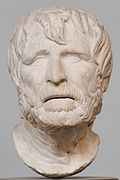
And the poet. A work has an author, a composition date, editions, translations and manuscripts, and all five are separate records with separate dates and separate rights. The habit of collapsing them is how a Victorian translation ends up described as an ancient text.
-
Jamain · CC BY-SA 4.0 Step 5 of 6: Deity
Zeus
Greek god of the sky and king of the gods
Zeus, the father in the other account. Follow the relationship back from his page and you find the same statement read from the other end — one statement, two pages, and the row marked so you can tell which side it lives on. That is what makes it safe to click.
-
Patar knight · CC BY-SA 3.0 Step 6 of 6: Tradition
Ancient Greek religion
Religion in ancient Greece
The tradition both accounts belong to. It has no founder, no single canon and no fixed roster of gods, and the page does not offer fields for any of them: an empty “Founder” row would be a claim that something is missing.


Continue exploring
Every stop on this route.
Each one a page of its own — free to read, whatever the journey's gate.
-
 Deity
DeityAphrodite
Greek goddess of love, beauty, pleasure, and procreation -
 Text
TextTheogony
Poem by Hesiod, describing the origins and genealogies of the greek gods -
 Figure
Hesiod
Ancient Greek poet of the archaic period -
 Deity
DeityZeus
Greek god of the sky and king of the gods -
 Tradition
Ancient Greek religion
Religion in ancient Greece


Next journey · 7 steps
A king, a poem and three clocks
Gilgamesh is a name in a list of kings, the hero of one of the oldest poems that survives, and the son of a goddess. Three kinds of date, kept apart.