

Guided journey
The sun goddess and a claimed descent
Two eighth-century chronicles, a sun goddess, and a royal house that traces itself to her — and why a descent claimed in an account is never drawn as a documented family.
Step 1 is free · every journey with Plus
Not yet reviewed · written . The notes follow the records; no editor has signed them.
-
Ken'yu (賢瑜), Koten Hozonkai (古典保存会) · Public domain Step 1 of 7: Text
Kojiki
8th-century Japanese chronicle
Begin with the source. The Kojiki was compiled for the court, and its date is on the source clock. Nearly everything on the next pages about the age of the gods is what this text and one other say: a date for the telling, not for anything told.
.png/960px-Shinpukuji-bon_Kojiki_(%E7%9C%9F%E7%A6%8F%E5%AF%BA%E6%9C%AC%E5%8F%A4%E4%BA%8B%E8%A8%98).png)
Plus
The rest of this journey is with Plus.
6 more steps, each with its own note — written here, and every one a real page.
- Every journey
- Every generation
- Every century
Already a member? Sign in
Still to come
- Izanagi Family tree
- Amaterasu Family tree
- Nihon Shoki Text
- Ninigi Deity
- Ise Jingū On the atlas
- Imperial House of Japan House


.jpg/120px-Postscript_from_The_Age_of_Gods_chapter%2C_The_Chronicles_of_Japan_(1286).jpg)


-
Originally uploaded on sv:wiki 10 April 2005 kl.18.50 by Lamré · Public domain Step 2 of 7: Deity · Family tree
Izanagi
Deity of Shinto religion
Izanagi and Izanami, the pair who shape the islands in the chronicles, with a long row of children. In the Kojiki the sun goddess, the moon god and Susanoo are born from Izanagi alone, as he purifies himself after leaving the land of the dead; other tellings give them both parents. The records keep both, so the drawing does too.
-
Utagawa Kunisada (歌川国貞; b. 1786, d. 1865) · Public domain Step 3 of 7: Deity · Family tree
Amaterasu
Sun goddess in Shinto
Amaterasu, the sun goddess, as the accounts tell it: her parents, her siblings, and the children born of a ritual contest with her brother Susanoo — which is why the records list him as her partner. The canvas labels all of it as kinship in the accounts. It is not a household anyone documented.
-
Urabe Kanekata · Public domain Step 4 of 7: Text
Nihon Shoki
8th century book of classical Japanese history
The Nihon Shoki, the second chronicle, finished a few years after the Kojiki and often telling the same events differently — sometimes giving several variants side by side. Two sources close in date that disagree are not an error to reconcile. They are two accounts, and a relationship names the account it holds in wherever the records say.
-
Ishii Rinkyo (1884-1930) · Public domain Step 5 of 7: Deity
Ninigi
Shinto god
Ninigi, Amaterasu’s grandson, sent down from heaven to rule: the step at which the chronicles join the age of the gods to a line of rulers. Whatever length of time the chronicles give the gods belongs to the story’s own clock. It is not history, and it is never a date on the historical clock.
-
MaedaAkihiko · CC0 Step 6 of 7: Place · On the atlas
Ise Jingū
Shinto shrine in Mie Prefecture, Japan
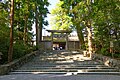
Ise Jingū, the shrine of Amaterasu. The founding year its record carries is the Nihon Shoki’s reckoning, stored as a historical date. The shrine is real and very old; that particular year is a chronicle’s, and its dot on the atlas should be read that way.
-
日本国政府 · CC BY 4.0 Step 7 of 7: House
Imperial House of Japan
Members of the extended family of the reigning Emperor of Japan
The Imperial House of Japan, which traces its line through Ninigi’s descendants to the first emperor of the chronicles. The founding date on its page is again the chronicle’s reckoning. A descent from the sun goddess is the chronicles’ account; a claimed descent is kinship in an account, not a documented family, however long the line that follows it.


.jpg/960px-Postscript_from_The_Age_of_Gods_chapter%2C_The_Chronicles_of_Japan_(1286).jpg)


.png)


.jpg)


Continue exploring
Every stop on this route.
Each one a page of its own — free to read, whatever the journey's gate.
-
.png/330px-Shinpukuji-bon_Kojiki_(%E7%9C%9F%E7%A6%8F%E5%AF%BA%E6%9C%AC%E5%8F%A4%E4%BA%8B%E8%A8%98).png) Text
TextKojiki
8th-century Japanese chronicle -
 Deity
DeityIzanagi
Deity of Shinto religion -
 Deity
DeityAmaterasu
Sun goddess in Shinto -
.jpg/330px-Postscript_from_The_Age_of_Gods_chapter%2C_The_Chronicles_of_Japan_(1286).jpg) Text
TextNihon Shoki
8th century book of classical Japanese history -
 Deity
DeityNinigi
Shinto god -
 Place
PlaceIse Jingū
Shinto shrine in Mie Prefecture, Japan -
 House
HouseImperial House of Japan
Members of the extended family of the reigning Emperor of Japan


Next journey · 5 steps
A king pays for a religion
Ashoka, Buddhism and the Mauryan state — four different claims that a single sentence usually merges into one, taken apart.