

Guided journey
Nine gods of Heliopolis
A family of creation told at one Egyptian city, and a Horus with seven recorded parents — what happens when several accounts share one name.
Step 1 is free · every journey with Plus
Not yet reviewed · written . The notes follow the records; no editor has signed them.
-
PharaohCrab · CC0 Step 1 of 7: Deity
Ennead
Group of nine deities in Egyptian mythology worshipped at Heliopolis
The Ennead, the nine gods of the creation account tied to Heliopolis: Atum, his children Shu and Tefnut, theirs Geb and Nut, and the four born to them. It is one city’s scheme among several — Memphis and Hermopolis told creation differently — and the page presents it as that, not as the Egyptian pantheon.
Plus
The rest of this journey is with Plus.
6 more steps, each with its own note — written here, and every one a real page.
- Every journey
- Every generation
- Every century
Already a member? Sign in
Still to come
- Atum Family tree
- Nut Family tree
- Osiris Deity
- Horus Family tree
- Heliopolis On the atlas
- Book of the Dead Text
.svg/120px-Atum_with_Double_Crown_(Pschent%2C_based_on_paintings).svg.png)


-
FDRMRZUSA · CC BY-SA 4.0 Step 2 of 7: Deity · Family tree
Atum
Ancient Egyptian creator deity
Atum’s family as the records draw it. Above him are Nun and Naunet, the primeval waters as a pair — a pairing from the Hermopolitan scheme — so a creator who comes first in one account has parents in the drawing because another account sits on the same record. Every recorded parent is drawn; none is chosen.
-
A. Parrot · CC BY-SA 3.0 Step 3 of 7: Deity · Family tree
Nut
Goddess of the sky in the Ennead of Egyptian mythology
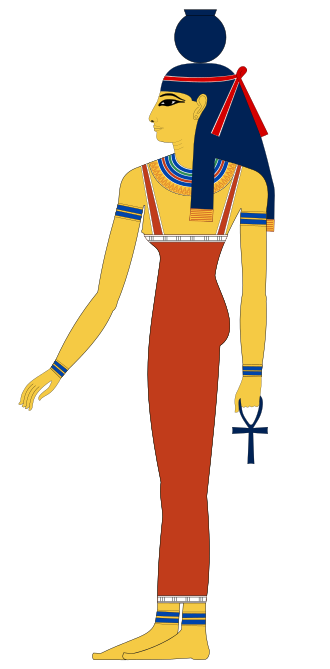
Nut, the sky, with Geb, the earth. Their children in the records are Osiris, Isis, Seth and Nephthys — and Horus too, whom some texts count among them as an elder Horus. The canvas does not decide which Horus a line belongs to. It draws what the records hold, and labels the whole drawing as kinship in the accounts.
-
Jeff Dahl · CC BY-SA 4.0 Step 4 of 7: Deity
Osiris
God of the afterlife in Egyptian mythology
Osiris, whose death and restoration is among the best-known Egyptian stories — told most fully as one continuous narrative by a Greek writer, Plutarch, long after the texts it draws on. Who told a story, and when, is part of its record: a late retelling in another language is evidence of how the story was told then.
-
Jeff Dahl · CC BY-SA 4.0 Step 5 of 7: Deity · Family tree
Horus
Egyptian sky deity
Horus, with seven recorded parents: Osiris and Isis, Geb and Nut, Ra, and the ram god of Mendes with his consort. Several gods called Horus, from several cities and centuries, sit on one Wikidata item. The canvas draws all seven rather than quietly picking the famous pair.
-
Didia (David Schmid) · CC BY-SA 3.0 Step 6 of 7: Place · On the atlas
Heliopolis
City of ancient Egypt
Heliopolis on the atlas, as a site. A pin marks where a cult centre was recorded. It is not the reach of a theology, and the atlas never shades a region because a creation story was told in one of its cities.
-
n·e·r·g·a·l · Public domain Step 7 of 7: Text
Book of the Dead
Ancient Egyptian funerary text
The Book of the Dead, one of the funerary texts in which these gods and their relationships appear. It is a family of texts rather than one book, copied and varied for individual burials — so a relationship “in the Book of the Dead” still needs a copy, a date and a spell before it is a citation.


.svg)


Continue exploring
Every stop on this route.
Each one a page of its own — free to read, whatever the journey's gate.
-
 Deity
DeityEnnead
Group of nine deities in Egyptian mythology worshipped at Heliopolis -
.svg/330px-Atum_with_Double_Crown_(Pschent%2C_based_on_paintings).svg.png) Deity
DeityAtum
Ancient Egyptian creator deity -
 Deity
DeityNut
Goddess of the sky in the Ennead of Egyptian mythology -
 Deity
DeityOsiris
God of the afterlife in Egyptian mythology -
 Deity
DeityHorus
Egyptian sky deity -
 Place
PlaceHeliopolis
City of ancient Egypt -
 Text
TextBook of the Dead
Ancient Egyptian funerary text
.png/960px-Thor_(Walhall).png)
.png)
Next journey · 7 steps
The gods Iceland wrote down
Almost everything told about the Norse gods was written down in Christian Iceland, two centuries after the conversion. How the site keeps the gods, the texts and the dates of each apart.