

Guided journey
Four jurists and their teachers
The four Sunni schools of law carry the names of Abū Ḥanīfa, Mālik, al-Shāfiʿī and Aḥmad ibn Ḥanbal — and three of them sat with one another as teachers and students.
Step 1 is free · every journey with Plus
Not yet reviewed · written . The notes follow the records; no editor has signed them.
-
OatCookies · CC BY-SA 4.0 Step 1 of 6: Figure
Abū Ḥanīfa
8th-century Sunni theologian and jurist
Abū Ḥanīfa, the earliest of the four, whose name the Hanafi school carries. His page lists many teachers and none of the other three: the records do not connect him to them directly, and the site does not draw a connection the records do not hold.
Plus
The rest of this journey is with Plus.
5 more steps, each with its own note — written here, and every one a real page.
- Every journey
- Every generation
- Every century
Already a member? Sign in
Still to come
- Malik ibn Anas Figure
- Prophet's Mosque On the atlas
- Al-Shafi'i Figure
- Ahmad ibn Hanbal Figure
- Islam Tradition


-
Sun'i · Public domain Step 2 of 6: Figure
Malik ibn Anas
Arab Islamic jurist, theologian and hadith traditionist (711–795)
Mālik ibn Anas of Medina, whose name the Maliki school carries. The records list about twenty teachers for him and one student among these four — al-Shāfiʿī. Being taught by someone is a relationship of learning. It is not descent, and it does not make the student’s school a branch of the teacher’s.
-
Bluemangoa2z at Malayalam Wikipedia · Public domain Step 3 of 6: Place · On the atlas
Prophet's Mosque
Mosque in Medina, Saudi Arabia
The Prophet’s Mosque in Medina, where Mālik is remembered teaching. Its date on the atlas is its founding, on the historical clock. A pin here says a site was recorded; it says nothing about who prayed there in any century, or which school anyone followed.
-
Sun'i · Public domain Step 4 of 6: Figure
Al-Shafi'i
Arab Muslim theologian, writer and scholar (767–820)
Al-Shāfiʿī, who studied with Mālik in Medina and also with a student of Abū Ḥanīfa, and who taught Aḥmad ibn Ḥanbal. One man sits between three of the four names and still founded a school of his own. That is what a teaching line looks like when it is not flattened into a family tree.
-
OatCookies · CC BY-SA 4.0 Step 5 of 6: Figure
Ahmad ibn Hanbal
Muslim jurist and theologian (780–855)
Aḥmad ibn Ḥanbal, the last of the four and al-Shāfiʿī’s student. Follow the “studied under” rows back and you walk a chain of teachers; nowhere does it become a chain of parents. The site draws transmission as transmission, and a school’s name as a school’s name.
-
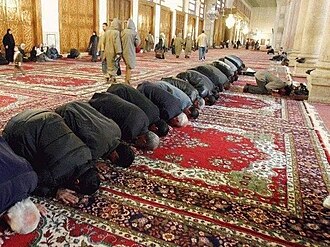
Antonio Melina/Agência Brasil · CC BY 3.0 br Step 6 of 6: Tradition
Islam
Monotheistic Abrahamic religion founded by Muhammad
Islam, the tradition. The four schools are traditions of legal reasoning inside it — not sects, and not descent groups — and this site never infers a person’s school, or anyone’s belief, from a name or a place.


Continue exploring
Every stop on this route.
Each one a page of its own — free to read, whatever the journey's gate.
-
 Figure
Abū Ḥanīfa
8th-century Sunni theologian and jurist -
 Figure
Malik ibn Anas
Arab Islamic jurist, theologian and hadith traditionist (711–795) -
 Place
PlaceProphet's Mosque
Mosque in Medina, Saudi Arabia -
 Figure
Al-Shafi'i
Arab Muslim theologian, writer and scholar (767–820) -
 Figure
Ahmad ibn Hanbal
Muslim jurist and theologian (780–855) -
 Tradition
Islam
Monotheistic Abrahamic religion founded by Muhammad


Next journey · 7 steps
From Zeus to Jupiter
A Greek god, a Roman god, and the old habit of calling one by the other’s name — followed from the records to the symbols to the places where each was worshipped.