

Guided journey
A king pays for a religion
Ashoka, Buddhism and the Mauryan state — four different claims that a single sentence usually merges into one, taken apart.
- Not held 1 of 5 step subjects — kept in place and marked
Step 1 is free · every journey with Plus
Reviewed Written and signed by HistorIQly editorial ·
-
Photo Dharma from Sadao, Thailand · CC BY 2.0 Step 1 of 5: Figure
Ashoka
Mauryan emperor from 268 to 232 BCE
A historical person, with dates on the historical clock. His page keeps four things apart that are usually said in one breath: what he is recorded as affiliated with, what he paid for, what his state did, and what anyone he ruled practised. Only the first two are in the data at all.

Plus
The rest of this journey is with Plus.
4 more steps, each with its own note — written and signed here, and every one a real page.
- Every journey
- Every generation
- Every century
Already a member? Sign in
Still to come
- Edicts of Ashoka Text
- Maurya empire Not held here
- Buddhism Tradition
- Mahabodhi Temple On the atlas


-
Sachin kumar tiwary · CC BY-SA 3.0 Step 2 of 5: Text
Edicts of Ashoka
3rd century BCE inscriptions in South Asia
The edicts: inscriptions, which is a kind of evidence with a location and a date of its own. An inscription tells you what was proclaimed at a place. It is the strongest evidence here and it still does not tell you what anyone believed.
-
Step 3 of 5: Not held in this collection
Maurya empire
The state. A reign is a chronology; patronage is an act; a population’s practice is a dataset nobody has. This site will draw the first two from records and will not infer the third — which is why there is no map of adherents anywhere on it.
-
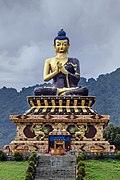
Subhrajyoti07 · CC BY-SA 4.0 Step 4 of 5: Tradition
Buddhism
Indian religion
The tradition, and the count that matters on its page: how many branches the records already know it has. “Buddhism” as a single affiliation row on a figure or a temple says much less than it looks like it says.
-
Bpilgrim · CC BY-SA 2.5 Step 5 of 5: Place · On the atlas
Mahabodhi Temple
Buddhist temple in Bodh Gaya, Bihar, India
A site, on the atlas. The mark is role “Site”: a location recorded for a place. Its building date is a date for the structure — not a date from which worship there is documented, and not a floor on the tradition’s presence. Move the year slider and watch what the map refuses to claim.


Continue exploring
Every stop on this route.
Each one a page of its own — free to read, whatever the journey's gate.


Next journey · 7 steps
Nine gods of Heliopolis
A family of creation told at one Egyptian city, and a Horus with seven recorded parents — what happens when several accounts share one name.