

Guided journey
A king, a poem and three clocks
Gilgamesh is a name in a list of kings, the hero of one of the oldest poems that survives, and the son of a goddess. Three kinds of date, kept apart.
Step 1 is free · every journey with Plus
Not yet reviewed · written . The notes follow the records; no editor has signed them.
-
Unknown artist · Public domain Step 1 of 7: Figure
Gilgamesh
Sumerian ruler and protagonist of the Epic of Gilgamesh
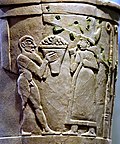
Gilgamesh as the records hold him: a person, a ruler of Uruk and the hero of an epic, all on one record. The parents on his page — the king Lugalbanda and the goddess Ninsun — come from the poems, not from any document of a reign. A parent who is a goddess is kinship inside an account, whatever kind of record the child is filed as.

Plus
The rest of this journey is with Plus.
6 more steps, each with its own note — written here, and every one a real page.
- Every journey
- Every generation
- Every century
Already a member? Sign in
Still to come
- Sumerian King List Text
- Epic of Gilgamesh Text
- Uruk On the timeline
- Eanna On the atlas
- Inanna Family tree
- Ninsun Deity



-
Step 2 of 7: Text
Sumerian King List
Mesopotamian literary composition
The Sumerian King List names him among the kings of Uruk and gives the kings around him reigns of improbable length. It is a source with a date and a purpose of its own — a composition that presented kingship as passing from one city to the next — and its numbers are the list’s, not a chronology anyone can put on the historical clock.
-
Public domain Step 3 of 7: Text
Epic of Gilgamesh
Epic poem from Mesopotamia, is amongst the earliest surviving works of literature
The epic. The date on its page is on the source clock: when the earliest poems about him were written down. That is a date for a text. It is not his date, and it is not a date for anything the poem describes.
-
SAC Andy Holmes (RAF) · OGL v1.0 Step 4 of 7: Place · On the timeline
Uruk
Ancient city of Sumer and Babylonia
Uruk on the timeline, dated on the historical clock by the city’s own archaeology. Archaeology dates a city; it does not date Gilgamesh. Whether a king of that name reigned there is argued from the king list and later inscriptions, and the timeline places the city, not the man.
-
Einsamer Schütze · CC BY-SA 3.0 Step 5 of 7: Place · On the atlas
Eanna
Ancient Sumerian temple in Uruk
The Eanna, the temple precinct of Inanna at the heart of Uruk, which the epic praises alongside the city’s walls. Here the three clocks touch without merging: a building the record places but does not date, a poem dated by its tablets, and a story whose own time this site never converts into years.
-
Osama Shukir Muhammed Amin FRCP(Glasg) · CC BY-SA 4.0 Step 6 of 7: Deity · Family tree
Inanna
Sumerian goddess
Inanna, the goddess of the Eanna, and her family as the accounts tell it. The canvas draws three recorded parents and a consort who is also listed as a parent, because Sumerian and Akkadian texts disagree and the records keep every version. Nothing is resolved into a single tree, and that is the point.
-
Rama · CC BY-SA 3.0 fr Step 7 of 7: Deity
Ninsun
Sumerian goddess
Ninsun, Gilgamesh’s mother in the poems: a goddess on one end of a relationship whose other end is a record filed as a person. A relationship keeps the mode of the account it comes from. A king’s divine mother is kinship in an account, and never evidence of a documented family.


Continue exploring
Every stop on this route.
Each one a page of its own — free to read, whatever the journey's gate.
-
 Figure
Gilgamesh
Sumerian ruler and protagonist of the Epic of Gilgamesh -
 Text
TextSumerian King List
Mesopotamian literary composition -
 Text
TextEpic of Gilgamesh
Epic poem from Mesopotamia, is amongst the earliest surviving works of literature -
 Place
PlaceUruk
Ancient city of Sumer and Babylonia -
 Place
PlaceEanna
Ancient Sumerian temple in Uruk -
 Deity
DeityInanna
Sumerian goddess -
 Deity
DeityNinsun
Sumerian goddess


Next journey · 7 steps
The sun goddess and a claimed descent
Two eighth-century chronicles, a sun goddess, and a royal house that traces itself to her — and why a descent claimed in an account is never drawn as a documented family.