
Institution Christianity
Order of Friars Minor
Ordo Fratrum Minorum la
Male Franciscan order in the Catholic Church
- Dated from 13th century CE
- Also called Ordo Fratrum Minorum, OFM, Franciscans
Founded, kept
and handed on.
As the records give it

Overview
From Wikipedia, quoted unmodified under CC BY-SA 4.0; the article’s history is its list of authors.
Founders
Named as founders
Who the records name as founding it.
What this means
An attribution, usually recorded long afterwards and often contested — not a claim that it began fully formed, or that everyone who belongs to it accepts the attribution. An order, a church or a dynasty named as founder is listed by name rather than drawn: an arch is for a likeness.


Nearby
Places nearby
The nearest this collection holds, measured between recorded coordinates.
What this means
Computed from coordinates, not stated by any source. Nearness is geometry, not a connection: two sites a kilometre apart may never have shared a worshipper, a tradition or a century. Where either coordinate is recorded only to a district, the distance is rounded and says “about”.
-
 under 1 km away
St Stephen of the Abyssinians
church of the Vatican City -
 under 1 km away
Santo Stefano degli Ungheresi
the former church of the Hungarians in Rome, next to the Vatican, demolished in 1776 -
 under 1 km away
Old St. Peter's Basilica
church in Rome, Papal States -
 under 1 km away
Vatican Grotto
crypt with papal tombs beneath St. Peter's Basilica, Vatican -
 under 1 km away
Vatican Necropolis
cemetery underneath the Vatican City -
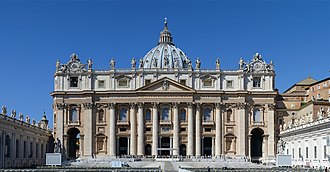 under 1 km away
St. Peter's Basilica
church in Vatican City
Connections
How Order of Friars Minor connects
Grouped by the kind of relationship, because a successor is not a son and a shared symbol is not an influence.
Affiliation 47
What this means
Association with a tradition or school. Traditions branch, overlap and re-merge; this is not a clean single-origin tree.
Does not imply a fixed roster · that every account of the tradition knows this figure · a clean single-origin family tree · that the parent recognises the branch · personal belief at every point in a life · the practice of a population
Imported from Wikidata unless a tile says otherwise. Nothing here has been read by an editor.
-
 includes Custodian of the Holy Land province of the Order of Friars Minor
 - has the branch Fraticelli Medieval radical groups of the Franciscan tradition declared heretical by the Church
-
 includes Santa Maria del Popolo church in Rome, Italy
 -
 includes Cerreto Abbey former abbey in Abbadia Cerreto, Italy
 -
 includes Royal Monastery of Saint Mary of Guadalupe Roman Catholic monastery in Guadalupe, Extremadura, Spain
 -
 includes Alexander of Hales English Franciscan theologian and philosopher (c.1185-1245)
 -
.JPG/120px-Antipope_Alexander_V_(1409-1410).JPG) includes Alexander V Catholic cardinal and antipope (1339-1410)
includes Alexander V Catholic cardinal and antipope (1339-1410) - includes Alonso de Molina Mexican Mesoamerican linguist
- includes Antonio Cesti Italian composer, singer and organist (1623-1669)
Show all 47
-
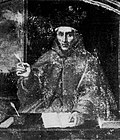 includes Antonio Guevara Noroña Spanish roman-catholic bishop
 -
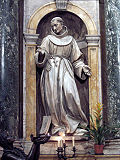 includes Bernardino of Siena Italian Franciscan and saint (1380–1444)
 -
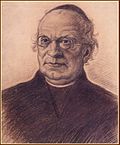 includes Bohuslav Matěj Černohorský Czech music educator, composer, organist and Roman Catholic priest (1684-1742)
 -
_-_Saint_Bonaventure.jpg/120px-Fran%C3%A7ois%2C_Claude_(dit_Fr%C3%A8re_Luc)_-_Saint_Bonaventure.jpg) includes Bonaventure Franciscan, bishop, cardinal, Doctor of the Church, Catholic saint (1221–1274)
includes Bonaventure Franciscan, bishop, cardinal, Doctor of the Church, Catholic saint (1221–1274) -
.jpg/120px-San_Francisco_de_As%C3%ADs_y_el_hermano_Le%C3%B3n._(detalle).jpg) includes Brother Leo disciple of Francis of Assisi
includes Brother Leo disciple of Francis of Assisi -
 includes Church and monastery of St. Catherine of Alexandria ruins of a church and a monastery and a national cultural monument in the village of Dechtice, Trnava district, Slovakia
 -
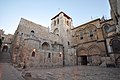 includes Church of the Holy Sepulchre church in Jerusalem, containing the two holiest sites in Christianity
 -
 includes Cláudio Hummes Catholic cardinal (1934–2022)
 -
 includes convent of St Agnes of Bohemia 13th century convent and museum in Prague
 -
 includes Convento de Santa Clara monastery in Funchal, Madeira, Portugal
 -
_IMG_6943_ShiftN.jpg/120px-K%C3%B6nigsfelden_(Windisch)_IMG_6943_ShiftN.jpg) includes Former Abbey Königsfelden monastery complex in Windisch in the canton of Aargau, Switzerland
includes Former Abbey Königsfelden monastery complex in Windisch in the canton of Aargau, Switzerland -
.jpg/120px-Abbazia_di_Fossanova_(2008).jpg) includes Fossanova Abbey abbey in Priverno, Italy
includes Fossanova Abbey abbey in Priverno, Italy -
_retrato_al_%C3%B3leo_sobre_lienzo.png/120px-Francisco_Jim%C3%A9nez_de_Cisneros_(Eugenio_Caj%C3%A9s_1604)_retrato_al_%C3%B3leo_sobre_lienzo.png) includes Francisco Jiménez de Cisneros Spanish Catholic cardinal (1436-1517)
includes Francisco Jiménez de Cisneros Spanish Catholic cardinal (1436-1517) -
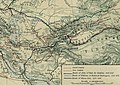 includes Giovanni da Pian del Carpine Roman Catholic archbishop and traveller (1182–1252)
 -
 includes Jacopone da Todi Italian Franciscan mystic
 -
.jpg/120px-Scoto_(Duns_Scoto).jpg) includes John Duns Scotus priest, friar, philosopher, theologian, college teacher
includes John Duns Scotus priest, friar, philosopher, theologian, college teacher -
 includes John of Capistrano Franciscan friar and Catholic saint (1386–1456)
 -
 includes John Peckham Archbishop of Canterbury
 -
 includes Juan de Zumárraga Archbishop of Mexico
 -
.jpg/120px-Juan_Land%C3%A1zuri_Ricketts_(cropped).jpg) includes Juan Landázuri Ricketts Catholic cardinal (1913-1997)
includes Juan Landázuri Ricketts Catholic cardinal (1913-1997) -
 includes Leonard of Port Maurice Italian Franciscan preacher and ascetic writer
 - includes Lodovico Grossi da Viadana Italian composer, teacher and Franciscan friar
-
 includes Louis of Toulouse French Catholic bishop and saint
 -
.jpg/120px-Matteo_d'Acquasparta_1_(cropped).jpg) includes Matthew of Aquasparta Catholic cardinal
includes Matthew of Aquasparta Catholic cardinal -
 includes Nostra Signora del Monte
 -
 includes Odoric of Pordenone 14th-century Italian Franciscan friar, missionary, and explorer
 -
 includes Ognissanti Church church in Florence
 -
 includes Paschal Baylon Spanish friar (1540-1592)
 -
 includes Peter of Alcantara Spanish Franciscan friar, Roman Catholic saint
 -
 includes Peter of Alcantara Church, Budapest franciscan church
 -
.jpg/120px-Pius_XI%2C_by_Nicola_Perscheid%2C_circa_1922_(retouched).jpg) includes Pius XI pope of the Catholic Church from 1922 to 1939
includes Pius XI pope of the Catholic Church from 1922 to 1939 -
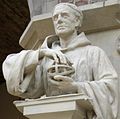 includes Roger Bacon English polymath, philosopher and friar (c.1219/20–c.1292)
 -
 includes Sanctuary of Arantzazu religious complex in Oñati, Spain
 -
_facciata.jpg/120px-Sant'Antonio_da_Padova_(Milano)_facciata.jpg) includes Sant'Antonio da Padova Sanctuary sanctuary in Milan, Italy
includes Sant'Antonio da Padova Sanctuary sanctuary in Milan, Italy -
%2C_Cleveland_Museum_of_Art.jpg/120px-Pedro_Berruguete%2C_Portrait_of_Pope_Sixtus_IV_della_Rovere_(early_1500s)%2C_Cleveland_Museum_of_Art.jpg) includes Sixtus IV pope of the Catholic Church from 1471 to 1484 (1414-1484)
includes Sixtus IV pope of the Catholic Church from 1471 to 1484 (1414-1484) -
 includes Ursberg Abbey monastery
 -
 includes William of Ockham English Franciscan friar and theologian (c.1287–1347)
 -
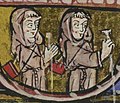 includes William of Rubruck Flemish Franciscan missionary and explorer
Succession in office 6
What this means
Who held an office after whom. Not parentage, not discipleship, and not universally recognised — offices are contested.
Does not imply parentage · discipleship · an explanation of why the succession happened
Imported from Wikidata unless a tile says otherwise. Nothing here has been read by an editor.
-
 succeeded Franciscans from 1517, group of three religious orders within the Catholic Church
 - succeeded Discalced franciscans 15th-century Spanish branch of the Franciscan Order
- succeeded Friars Minor of the Observance
- succeeded Ordo Fratrum Minorum de Regularis Observantia Catholic order (1517–1897)
- succeeded Récollets
- succeeded Villacrecians
Sources
Sources and evidence
Where every statement on this page comes from, and how each one stands.
11 statements on this record
- 5 Has references The statement cites something outside Wikimedia. That citation has not been checked here.
- 6 Imported Taken from Wikidata as it stands. Nobody here has read it. 3 of them cite only Wikipedia: one source, counted once.
Only this record’s own statements. What other records say about it is counted on theirs.
Three layers, three licences
- Text
- Wikipedia · CC BY-SA 4.0, quoted, not merged
- Pictures
- Wikimedia Commons · each file’s own terms
Review
Not yet read by an editor here. Every relationship on this page is an import.
Disagreements are kept, not resolved, and a count of sources is not a confidence score.


Keep exploring
More from Christianity
Its branches, councils, saints, offices and buildings — and where they stopped recognising each other.