
Institution Christianity
Congregation of the Legionaries of Christ
Congregatio Legionariorum Christi la
Catholic religious congregation
- Dated from 3 January 1941 CE
- Also called LC, Legionaries, Congregation of the Legionaries of Christ
Founded, kept
and handed on.
As the records give it
Overview
From Wikipedia, quoted unmodified under CC BY-SA 4.0; the article’s history is its list of authors.
Founders
Named as founders
Who the records name as founding it.
What this means
An attribution, usually recorded long afterwards and often contested — not a claim that it began fully formed, or that everyone who belongs to it accepts the attribution. An order, a church or a dynasty named as founder is listed by name rather than drawn: an arch is for a likeness.
Where
Located in
The places its record gives — a location, not a claim about what happened there.
Located in, not held here: Rome
More
More institutions in Christianity
The institutions this collection holds nearest in date, in their order.
What this means
Listed because they are institutions in Christianity, as this one is, dated close to it — not because either record names the other. Being on the same shelf is not a connection, an influence or a sequence.
-
%2C_Los_Angeles.JPG/250px-Cathedral_of_Our_Lady_of_Angels_(from_plaza)%2C_Los_Angeles.JPG) from 11 July 1936 CE
from 11 July 1936 CERoman Catholic Archdiocese of Los Angeles
archdiocese of the Catholic Church in the United States -
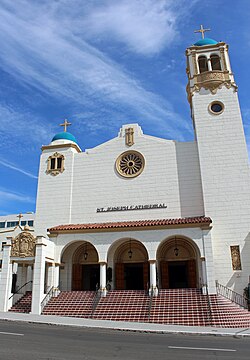 from 11 July 1936 CE
Diocese of San Diego
diocese of the Catholic Church in the United States -
 from 22 May 1937 CE
Archdiocese of Detroit
Catholic archdiocese in the United States -
 from 1942 CE
Fairfield University
university located in Fairfield, Connecticut -
 from 9 February 1946 CE
Roman Catholic Archdiocese of Rimouski
Catholic ecclesiastical territory -
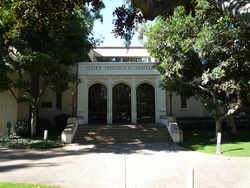 from 1947 CE
Fuller Theological Seminary
American Evangelical theological seminary
Connections
How Congregation of the Legionaries of Christ connects
Grouped by the kind of relationship, because a successor is not a son and a shared symbol is not an influence.
Affiliation 1
What this means
Association with a tradition or school. Traditions branch, overlap and re-merge; this is not a clean single-origin tree.
Does not imply personal belief at every point in a life · the practice of a population
Imported from Wikidata unless a tile says otherwise. Nothing here has been read by an editor.

Text 1
What this means
A work, its editions and its witnesses are distinct; their dates are not interchangeable.
Does not imply that the work is the only account · that the work is contemporary with what it describes
Imported from Wikidata unless a tile says otherwise. Nothing here has been read by an editor.
Recorded events and days 1
What this means
Events Wikidata records in a subject’s history, and the day a festival is kept. Not a complete history, and the day a festival falls on is not when it began.
Does not imply that these are all the events in its history · that Wikidata ranks the events by importance
Imported from Wikidata unless a tile says otherwise. Nothing here has been read by an editor.
Sources
Sources and evidence
Where every statement on this page comes from, and how each one stands.
5 statements on this record
- 1 Has references The statement cites something outside Wikimedia. That citation has not been checked here.
- 4 Imported Taken from Wikidata as it stands. Nobody here has read it.
Only this record’s own statements. What other records say about it is counted on theirs.
Three layers, three licences
- Text
- Wikipedia · CC BY-SA 4.0, quoted, not merged
Review
Not yet read by an editor here. Every relationship on this page is an import.
Disagreements are kept, not resolved, and a count of sources is not a confidence score.


Keep exploring
More from Christianity
Its branches, councils, saints, offices and buildings — and where they stopped recognising each other.