

Figure Christianity
William the Conqueror
Gulielmus I la
King of England from 1066 to 1087, Duke of Normandy from 1035 to 1087 (1028–1087)
- Child of Robert I, Duke of Normandy and Herleva
- Married to Matilda of Flanders
- Dated c. 8 November 1028 CE – 9 September 1087 CE
Duke of Normandy
Monarch of England
Offices on record
Overview
From Wikipedia, quoted unmodified under CC BY-SA 4.0; the article’s history is its list of authors.
Life
Roles and affiliation
Holding an office is not parentage and not discipleship.
What this means
As the records give them: every row is a third party’s statement, not a self-description, and a role or an affiliation is often held for one period of a life only. An affiliation is not a belief, and this site does not ask anyone about theirs. For an office: which one, for how long, and where the records give an ordinal or the holders either side. Recognition of a tenure is never universal: contested lines appear as overlapping tenures rather than as one corrected sequence.
Offices held 2
- 3 July 1035 CE – 9 September 1087 CE Duke of Normandy Succeeded Robert I, Duke of Normandy · Succeeded by Robert Curthose
Family
The family of William the Conqueror
Parents, spouses and children as the records give them.
Documented family only. A teacher, a successor or a patron is never drawn in this tree.
The family as a list · 18
Family 18
What this means
A documented human family relationship. Not a succession mechanism, and not religious transmission.
Does not imply a right to an office · transmission of a teaching · a religious affiliation held by the whole house · continuous rule · a shared religious affiliation
Imported from Wikidata unless a tile says otherwise. Nothing here has been read by an editor.
- child of (mother) Herleva mother of William the Conqueror
-
 child of (child) Robert I, Duke of Normandy Robert "The Magnificent"
 -
 of the house House of Normandy usual designation for the family that were the Dukes of Normandy and Kings of England
 - parent of (child) Adeliza Anglo-Norman princess (died before 1113)
-
 parent of (father) Adela of Normandy Countess of Blois from 1089 to 1102
 - parent of (child) Agatha of Normandy daughter of William the Conqueror and Matilda of Flanders
- parent of (child) Alberta wife of Sancho II of Castile and León
-
 parent of (father) Cecilia of Normandy Abbess of Holy Trinity
 -
 parent of (father) Constance of Normandy Duchess of Brittany as wife of Alan IV, Duke of Brittany
 -
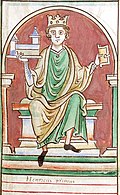 parent of (father) Henry I of England King of England from 1100 to 1135 (1068–1135)
 - parent of (child) Matilda of Normandy daughter of William the Conqueror and Matilda of Flanders
-
 parent of (father) Richard of Normandy second son of William the Conqueror, King of England, and Matilda of Flanders
 -
 parent of (father) Robert Curthose Duke of Normandy
 -
 parent of (father) William II of England King of England from 1087 to 1100
 - sibling of Adelaide of Normandy Countess of Aumale from 1069 to 1090
-
 sibling of Odo, Earl of Kent Bishop of Conteville
 - sibling of Robert, Count of Mortain Norman nobleman and the uterine half-brother of William the Conqueror
-
 married to Matilda of Flanders wife of William the Conqueror and Queen consort of the Kingdom of England
Religious context
What the records tie them to
Founded, supported, associated with — as third parties recorded it.
What this means
A founding is an attribution, usually contested, and not a claim that the tradition began fully formed. Patronage is an act, not a belief: it says nothing about the religion of a population, and nothing about the patron’s own practice in every period of a life. Domains are as sources record them — for a saint, usually a patronage — rarely exclusive, and not the same in every account.

.jpg/250px-02_NOR_-_Calvados_-_Caen_-_Abbaye_aux_Dames_(2016-09-08_11-40-32).jpg)
Sources
Sources and evidence
Where every statement on this page comes from, and how each one stands.
21 statements on this record
- 9 Has references The statement cites something outside Wikimedia. That citation has not been checked here.
- 12 Imported Taken from Wikidata as it stands. Nobody here has read it. 2 of them cite only Wikipedia: one source, counted once.
Only this record’s own statements. What other records say about it is counted on theirs.
Three layers, three licences
- Text
- Wikipedia · CC BY-SA 4.0, quoted, not merged
- Pictures
- Wikimedia Commons · each file’s own terms
Review
Not yet read by an editor here. Every relationship on this page is an import.
Disagreements are kept, not resolved, and a count of sources is not a confidence score.


Keep exploring
More from Christianity
Its branches, councils, saints, offices and buildings — and where they stopped recognising each other.