

Figure Judaism
Saul
שאול he
First king of the United Kingdom of Israel
King of Israel
prophet
Offices on record
Overview
From Wikipedia, quoted unmodified under CC BY-SA 4.0; the article’s history is its list of authors.
Life
Roles and affiliation
Holding an office is not parentage and not discipleship.
What this means
As the records give them: every row is a third party’s statement, not a self-description, and a role or an affiliation is often held for one period of a life only. An affiliation is not a belief, and this site does not ask anyone about theirs. For an office: which one, for how long, and where the records give an ordinal or the holders either side. Recognition of a tenure is never universal: contested lines appear as overlapping tenures rather than as one corrected sequence.
Offices held 2
-
 Dates unrecorded prophet
Family
The family of Saul
Parents, consorts and children as the accounts give them. Choose a consort to see the children the stories give the two.
Accounts differ about a god’s family. Where they name different parents, the tree sets them side by side instead of choosing one.
The family as a list · 12
Kinship in an account 12
What this means
Parentage as a named source tells it. Not an independently established biological relationship, and different accounts disagree.
Does not imply an independently established biological relationship · agreement between accounts · marriage as a legal institution · exclusivity, or a single canonical pairing
Imported from Wikidata unless a tile says otherwise. Nothing here has been read by an editor.
- child of (child) Kish Biblical figure, father of Saul
- parent of (child) Abinadab Biblical figure; son of Saul
- parent of (child) Armoni son of Saul and Rizpah
-
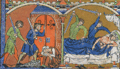 parent of (father) Ish-bosheth biblical character (Second Book of Samuel)
 - parent of (child) Ishvi son of Saul and Ahinoam
-
 parent of (father) Jonathan heroic figure in 1 Samuel
 - parent of (child) Malchishua son of Saul and Ahinoam
- parent of (child) Mephibosheth son of Saul and Rizpah
- parent of (child) Merab elder daughter of Saul
-
.jpg/120px-Michal_lets_David_escape_(89398919).jpg) parent of (father) Michal biblical figure, daughter of Saul
parent of (father) Michal biblical figure, daughter of Saul - partner of (spouse) Achinoam human biblical figure (First Book of Samuel)
-
.jpg/120px-Rizpah_keeps_watch_in_the_tranquil_night_over_the_decaying_b_Wellcome_V0034314_(cropped).jpg) partner of (spouse) Rizpah Saul's concubine
partner of (spouse) Rizpah Saul's concubine
Texts
In the texts
Works this figure appears in. A work’s date is the source’s, not this figure’s.


Later works
Later works that name Saul
Written in 1500 CE or later, and not religious texts: works that retell or borrow the figure, not sources for the life.
What this means
Sorted out of the texts by each work’s own recorded date on the source clock, and by its record not marking it as a religious text: the split is worked out here, not stated by any source. A religious text of any date stays among the texts.
Connections
How Saul connects
Grouped by the kind of relationship, because a successor is not a son and a shared symbol is not an influence.
Identification 1
What this means
One figure treated as another in some context. Not literal identity in all contexts, and usually a claim by a third party.
Does not imply literal identity in all contexts · that either tradition made the identification
Imported from Wikidata unless a tile says otherwise. Nothing here has been read by an editor.

Sources
Sources and evidence
Where every statement on this page comes from, and how each one stands.
19 statements on this record
- 3 Has references The statement cites something outside Wikimedia. That citation has not been checked here.
- 15 Imported Taken from Wikidata as it stands. Nobody here has read it. 1 of them cite only Wikipedia: one source, counted once.
- 1 Hedged in the source The source said circa, allegedly or presumably. This does not turn that into a date.
Only this record’s own statements. What other records say about it is counted on theirs.
Three layers, three licences
- Text
- Wikipedia · CC BY-SA 4.0, quoted, not merged
- Pictures
- Wikimedia Commons · each file’s own terms
Review
Not yet read by an editor here. Every relationship on this page is an import.
Computed Worked out here, not stated by any source: 1 collection membership. Each is marked where it is shown.
Disagreements are kept, not resolved, and a count of sources is not a confidence score.
.jpg/960px-Genesis_1_Dead_Sea_Scroll_(Cropped).jpg)
.jpg)
Keep exploring
More from Judaism
Texts, sages, institutions and places, and the schools that read them differently.