

Figure
Plato
4th-century BCE Greek philosopher
- Child of Ariston of Athens and Perictione
- Dated the 420s BCE – the 340s BCE
A life on the record,
dated by its sources.
Roles, not beliefs
Overview
From Wikipedia, quoted unmodified under CC BY-SA 4.0; the article’s history is its list of authors.
Life
One office on record
Holding an office is not parentage and not discipleship.
What this means
As the records give them: every row is a third party’s statement, not a self-description, and a role or an affiliation is often held for one period of a life only. An affiliation is not a belief, and this site does not ask anyone about theirs. For an office: which one, for how long, and where the records give an ordinal or the holders either side. Recognition of a tenure is never universal: contested lines appear as overlapping tenures rather than as one corrected sequence.
Family
The family of Plato
Parents, spouses and children as the records give them.
Documented family only. A teacher, a successor or a patron is never drawn in this tree.
The family as a list · 6
Family 6
What this means
A documented human family relationship. Not a succession mechanism, and not religious transmission.
Does not imply a right to an office · transmission of a teaching · a shared religious affiliation
Imported from Wikidata unless a tile says otherwise. Nothing here has been read by an editor.
Transmission
Teachers and students
Teaching passed from one person to another, in the direction of the arrows — not ancestry, and not succession.
What this means
In the direction the records give it. This is not biological ancestry and it is not institutional succession: a student who inherited no office still received the teaching, and an heir who received the office may have been taught by someone else entirely. It does not imply that teacher and student agreed.
Studied under 4
 Plato 4th-century BCE Greek philosopher
 Taught 21
-
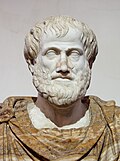 Aristotle Greek philosopher Has references
 -
 Theophrastus Greek philosopher (c.371-c.287 BC) Has references
 - Coriscus of Scepsis ↗ ancient Greek philosopher
- Axiothea of Phlius ↗
- Chaeron of Pellene ↗
Show all 21
- Demetrios of Amphipolis ↗
- Erastus of Scepsis ↗
- Euaeon of Lampsacus ↗
- Eudoxus of Cnidus ↗
- Euphraeus ↗
- Heraclides of Aenus ↗
- Heraclides Ponticus ↗
- Hestiaeus of Perinthus ↗
- Lastheneia of Mantinea ↗
- Leon of Byzantium ↗
- Philippus of Opus ↗
- Python of Aenus ↗
- Speusippus ↗
- Theodectes ↗ Has references
- Timolaus of Cyzicus ↗
- Xenocrates ↗
Texts
In the texts
Works this figure appears in. A work’s date is the source’s, not this figure’s.

Connections
How Plato connects
Grouped by the kind of relationship, because a successor is not a son and a shared symbol is not an influence.
Documented influence 30
What this means
A transmission argued from evidence. Not shared symbols, and not a short path through a database.
Does not imply shared symbols as evidence · a short path through a database
Imported from Wikidata unless a tile says otherwise. Nothing here has been read by an editor.
- was influenced by Aristophanes
-
 was influenced by Heraclitus Greek philosopher (late 6th/early 5th-century BC)
 -
 was influenced by Hesiod ancient Greek poet of the archaic period
 -
.jpg/120px-Homer_bust%2C_Farnese_collection_(Naples).jpg) was influenced by Homer reputed author of the Iliad and the Odyssey
was influenced by Homer reputed author of the Iliad and the Odyssey -
 was influenced by Orphism set of religious beliefs and practices originating in the ancient Greek and Hellenistic world
 -
.jpg/120px-Busto_di_Parmenide_(cropped).jpg) was influenced by Parmenides late 6th/early 5th century BC Greek pre-Socratic philosopher
was influenced by Parmenides late 6th/early 5th century BC Greek pre-Socratic philosopher - was influenced by Protagoras
-
 was influenced by Pythagoras Greek philosopher and mathematician (c. 570 – c. 495 BC)
 -
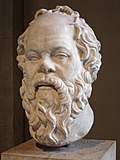 was influenced by Socrates 5th-century BCE Greek philosopher
Show all 30
-
 influenced Alain Badiou French writer and philosopher
 - influenced Aristotle Greek philosopher
-
 influenced Arthur Schopenhauer German philosopher (1788-1860)
 -
 influenced Augustine of Hippo Christian theologian, philosopher, and saint (354–430)
 -
 influenced Averroes Arab Andalusian Muslim writer and philosopher (1126–1198)
 -
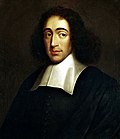 influenced Benedictus de Spinoza Dutch philosopher (1632-1677)
 -
 influenced Boethius Roman senator and philosopher of the early 6th century (480–524)
 -
 influenced C. S. Lewis British writer, lay theologian, and scholar (1898–1963)
 -
 influenced Farabi 10th century Persian philosopher and jurist
 -
 influenced Friedrich Wilhelm Joseph Schelling German philosopher (1775–1854)
 -
 influenced Georg Wilhelm Friedrich Hegel German philosopher and theologian (1770–1831)
 -
.jpg/120px-Christoph_Bernhard_Francke_-_Bildnis_des_Philosophen_Leibniz_(ca._1695).jpg) influenced Gottfried Wilhelm Leibniz German mathematician and philosopher (1646–1716)
influenced Gottfried Wilhelm Leibniz German mathematician and philosopher (1646–1716) -
.jpg/120px-Hannah_Arendt_auf_dem_1._Kulturkritikerkongress%2C_Barbara_Niggl_Radloff%2C_FM-2019-1-5-9-16_(cropped).jpg) influenced Hannah Arendt German-American political theorist and philosopher (1906–1975)
influenced Hannah Arendt German-American political theorist and philosopher (1906–1975) -
 influenced Henri Bergson French philosopher (1859–1941)
 -
 influenced Hermann Cohen German philosopher (1842–1918)
 -
 influenced Leo Tolstoy Russian author (1828–1910)
 -
 influenced Proclus 5th-century Greek Neoplatonist philosopher
 -
 influenced René Descartes French philosopher, mathematician, and scientist (1596–1650)
 -
 influenced Thomas Aquinas Italian Dominican friar, philosopher, Catholic priest, and Doctor of the Church (1225–1274)
 -
.jpg/120px-Thomas_Hobbes_(portrait).jpg) influenced Thomas Hobbes English philosopher (1588–1679)
influenced Thomas Hobbes English philosopher (1588–1679) -
 influenced Vladimir Solovyov Russian philosopher (1853-1900)
Sources
Sources and evidence
Where every statement on this page comes from, and how each one stands.
42 statements on this record
- 7 Has references The statement cites something outside Wikimedia. That citation has not been checked here.
- 34 Imported Taken from Wikidata as it stands. Nobody here has read it. 6 of them cite only Wikipedia: one source, counted once.
- 1 Hedged in the source The source said circa, allegedly or presumably. This does not turn that into a date.
Only this record’s own statements. What other records say about it is counted on theirs.
Three layers, three licences
- Text
- Wikipedia · CC BY-SA 4.0, quoted, not merged
- Pictures
- Wikimedia Commons · each file’s own terms
Review
Not yet read by an editor here. Every relationship on this page is an import.
Disagreements are kept, not resolved, and a count of sources is not a confidence score.


Keep exploring
More figures, tradition by tradition
The directory lists every one on record, most widely recorded first.
People on the record,
and people in the telling.