
.jpg/960px-Inconnu_d'apr%C3%A8s_J.-M._Nattier%2C_Portrait_de_Pierre_Ier_(mus%C3%A9e_de_l%E2%80%99Ermitage).jpg)
Figure Christianity
Peter the Great
Petrus I la
Tsar/Emperor of Russia from 1682 to 1725
- Child of Alexei I of Russia and Natalya Naryshkina
- Married to Eudoxia Lopukhina, Catherine I of Russia
- Dated 30 May 1672 CE (Old Style) – 28 January 1725 CE (Old Style)
Tsar of All Russia
Emperor of all the Russias
Offices on record
Overview
From Wikipedia, quoted unmodified under CC BY-SA 4.0; the article’s history is its list of authors.
Life
Roles and affiliation
Holding an office is not parentage and not discipleship.
What this means
As the records give them: every row is a third party’s statement, not a self-description, and a role or an affiliation is often held for one period of a life only. An affiliation is not a belief, and this site does not ask anyone about theirs. For an office: which one, for how long, and where the records give an ordinal or the holders either side. Recognition of a tenure is never universal: contested lines appear as overlapping tenures rather than as one corrected sequence.
Belonged to

Offices held 2
- 2 November 1721 CE – 8 February 1725 CE Emperor of all the Russias Succeeded by Catherine I of Russia
Family
The family of Peter the Great
Parents, spouses and children as the records give them.
Documented family only. A teacher, a successor or a patron is never drawn in this tree.
The family as a list · 28
Family 28
What this means
A documented human family relationship. Not a succession mechanism, and not religious transmission.
Does not imply a right to an office · transmission of a teaching · a religious affiliation held by the whole house · continuous rule · a shared religious affiliation
Imported from Wikidata unless a tile says otherwise. Nothing here has been read by an editor.
-
.jpg/120px-Alexis_I_of_Russia_(1670-1680s%2C_GIM).jpg) child of (child) Alexei I of Russia Tsar of Russia (1645–1676)
child of (child) Alexei I of Russia Tsar of Russia (1645–1676) - child of (mother) Natalya Naryshkina russian Tsarina (1651–1694)
-
 of the house House of Romanov imperial dynasty of Russia from 1613 to 1762
 - parent of (child) Alexander Petrovich (1691-1692)
-
.jpg/120px-Alexey_Petrovich_by_J.G.Tannauer_(1710-15%2C_Russian_museum).jpg) parent of (father) Alexei Petrovich, Tsarevich of Russia Russian Tsarevich (1690-1718)
parent of (father) Alexei Petrovich, Tsarevich of Russia Russian Tsarevich (1690-1718) - parent of (child) Anna Petrovna of Russia elder daughter of Emperor Peter I of Russia and Catherine I of Russia
- parent of (child) Elizabeth I of Russia sixth Empress of Russia from 1741 to 1762 (lived 1709-1762)
- parent of (child) Katherine Petrovna Romanov (born 1707)
- parent of (child) Margaret Petrovna Romanov (1714-1715)
- parent of (child) Natalia Maria Petrovna (1713-1715)
- parent of (child) Natalia Petrovna Grand Duchess of Russia, the youngest daughter of Peter the Great
- parent of (child) Paul Petrovich Romanov (1717-1717)
- parent of (child) Pavel Petrovich Romanov son of Peter the Great (1693-1693)
- parent of (child) Pyotr Petrovich (1715-1719)
- sibling of Catherine Alekseyevna of Russia Russian princess (1658-1718)
-
 sibling of Feodor III of Russia Tsar of Russia (1676–1682)
 - sibling of Feodosia Alekseyevna of Russia Tsarevna of Russia
-
.jpg/120px-Ivan_V_(Russian_museum).jpg) sibling of Ivan V of Russia Tsar of Russia from 1682 to 1696 (lived 1666-1696)
sibling of Ivan V of Russia Tsar of Russia from 1682 to 1696 (lived 1666-1696) - sibling of Marfa Alekseyevna of Russia Russian princess (1652-1707)
- sibling of Maria Alekseyevna of Russia Russian princess (1660-1723)
-
.jpg/120px-Natalia_Alexeevna_by_anonim_(1700s%2C_GRM).jpg) sibling of Natalya Alexeevna of Russia Russian princess
sibling of Natalya Alexeevna of Russia Russian princess -
.jpg/120px-%D0%9F%D0%BE%D1%80%D1%82%D1%80%D0%B5%D1%82_%D1%81%D0%B0%D0%BC%D0%BE%D0%B4%D0%B5%D1%80%D0%B6%D0%B8%D1%86%D1%8B_%D0%A1%D0%BE%D1%84%D1%8C%D0%B8_%D0%90%D0%BB%D0%B5%D0%BA%D1%81%D0%B5%D0%B5%D0%B2%D0%BD%D1%8B_(cropped).jpg) sibling of Sophia Alekseyevna of Russia Russian tsarevna (1657–1704)
sibling of Sophia Alekseyevna of Russia Russian tsarevna (1657–1704) - sibling of Tsarevich Alexei Alexeyevich of Russia second son and heir of Tsar Alexis of Russia and Maria Miloslavskaya
- sibling of Tsarevich Dmitry Alexeyevich of Russia Russian tsarevich
Show all 28
- sibling of Tsarevich Simeon Alexeyevich of Russia Russian tsarevich
- sibling of Tsarevna Yevdokia Alekseyevna of Russia Russian princess (1650-1712)
- married to Catherine I of Russia The first Empress of Russia from 1725 to 1727
-
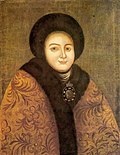 married to Eudoxia Lopukhina russian Tsarina as the first wife of Peter I
Religious context
What the records tie them to
Founded, supported, associated with — as third parties recorded it.
What this means
A founding is an attribution, usually contested, and not a claim that the tradition began fully formed. Patronage is an act, not a belief: it says nothing about the religion of a population, and nothing about the patron’s own practice in every period of a life. Domains are as sources record them — for a saint, usually a patronage — rarely exclusive, and not the same in every account.
-
 Named as founder
Peter and Paul Cathedral
Russian Orthodox cathedral located inside the Peter and Paul Fortress in St. Petersburg, Russia -
 Named as founder
Alexander Nevsky Lavra
monastery in Saint Petersburg, Russia -
 Named as founder
Annunciation Church of the Alexander Nevsky Lavra
church in Saint Petersburg, Russia
Connections
How Peter the Great connects
Grouped by the kind of relationship, because a successor is not a son and a shared symbol is not an influence.
Text 1
What this means
A work, its editions and its witnesses are distinct; their dates are not interchangeable.
Does not imply that the work is the only account · that the work is contemporary with what it describes
Imported from Wikidata unless a tile says otherwise. Nothing here has been read by an editor.
Recorded events and days 5
What this means
Events Wikidata records in a subject’s history, and the day a festival is kept. Not a complete history, and the day a festival falls on is not when it began.
Does not imply that these are all the events in its history · that Wikidata ranks the events by importance
Imported from Wikidata unless a tile says otherwise. Nothing here has been read by an editor.
Sources
Sources and evidence
Where every statement on this page comes from, and how each one stands.
38 statements on this record
- 19 Has references The statement cites something outside Wikimedia. That citation has not been checked here.
- 19 Imported Taken from Wikidata as it stands. Nobody here has read it. 2 of them cite only Wikipedia: one source, counted once.
Only this record’s own statements. What other records say about it is counted on theirs.
Three layers, three licences
- Text
- Wikipedia · CC BY-SA 4.0, quoted, not merged
- Pictures
- Wikimedia Commons · each file’s own terms
Review
Not yet read by an editor here. Every relationship on this page is an import.
Disagreements are kept, not resolved, and a count of sources is not a confidence score.


Keep exploring
More from Christianity
Its branches, councils, saints, offices and buildings — and where they stopped recognising each other.