
.jpg/960px-Seleznikha_church_-_prophet_Moses_(18_c.).jpg)
Overview
From Wikipedia, quoted unmodified under CC BY-SA 4.0; the article’s history is its list of authors.
Life
Roles and affiliation
Holding an office is not parentage and not discipleship.
What this means
As the records give them: every row is a third party’s statement, not a self-description, and a role or an affiliation is often held for one period of a life only. An affiliation is not a belief, and this site does not ask anyone about theirs. For an office: which one, for how long, and where the records give an ordinal or the holders either side. Recognition of a tenure is never universal: contested lines appear as overlapping tenures rather than as one corrected sequence.
Offices held 2
- Dates unrecorded biblical judge
-

Family
The family of Moses
Parents, consorts and children as the accounts give them. Choose a consort to see the children the stories give the two.
Accounts differ about a god’s family. Where they name different parents, the tree sets them side by side instead of choosing one.
The family as a list · 9
Kinship in an account 9
What this means
Parentage as a named source tells it. Not an independently established biological relationship, and different accounts disagree.
Does not imply an independently established biological relationship · agreement between accounts · marriage as a legal institution · exclusivity, or a single canonical pairing · shared parentage in every account · descent from the same generation in a single tree
Imported from Wikidata unless a tile says otherwise. Nothing here has been read by an editor.
- child of (child) Amram human biblical character in Exodus, husband of Jochebed and father of Aaron, Moses and Miriam
-
 child of (adoptive) Bithiah adoptive mother of the prophet Moses
 -
 child of (child) Jochebed biblical figure, mother of Moses
 - parent of (child) Eliezer in the Book of Exodus, the second son of Moses
- parent of (father) Gershom firstborn son of Moses and Zipporah
- partner of (spouse) Tharbis Cushite princess
-
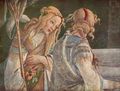 partner of (spouse) Zipporah biblical character, wife of Moses
 -
 sibling of Aaron male human biblical and quranic figure, brother of Moses
 -
 sibling of Miriam sister of Moses and Aaron
Transmission
Teachers and students
Teaching passed from one person to another, in the direction of the arrows — not ancestry, and not succession.
What this means
In the direction the records give it. This is not biological ancestry and it is not institutional succession: a student who inherited no office still received the teaching, and an heir who received the office may have been taught by someone else entirely. It does not imply that teacher and student agreed.
.jpg/330px-Seleznikha_church_-_prophet_Moses_(18_c.).jpg) Moses Abrahamic prophet said to have led the Israelites out of Egypt
Moses Abrahamic prophet said to have led the Israelites out of Egypt 


Texts
In the texts
Works this figure appears in. A work’s date is the source’s, not this figure’s.
-
 Written 631 CE
Qur’an
foundational Islamic religious text -

Exodus
second book of the Bible -

Leviticus
third book of the Bible -

Deuteronomy
fifth book of the Torah and Christian Old Testament -

Book of Numbers
fourth book of Bible -
 Written 1st century CE
Assumption of Moses
Jewish pseudepigraphical work, surviving in a 6th century Latin manuscript, purporting to describe secret prophecies that Moses revealed to Joshua -
Israel in Egypt ↗
oratorio by Georg Friedrich Händel -
Go Down Moses ↗
song -

Moses
opera by Myroslav Skoryk
Show all 27
-
 Written c. 1000 CE
Exodus
poem in the Junius manuscript -
Les Dix Commandements
musical by Élie Chouraqui and Pascal Obispo -
Moses
poem by Ivan Franko -
Die Israeliten in der Wüste ↗
oratorio by Carl Philipp Emanuel Bach -
La Terre Promise ↗
oratorio in three parts by Jules Massenet to a French libretto by the composer based on the French translation of the Vulgate by Silvestre de Sacy -
Moses ↗
opera by Anton Rubinstein -
Moses the Lawgiver ↗
book by Thomas Keneally -
Ol' Man Adam an' His Chillun ↗
collection of folk tales -
The Promised Land ↗
oratorio by Camille Saint-Saëns -
Himmelfahrt des Moses ↗
-
La Terre promise ↗
-
Mojžíš ↗
poem by Alfred de Vigny -
Mojžíšův rozsudek ↗
poem written by Simeon Karel Macháček -
Moses und Josua ↗
1917 poem written by Else Lasker-Schüler -
Moses, Man of the Mountain ↗
novel by Zora Neale Hurston -
Pillar of Fire ↗
1995 novel by Judith Tarr -
The Finding of Moses ↗
poem by Zozimus (Michael J. Moran) -
The Ten Commandments: The Musical ↗
musical
Later works
Later works that name Moses
Written in 1500 CE or later, and not religious texts: works that retell or borrow the figure, not sources for the life.
What this means
Sorted out of the texts by each work’s own recorded date on the source clock, and by its record not marking it as a religious text: the split is worked out here, not stated by any source. A religious text of any date stays among the texts.
-
 Written 19th century CE
Mosè in Egitto
opera by Gioachino Rossini - Written 20th century CE
Moses und Aron
opera by Arnold Schoenberg -
 Written 19th century CE
Moïse et Pharaon
opera by Gioachino Rossini -
_still_1.jpg/250px-The_Green_Pastures_(1930_play)_still_1.jpg) Written 1929 CE
Written 1929 CEThe Green Pastures
play by Marc Connelly -
 Written 1909 CE
Extract from Captain Stormfield's Visit to Heaven
1909 short story by Mark Twain -
 Written 1944 CE
The Tables of the Law
novel by Thomas Mann
Also in films, games and series: De Mantel der Liefde, Exodus: Gods and Kings, History of the World, Part I, In the Beginning, Moses, Moses the Lawgiver, Moses und Aron, Once Upon a Time... Man, Os Dez Mandamentos, The Green Pastures, The Life of Moses, The Manga Bible: From Genesis to Revelation, The Moon of Israel, The Prince of Egypt, The Ten Commandments
Connections
How Moses connects
Grouped by the kind of relationship, because a successor is not a son and a shared symbol is not an influence.
Succession in office 1
What this means
Who held an office after whom. Not parentage, not discipleship, and not universally recognised — offices are contested.
Does not imply parentage · discipleship · an explanation of why the succession happened
Imported from Wikidata unless a tile says otherwise. Nothing here has been read by an editor.
Identification 3
What this means
One figure treated as another in some context. Not literal identity in all contexts, and usually a claim by a third party.
Does not imply literal identity in all contexts · that either tradition made the identification
Imported from Wikidata unless a tile says otherwise. Nothing here has been read by an editor.


Recorded events and days 2
What this means
Events Wikidata records in a subject’s history, and the day a festival is kept. Not a complete history, and the day a festival falls on is not when it began.
Does not imply that these are all the events in its history · that Wikidata ranks the events by importance
Imported from Wikidata unless a tile says otherwise. Nothing here has been read by an editor.
Sources
Sources and evidence
Where every statement on this page comes from, and how each one stands.
72 statements on this record
- 7 Has references The statement cites something outside Wikimedia. That citation has not been checked here.
- 65 Imported Taken from Wikidata as it stands. Nobody here has read it. 1 of them cite only Wikipedia: one source, counted once.
Only this record’s own statements. What other records say about it is counted on theirs.
Three layers, three licences
- Text
- Wikipedia · CC BY-SA 4.0, quoted, not merged
- Pictures
- Wikimedia Commons · each file’s own terms
Review
Not yet read by an editor here. Every relationship on this page is an import.
Disagreements are kept, not resolved, and a count of sources is not a confidence score.
.jpg/960px-Genesis_1_Dead_Sea_Scroll_(Cropped).jpg)
.jpg)
Keep exploring
More from Judaism
Texts, sages, institutions and places, and the schools that read them differently.