

Figure
Louis the German
King of East Francia from 843 to 876
- Child of Louis the Pious and Ermengarde of Hesbaye
- Married to Hemma
- Dated c. 806 CE – 28 August 876 CE
A life on the record,
dated by its sources.
Roles, not beliefs
Overview
From Wikipedia, quoted unmodified under CC BY-SA 4.0; the article’s history is its list of authors.
Life
One office on record
Holding an office is not parentage and not discipleship.
What this means
As the records give them: every row is a third party’s statement, not a self-description, and a role or an affiliation is often held for one period of a life only. An affiliation is not a belief, and this site does not ask anyone about theirs. For an office: which one, for how long, and where the records give an ordinal or the holders either side. Recognition of a tenure is never universal: contested lines appear as overlapping tenures rather than as one corrected sequence.
Family
The family of Louis the German
Parents, spouses and children as the records give them.
Documented family only. A teacher, a successor or a patron is never drawn in this tree.
The family as a list · 22
Family 22
What this means
A documented human family relationship. Not a succession mechanism, and not religious transmission.
Does not imply a right to an office · transmission of a teaching · a religious affiliation held by the whole house · continuous rule · a shared religious affiliation
Imported from Wikidata unless a tile says otherwise. Nothing here has been read by an editor.
-
 child of (child) Ermengarde of Hesbaye Holy Roman empress
 -
 child of (child) Louis the Pious King of the Franks
 -
 of the house Carolingian dynasty Frankish noble family founded by Charles Martel
 - parent of (child) Bertha abbess
-
 parent of (father) Carloman of Bavaria King of Bavaria from 876 to 879
 -
 parent of (father) Charles the Fat Emperor of the Carolingian Empire (839-888) (r. 881-887)
 - parent of (child) Gisela frankish princess daughter of Louis the German
- parent of (child) Hildegard abbess of Fraumünster, daughter of Louis the German
- parent of (child) Irmgard of Chiemsee Beatified German nun
-
 parent of (father) Louis III the Younger King of East Francia
 - parent of (child) Verona of Leefdaal medieval saint
- parent of (child) Veronus of Lembeek medieval saint
- sibling of Alpaïs of Paris illegitimate daughter of Louis the Pious
- sibling of Arnulf of Sens born 794, illegitimate son of Louis the Pious
- sibling of Bertha frankish princess daughter of Louis the Pious
-
 sibling of Charles the Bald King of West Francia from 843 to 877 and Carolingian Emperor from 875 to 877
 -
 sibling of Gisela Frankish noble, daughter of Louis the Pious
 - sibling of Hildegard, princess of Francia princess of the Frankish Empire
-
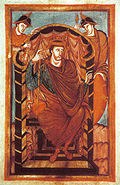 sibling of Lothair I Emperor of the Carolingian Empire from 817 to 855
 -
 sibling of Pepin I of Aquitaine 9th-century Frankish king
 - sibling of Rotrude frankish princess daughter of Louis the Pious
-
 married to Hemma Frankish queen
Religious context
What the records tie them to
Founded, supported, associated with — as third parties recorded it.
What this means
A founding is an attribution, usually contested, and not a claim that the tradition began fully formed. Patronage is an act, not a belief: it says nothing about the religion of a population, and nothing about the patron’s own practice in every period of a life. Domains are as sources record them — for a saint, usually a patronage — rarely exclusive, and not the same in every account.

Sources
Sources and evidence
Where every statement on this page comes from, and how each one stands.
23 statements on this record
- 21 Has references The statement cites something outside Wikimedia. That citation has not been checked here.
- 2 Imported Taken from Wikidata as it stands. Nobody here has read it.
Only this record’s own statements. What other records say about it is counted on theirs.
Three layers, three licences
- Text
- Wikipedia · CC BY-SA 4.0, quoted, not merged
- Pictures
- Wikimedia Commons · each file’s own terms
Review
Not yet read by an editor here. Every relationship on this page is an import.
Disagreements are kept, not resolved, and a count of sources is not a confidence score.


Keep exploring
More figures, tradition by tradition
The directory lists every one on record, most widely recorded first.
People on the record,
and people in the telling.