

Figure Greek and Roman
Laomedon
Λαομέδων grc
Trojan king, son of Ilus
A life on the record,
dated by its sources.
Roles, not beliefs
Overview
From Wikipedia, quoted unmodified under CC BY-SA 4.0; the article’s history is its list of authors.
Life
One office on record
Holding an office is not parentage and not discipleship.
What this means
As the records give them: every row is a third party’s statement, not a self-description, and a role or an affiliation is often held for one period of a life only. An affiliation is not a belief, and this site does not ask anyone about theirs. For an office: which one, for how long, and where the records give an ordinal or the holders either side. Recognition of a tenure is never universal: contested lines appear as overlapping tenures rather than as one corrected sequence.
- Dates unrecorded king of Troy
Family
The family of Laomedon
Parents, consorts and children as the accounts give them. Choose a consort to see the children the stories give the two.
Accounts differ about a god’s family. Where they name different parents, the tree sets them side by side instead of choosing one.
The family as a list · 22
Kinship in an account 1
What this means
Parentage as a named source tells it. Not an independently established biological relationship, and different accounts disagree.
Does not imply marriage as a legal institution · exclusivity, or a single canonical pairing
Imported from Wikidata unless a tile says otherwise. Nothing here has been read by an editor.
Family 21
What this means
A documented human family relationship. Not a succession mechanism, and not religious transmission.
Does not imply a right to an office · transmission of a teaching · a religious affiliation held by the whole house · continuous rule · a shared religious affiliation
Imported from Wikidata unless a tile says otherwise. Nothing here has been read by an editor.
- child of (child) Ilus son of Tros in Greek mythology, mythological founder of Troy
- of the house Dardanides
- parent of (child) Aethilla Greek mythical character, daughter of Laomedon
-
 parent of (father) Antigone of Troy daughter of Laomedon in Greek mythology
 - parent of (father) Astyoche daughter of Laomedon
- parent of (child) Bucolion son of Laomedon in Greek mythology
- parent of (father) Cilla mythological Greek character, daughter of Laomedon
- parent of (child) Clytius son of Laomedon of Troy
- parent of (child) Clytodora daughter of Laomedon in Greek mythology
-
 parent of (father) Hesione Greek mythical character, daughter of Laomedon
 - parent of (child) Hicetaon son of Laomedon of Troy
- parent of (child) Lampus elder of Troy, one of the sons of King Laomedon, in Greek mythology
- parent of (child) Medesicaste daughter of Laomedon in Greek mythology
- parent of (child) Nauprestides daughters of Laomedon of Troy in Greek mythology
-
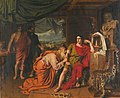 parent of (father) Priam the legendary and last king of Troy during the Trojan war; son of Laomedon
 - parent of (child) Proclia mythical mother of Tenes
-
_(cropped).jpg/120px-Red-figure_kylix_Eos_and_Tithonos_(Boston_MFA_95.28)_(cropped).jpg) parent of (father) Tithonus prince of Troy loved by Eos in Greek mythology
parent of (father) Tithonus prince of Troy loved by Eos in Greek mythology - married to Calybe nymph from Greek mythology
- married to Leucippe mother of Priam in Greek myth
- married to Strymo mythical daughter of Scamander
- married to Zeuxippe mother of Priam
Sources
Sources and evidence
Where every statement on this page comes from, and how each one stands.
22 statements on this record
- 3 Has references The statement cites something outside Wikimedia. That citation has not been checked here.
- 19 Imported Taken from Wikidata as it stands. Nobody here has read it.
Only this record’s own statements. What other records say about it is counted on theirs.
Three layers, three licences
- Text
- Wikipedia · CC BY-SA 4.0, quoted, not merged
- Pictures
- Wikimedia Commons · each file’s own terms
Review
Not yet read by an editor here. Every relationship on this page is an import.
Disagreements are kept, not resolved, and a count of sources is not a confidence score.


Keep exploring
More from Greek and Roman
The Olympians and their Roman equivalents, the mystery cults, and the poets whose accounts disagree.