

Figure Christianity
James VI and I
Iacobus I la
King of Scotland from 1566 to 1625, King of England and Ireland from 1603 to 1625 (1566-1625)
- Child of Henry Stuart, Lord Darnley and Mary, Queen of Scots
- Married to Anne of Denmark
- Dated 19 June 1566 CE – 27 March 1625 CE (Old Style)
Duke of Rothesay
Monarch of Scotland
King of Ireland
Offices on record
Overview
From Wikipedia, quoted unmodified under CC BY-SA 4.0; the article’s history is its list of authors.
Life
Roles and affiliation
Holding an office is not parentage and not discipleship.
What this means
As the records give them: every row is a third party’s statement, not a self-description, and a role or an affiliation is often held for one period of a life only. An affiliation is not a belief, and this site does not ask anyone about theirs. For an office: which one, for how long, and where the records give an ordinal or the holders either side. Recognition of a tenure is never universal: contested lines appear as overlapping tenures rather than as one corrected sequence.
Belonged to
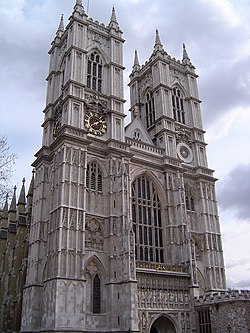

Offices held 4
- 19 June 1566 CE – 8 February 1587 CE (Old Style) Duke of Rothesay
- 8 February 1587 CE (Old Style) – 27 March 1625 CE Monarch of Scotland Succeeded Mary, Queen of Scots · Succeeded by Charles I of England
- 24 March 1603 CE (Old Style) – 27 March 1625 CE King of Ireland Succeeded Elizabeth I of England · Succeeded by Charles I of England
- 24 March 1603 CE (Old Style) – 27 March 1625 CE Monarch of England Succeeded Elizabeth I of England · Succeeded by Charles I of England
Family
The family of James VI and I
Parents, spouses and children as the records give them.
Documented family only. A teacher, a successor or a patron is never drawn in this tree.
The family as a list · 16
Family 16
What this means
A documented human family relationship. Not a succession mechanism, and not religious transmission.
Does not imply a right to an office · transmission of a teaching · a religious affiliation held by the whole house · continuous rule · a shared religious affiliation
Imported from Wikidata unless a tile says otherwise. Nothing here has been read by an editor.
-
 child of (child) Henry Stuart, Lord Darnley Duke of Albany and King consort of Scotland (1545-1567)
 -
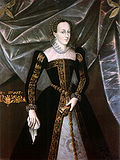 child of (child) Mary, Queen of Scots Queen of Scotland from 1542 to 1567 (1542–1587)
 - of the house House of Stewart di Darnley
-
_-_Charles_I_(1600-1649)_-_RCIN_404398_-_Royal_Collection.jpg/120px-Anthony_van_Dyck_(1599-1641)_-_Charles_I_(1600-1649)_-_RCIN_404398_-_Royal_Collection.jpg) parent of (father) Charles I of England King of England, Scotland, and Ireland from 1625 to 1649 (1600-1649)
parent of (father) Charles I of England King of England, Scotland, and Ireland from 1625 to 1649 (1600-1649) -
 parent of (father) Elizabeth Stuart, Queen of Bohemia Electress consort of the Palatine and Queen of Bohemia (1596-1662)
 - parent of (child) Henry Frederick, Prince of Wales eldest son and heir apparent of James VI and I
- parent of (child) Jacob Kettler Duke of Courland (1610–1682)
- parent of (child) Margaret Stuart Scottish princess; second daughter of King James VI of Scotland and Anne of Denmark
- parent of (child) Mary Stuart English-Scottish princess; third daughter and sixth child of King James VI of Scotland and Anne of Denmark
- parent of (child) Robert Stuart, Duke of Kintyre and Lorne fifth child of James VI of Scotland and Anne of Denmark
- parent of (child) Sophia of England fourth daughter and seventh child of King James VI and I by his wife, Anne of Denmark
- parent of (child) unnamed son Stuart (1595-1595)
- parent of (child) unnamed son Stuart (1603-1603)
- sibling of (half) stillborn twin Hepburn son of Mary, Queen of Scots and James Hepburn, 4th Earl of Bothwell
- sibling of (half) stillborn twin Hepburn son of James Hepburn, 4th Earl of Bothwell and Mary, Queen of Scots
- married to Anne of Denmark Queen consort of James VI of Scots, I of England (1574-1619)
Transmission
Teachers and students
Teaching passed from one person to another, in the direction of the arrows — not ancestry, and not succession.
What this means
In the direction the records give it. This is not biological ancestry and it is not institutional succession: a student who inherited no office still received the teaching, and an heir who received the office may have been taught by someone else entirely. It does not imply that teacher and student agreed.
Studied under 4
 James VI and I King of Scotland from 1566 to 1625, King of England and Ireland from 1603 to 1625 (1566-1625)
 Religious context
What the records tie them to
Founded, supported, associated with — as third parties recorded it.
What this means
A founding is an attribution, usually contested, and not a claim that the tradition began fully formed. Patronage is an act, not a belief: it says nothing about the religion of a population, and nothing about the patron’s own practice in every period of a life. Domains are as sources record them — for a saint, usually a patronage — rarely exclusive, and not the same in every account.
History
Recorded events
What James VI and I’s own record names in its history. None of the statements carries a date.
What this means
Events Wikidata records in a subject’s history, and the day a festival is kept. Not a complete history, and the day a festival falls on is not when it began. Each date is the one on the statement itself; an event with none is named after the line. It does not imply that these are all the events in its history, or that Wikidata ranks the events by importance.
Recorded, with no date on the statement
- Act Anent the demission of the Crown in favour of our Sovereign Lord, and his Majesty's Coronation 1567 ↗
- Baptism of James VI ↗
- Coronation of James I and Anne ↗
- Coronation of James VI of Scotland ↗
- English subsidy of James VI ↗
- Entry of James VI into Edinburgh ↗
- Gunpowder Plot ↗
- Jacobean era ↗
- Murder of Lord Darnley ↗
- Succession to Elizabeth I of England ↗
- Treaty of Berwick ↗
- Union of the Crowns ↗
Sources
Sources and evidence
Where every statement on this page comes from, and how each one stands.
38 statements on this record
- 12 Has references The statement cites something outside Wikimedia. That citation has not been checked here.
- 26 Imported Taken from Wikidata as it stands. Nobody here has read it. 3 of them cite only Wikipedia: one source, counted once.
Only this record’s own statements. What other records say about it is counted on theirs.
Three layers, three licences
- Text
- Wikipedia · CC BY-SA 4.0, quoted, not merged
- Pictures
- Wikimedia Commons · each file’s own terms
Review
Not yet read by an editor here. Every relationship on this page is an import.
Disagreements are kept, not resolved, and a count of sources is not a confidence score.


Keep exploring
More from Christianity
Its branches, councils, saints, offices and buildings — and where they stopped recognising each other.