

Figure East Asian traditions
Emperor Taishō
大正天皇 zh 다이쇼 천황 ko
Emperor of Japan from 1912 until 1926
- Child of Emperor Meiji and Yanagiwara Naruko
- Married to Empress Teimei
- Dated 31 August 1879 CE – 25 December 1926 CE
Emperor of Japan
heir apparent
Crown Prince of Japan
Offices on record
Overview
From Wikipedia, quoted unmodified under CC BY-SA 4.0; the article’s history is its list of authors.
Life
Roles and affiliation
Holding an office is not parentage and not discipleship.
What this means
As the records give them: every row is a third party’s statement, not a self-description, and a role or an affiliation is often held for one period of a life only. An affiliation is not a belief, and this site does not ask anyone about theirs. For an office: which one, for how long, and where the records give an ordinal or the holders either side. Recognition of a tenure is never universal: contested lines appear as overlapping tenures rather than as one corrected sequence.
Offices held 3
- 31 August 1887 CE – 30 July 1912 CE heir apparent
- 3 November 1888 CE – 30 July 1912 CE Crown Prince of Japan
-
 30 July 1912 CE – 25 December 1926 CE Emperor of Japan Number 123 in the sequence Succeeded Emperor Meiji · Succeeded by Hirohito
Family
The family of Emperor Taishō
Parents, spouses and children as the records give them.
Documented family only. A teacher, a successor or a patron is never drawn in this tree.
The family as a list · 22
Family 22
What this means
A documented human family relationship. Not a succession mechanism, and not religious transmission.
Does not imply a right to an office · transmission of a teaching · a religious affiliation held by the whole house · continuous rule · a shared religious affiliation
Imported from Wikidata unless a tile says otherwise. Nothing here has been read by an editor.
-
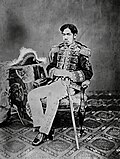 child of (child) Emperor Meiji Emperor of Japan from 1867 until 1912
 - child of (mother) Yanagiwara Naruko Japanese lady-in-waiting; concubine of Emperor Meiji; mother of Emperor Taishō
-
 of the house Imperial House of Japan members of the extended family of the reigning Emperor of Japan
 -
 parent of (father) Hirohito emperor of Japan from 1926 to 1989
 - parent of (child) Nobuhito, Prince Takamatsu
- parent of (child) Takahito, Prince Mikasa
- parent of (child) Yasuhito, Prince Chichibu
- sibling of Akiko, Princess Shige elder daughter of Emperor Meiji and Chigusa Kotoko
- sibling of Fumiko, Princess Masu younger daughter of Emperor Meiji and Chigusa Kotoko
- sibling of Fusako Kitashirakawa daughter of Emperor Meiji; spouse of Prince Kitashirakawa Naruhisa (1890-1974)
- sibling of Michihito, Prince Aki fourth son of Emperor Meiji
- sibling of Princess Masako Takeda Japanese princess; daughter of Emperor Meiji and Sono Sachiko (1888–1940)
- sibling of Princess Nobuko Asaka Japanese princess (1891-1931)
- sibling of Shigeko, Princess Ume daughter of Emperor Meiji and Yanagiwara Naruko
- sibling of Shizuko, Princess Hisa Japanese princess; eldest child of Emperor Meiji and Sono Sachiko
- sibling of Takiko, Princess Sada daughter of emperor Meiji
- sibling of Teruhito, Prince Mitsu (1893-1894); son of Emperor Meiji and Sono Sachiko
- sibling of Toshiko Higashikuni daughter of Emperor Meiji of Japan (1896–1978)
- sibling of Wakamitsuteru-hiko no Mikoto stillborn son of Emperor Meiji and Hamuro Mitsuko (1873–1873)
- sibling of Wakatakayori-hime no Mikoto stillborn daughter of Emperor Meiji and Hashimoto Natsuko
- sibling of Yukihito, Prince Take (1877-1878); son of Emperor Meiji and Yanagiwara Naruko
- married to Empress Teimei Japanese empress consort (1884–1951)
Sources
Sources and evidence
Where every statement on this page comes from, and how each one stands.
26 statements on this record
- 26 Imported Taken from Wikidata as it stands. Nobody here has read it. 3 of them cite only Wikipedia: one source, counted once.
Only this record’s own statements. What other records say about it is counted on theirs.
Three layers, three licences
- Text
- Wikipedia · CC BY-SA 4.0, quoted, not merged
- Pictures
- Wikimedia Commons · each file’s own terms
Review
Not yet read by an editor here. Every relationship on this page is an import.
Disagreements are kept, not resolved, and a count of sources is not a confidence score.


Keep exploring
More from East Asian traditions
Daoism, Confucian practice, Chinese folk religion, Shinto and Korean tradition.