

Figure Christianity
Emperor Rudolf II
Rudolphus II la
Holy Roman Emperor, King of Hungary and Croatia, King of Bohemia and Archduke of Austria (1552-1612)
- Child of Maximilian II, Holy Roman Emperor and Maria of Austria, Holy Roman Empress
- Dated 18 July 1552 CE – 20 January 1612 CE
King of Bohemia
Apostolic King of Hungary
Holy Roman Emperor
Offices on record
Overview
From Wikipedia, quoted unmodified under CC BY-SA 4.0; the article’s history is its list of authors.
Life
Roles and affiliation
Holding an office is not parentage and not discipleship.
What this means
As the records give them: every row is a third party’s statement, not a self-description, and a role or an affiliation is often held for one period of a life only. An affiliation is not a belief, and this site does not ask anyone about theirs. For an office: which one, for how long, and where the records give an ordinal or the holders either side. Recognition of a tenure is never universal: contested lines appear as overlapping tenures rather than as one corrected sequence.
Offices held 4
- 1576 CE – 1611 CE King of Bohemia Number 21 in the sequence Succeeded Maximilian II, Holy Roman Emperor · Succeeded by Matthias, Holy Roman Emperor
- 12 October 1576 CE – 25 June 1608 CE Apostolic King of Hungary Succeeded Maximilian II, Holy Roman Emperor · Succeeded by Matthias, Holy Roman Emperor Has references
- 12 October 1576 CE – 20 January 1612 CE Holy Roman Emperor Succeeded Maximilian II, Holy Roman Emperor · Succeeded by Matthias, Holy Roman Emperor
- Dates unrecorded Prince-Elector
Family
The family of Emperor Rudolf II
Parents, spouses and children as the records give them.
Documented family only. A teacher, a successor or a patron is never drawn in this tree.
The family as a list · 19
Family 19
What this means
A documented human family relationship. Not a succession mechanism, and not religious transmission.
Does not imply a right to an office · transmission of a teaching · a religious affiliation held by the whole house · continuous rule · a marriage · a shared religious affiliation
Imported from Wikidata unless a tile says otherwise. Nothing here has been read by an editor.
-
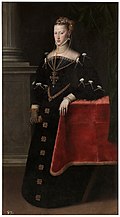 child of (child) Maria of Austria, Holy Roman Empress Holy Roman empress (1528-1603)
 -
 child of (child) Maximilian II, Holy Roman Emperor King of the Romans, King of Hungary, Croatia and Bohemia (1527-1576)
 -
 of the house House of Habsburg European imperial dynasty
 - parent of (child) Ana Dorothea of Austria
- parent of (child) Anna Dorothea von Österreich
- parent of (child) Caroline d'Autriche
- parent of (child) Julius d’Austria
- parent of (child) Karl von Osterreich
- parent of (child) Matthias von Osterreich
- partner of Katharina Strada
-
%2C_after_Peter_Paul_Rubens_-_Portrait_of_Albert_VII%2C_Archduke_of_Austria.jpg/120px-Jacob_Jordaens_(Attr%2C)%2C_after_Peter_Paul_Rubens_-_Portrait_of_Albert_VII%2C_Archduke_of_Austria.jpg) sibling of Albert VII, Archduke of Austria Austrian cardinal and governor of the Netherlands (1559-1621)
sibling of Albert VII, Archduke of Austria Austrian cardinal and governor of the Netherlands (1559-1621) - sibling of Anna of Austria, Queen of Spain queen consort of Spain (1549-1580)
- sibling of Archduchess Margaretha of Austria Austrian archduchess (1567-1633)
-
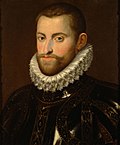 sibling of Archduke Ernest of Austria Austrian nobleman (1553-1595)
 -
 sibling of Archduke Wenceslaus of Austria Austrian archduke
 - sibling of Elisabeth of Austria Queen consort of France (1554–1592)
-
.jpg/120px-Matthias_-_Holy_Roman_Emperor_(Hans_von_Aachen%2C_1625).jpg) sibling of Matthias, Holy Roman Emperor Holy Roman Emperor (1557-1619)
sibling of Matthias, Holy Roman Emperor Holy Roman Emperor (1557-1619) - sibling of Maximilian III, Archduke of Austria Austrian archduke (1558-1618)
- married to married to: recorded as none
Sources
Sources and evidence
Where every statement on this page comes from, and how each one stands.
24 statements on this record
- 6 Has references The statement cites something outside Wikimedia. That citation has not been checked here.
- 18 Imported Taken from Wikidata as it stands. Nobody here has read it. 3 of them cite only Wikipedia: one source, counted once.
Only this record’s own statements. What other records say about it is counted on theirs.
Three layers, three licences
- Text
- Wikipedia · CC BY-SA 4.0, quoted, not merged
- Pictures
- Wikimedia Commons · each file’s own terms
Review
Not yet read by an editor here. Every relationship on this page is an import.
Disagreements are kept, not resolved, and a count of sources is not a confidence score.


Keep exploring
More from Christianity
Its branches, councils, saints, offices and buildings — and where they stopped recognising each other.