

Figure South Asian traditions
Draupadī
द्रौपदी sa திரௌபதி ta
Main female character in the Hindu epic Mahabharata
A life on the record,
dated by its sources.
Roles, not beliefs
Overview
From Wikipedia, quoted unmodified under CC BY-SA 4.0; the article’s history is its list of authors.
Life
Affiliation
As a third party recorded it, often for one period of a life.
What this means
As the records give them: every row is a third party’s statement, not a self-description, and a role or an affiliation is often held for one period of a life only. An affiliation is not a belief, and this site does not ask anyone about theirs. For an office: which one, for how long, and where the records give an ordinal or the holders either side. Recognition of a tenure is never universal: contested lines appear as overlapping tenures rather than as one corrected sequence.

Family
The family of Draupadī
Parents, consorts and children as the accounts give them. Choose a consort to see the children the stories give the two.
Accounts differ about a god’s family. Where they name different parents, the tree sets them side by side instead of choosing one.
The family as a list · 12
Kinship in an account 11
What this means
Parentage as a named source tells it. Not an independently established biological relationship, and different accounts disagree.
Does not imply an independently established biological relationship · agreement between accounts · marriage as a legal institution · exclusivity, or a single canonical pairing · shared parentage in every account · descent from the same generation in a single tree
Imported from Wikidata unless a tile says otherwise. Nothing here has been read by an editor.
- child of (father) Drupada
- parent of (child) Prativindhya
- parent of (child) Shrutakarma
- parent of (child) Sutasoma
-
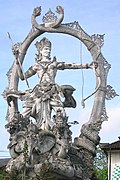 partner of (spouse) Arjuna central character of Indian epic Mahabharata
 -
 partner of (spouse) Bhīma Great Kshatriya(Rajput) warrior of Mahabharata
 - partner of (spouse) Nakula character of Indian epic Mahabharata
-
 partner of (spouse) Sahadeva character of Indian epic Mahabharata
 - partner of (spouse) Yudhiṣṭhira character from Indian epic Mahabharata
- sibling of Dhṛṣṭadyumna
- sibling of Śikhaṇḍī
Family 1
What this means
A documented human family relationship. Not a succession mechanism, and not religious transmission.
Does not imply a shared religious affiliation
Imported from Wikidata unless a tile says otherwise. Nothing here has been read by an editor.
Texts
In the texts
Works this figure appears in. A work’s date is the source’s, not this figure’s.
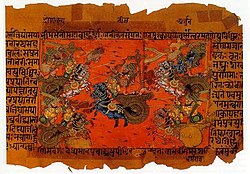
Sources
Sources and evidence
Where every statement on this page comes from, and how each one stands.
13 statements on this record
- 10 Has references The statement cites something outside Wikimedia. That citation has not been checked here.
- 3 Imported Taken from Wikidata as it stands. Nobody here has read it. 3 of them cite only Wikipedia: one source, counted once.
Only this record’s own statements. What other records say about it is counted on theirs.
Three layers, three licences
- Text
- Wikipedia · CC BY-SA 4.0, quoted, not merged
- Pictures
- Wikimedia Commons · each file’s own terms
Review
Not yet read by an editor here. Every relationship on this page is an import.
Disagreements are kept, not resolved, and a count of sources is not a confidence score.
.jpeg/960px-UgrataraTemple2_(cropped).jpeg)
.jpeg)
Keep exploring
More from South Asian traditions
Hinduism and its schools, Jainism, Sikhism, and the Vedic material behind them.