

Figure
Benedictus de Spinoza
Dutch philosopher (1632-1677)
- Child of Miguel de Espinoza and Hanna Debora d'Espinoza
- Dated 24 November 1632 CE – 21 February 1677 CE
A life on the record,
dated by its sources.
Roles, not beliefs
Family
The family of Benedictus de Spinoza
Parents, spouses and children as the records give them.
Documented family only. A teacher, a successor or a patron is never drawn in this tree.
The family as a list · 3
Family 3
What this means
A documented human family relationship. Not a succession mechanism, and not religious transmission.
Does not imply a right to an office · transmission of a teaching · a shared religious affiliation
Imported from Wikidata unless a tile says otherwise. Nothing here has been read by an editor.
- child of (mother) Hanna Debora d'Espinoza mother of Baruch Spinoza
- child of (father) Miguel de Espinoza father of Baruch Spinoza
- married to married to: recorded as none
Transmission
Teachers and students
Teaching passed from one person to another, in the direction of the arrows — not ancestry, and not succession.
What this means
In the direction the records give it. This is not biological ancestry and it is not institutional succession: a student who inherited no office still received the teaching, and an heir who received the office may have been taught by someone else entirely. It does not imply that teacher and student agreed.
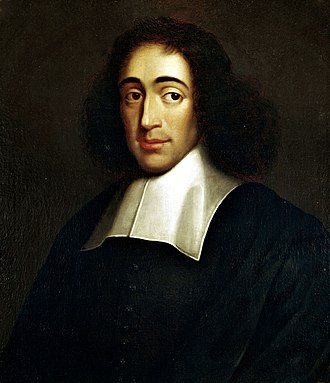 Benedictus de Spinoza Dutch philosopher (1632-1677)
 Connections
How Benedictus de Spinoza connects
Grouped by the kind of relationship, because a successor is not a son and a shared symbol is not an influence.
Identification 1
What this means
One figure treated as another in some context. Not literal identity in all contexts, and usually a claim by a third party.
Does not imply literal identity in all contexts · that either tradition made the identification
Imported from Wikidata unless a tile says otherwise. Nothing here has been read by an editor.
Documented influence 28
What this means
A transmission argued from evidence. Not shared symbols, and not a short path through a database.
Does not imply shared symbols as evidence · a short path through a database
Imported from Wikidata unless a tile says otherwise. Nothing here has been read by an editor.
-
 was influenced by Aristotle Greek philosopher
 -
 was influenced by Averroes Arab Andalusian Muslim writer and philosopher (1126–1198)
 -
 was influenced by Avicenna Persian polymath, physician and philosopher (c. 980–1037)
 -
 was influenced by Democritus Greek philosopher (c. 460–c. 370 BC)
 -
 was influenced by Epicurus ancient Greek philosopher
 -
 was influenced by Francis Bacon English philosopher and statesman (1561–1626)
 -
.jpg/120px-Portrait_of_Giordano_Bruno_in_%22Opere%22_Wellcome_L0015152_(cropped).jpg) was influenced by Giordano Bruno Italian Dominican friar, philosopher and mathematician (1548–1600)
was influenced by Giordano Bruno Italian Dominican friar, philosopher and mathematician (1548–1600) - was influenced by Hasdai Crescas Spanish Jewish philosopher and teacher (c.1340–1410/11)
-
 was influenced by Ibn Tufayl Arab Muslim polymath (c. 1105–1185)
Show all 28
-
 was influenced by Lucretius 1st-century BC Roman poet and philosopher
 -
 was influenced by Moshe ben Maimon Medieval Jewish philosopher from Spain (1135–1204)
 - was influenced by Nicolas Machiavel Florentine statesman, diplomat, and political theorist (1469–1527)
-
 was influenced by Nicolas Malebranche French philosopher
 -
.jpg/120px-Busto_di_Parmenide_(cropped).jpg) was influenced by Parmenides late 6th/early 5th century BC Greek pre-Socratic philosopher
was influenced by Parmenides late 6th/early 5th century BC Greek pre-Socratic philosopher -
 was influenced by Plato 4th-century BCE Greek philosopher
 -
 was influenced by René Descartes French philosopher, mathematician, and scientist (1596–1650)
 -
.jpg/120px-Thomas_Hobbes_(portrait).jpg) was influenced by Thomas Hobbes English philosopher (1588–1679)
was influenced by Thomas Hobbes English philosopher (1588–1679) -
 was influenced by Xenophanes Greek Pre-Socratic philosopher (c.570–c.478 BC)
 -
 influenced Arthur Schopenhauer German philosopher (1788-1860)
 -
 influenced Bertrand Russell British philosopher and logician (1872–1970)
 -
 influenced Friedrich Wilhelm Joseph Schelling German philosopher (1775–1854)
 -
 influenced Georg Wilhelm Friedrich Hegel German philosopher and theologian (1770–1831)
 -
.jpg/120px-Christoph_Bernhard_Francke_-_Bildnis_des_Philosophen_Leibniz_(ca._1695).jpg) influenced Gottfried Wilhelm Leibniz German mathematician and philosopher (1646–1716)
influenced Gottfried Wilhelm Leibniz German mathematician and philosopher (1646–1716) -
 influenced Henri Bergson French philosopher (1859–1941)
 -
 influenced Johann Gottfried Herder German philosopher, theologian, poet (1744–1803)
 -
.jpg/120px-Goethe_(Stieler_1828).jpg) influenced Johann Wolfgang von Goethe German writer, artist, natural scientist and politician (1749–1832)
influenced Johann Wolfgang von Goethe German writer, artist, natural scientist and politician (1749–1832) -
_(cropped).jpg/120px-Louis_Althusser_sketch_(8420987781)_(cropped).jpg) influenced Louis Althusser French Marxist philosopher (1918–1990)
influenced Louis Althusser French Marxist philosopher (1918–1990) -
 influenced Ludwig Feuerbach German philosopher and anthropologist (1804–1872)
Sources
Sources and evidence
Where every statement on this page comes from, and how each one stands.
24 statements on this record
- 2 Has references The statement cites something outside Wikimedia. That citation has not been checked here.
- 22 Imported Taken from Wikidata as it stands. Nobody here has read it. 1 of them cite only Wikipedia: one source, counted once.
Only this record’s own statements. What other records say about it is counted on theirs.
Three layers, three licences
- Text
- Wikipedia · CC BY-SA 4.0, quoted, not merged
- Pictures
- Wikimedia Commons · each file’s own terms
Review
Not yet read by an editor here. Every relationship on this page is an import.
Disagreements are kept, not resolved, and a count of sources is not a confidence score.


Keep exploring
More figures, tradition by tradition
The directory lists every one on record, most widely recorded first.
People on the record,
and people in the telling.