

Figure Christianity
Augustine of Hippo
Augustinus la Αὐγουστῖνος grc آگوستین fa
Christian theologian, philosopher, and saint (354–430)
- Child of Patricius and Monica of Hippo
- Dated 13 November 354 CE – 28 August 430 CE
- Recognised as Saint
A life on the record,
dated by its sources.
Roles, not beliefs
Overview
From Wikipedia, quoted unmodified under CC BY-SA 4.0; the article’s history is its list of authors.
Life
Roles and affiliation
Holding an office is not parentage and not discipleship.
What this means
As the records give them: every row is a third party’s statement, not a self-description, and a role or an affiliation is often held for one period of a life only. An affiliation is not a belief, and this site does not ask anyone about theirs. For an office: which one, for how long, and where the records give an ordinal or the holders either side. Recognition of a tenure is never universal: contested lines appear as overlapping tenures rather than as one corrected sequence.
Belonged to
Offices held 1
Family
The family of Augustine of Hippo
Parents, spouses and children as the records give them.
Documented family only. A teacher, a successor or a patron is never drawn in this tree.
The family as a list · 6
Family 6
What this means
A documented human family relationship. Not a succession mechanism, and not religious transmission.
Does not imply a right to an office · transmission of a teaching · a shared religious affiliation
Imported from Wikidata unless a tile says otherwise. Nothing here has been read by an editor.
-
 child of (child) Monica of Hippo Christian saint; mother of St. Augustine (c.332-387)
 - child of (father) Patricius father of Augustine of Hippo
- parent of (child) Adeodatus monk, son of Augustinus
- sibling of Navigius of Hippo brother of Augustine of Hippo
- sibling of Perpetua of Hippo sister Augustine of Hippo and abbess
- married to married to: recorded as none
Transmission
Teachers and students
Teaching passed from one person to another, in the direction of the arrows — not ancestry, and not succession.
What this means
In the direction the records give it. This is not biological ancestry and it is not institutional succession: a student who inherited no office still received the teaching, and an heir who received the office may have been taught by someone else entirely. It does not imply that teacher and student agreed.
 Augustine of Hippo Christian theologian, philosopher, and saint (354–430)
 Taught 1
History
Recorded events
What Augustine of Hippo’s own record names in its history, in the order of the dates on the statements.
What this means
Events Wikidata records in a subject’s history, and the day a festival is kept. Not a complete history, and the day a festival falls on is not when it began. Each date is the one on the statement itself; an event with none is named after the line. It does not imply that these are all the events in its history, or that Wikidata ranks the events by importance.
- 391 CE Priestly ordination in the Roman rite ↗
- 396 CE Consecration ↗
Connections
How Augustine of Hippo connects
Grouped by the kind of relationship, because a successor is not a son and a shared symbol is not an influence.
Documented influence 14
What this means
A transmission argued from evidence. Not shared symbols, and not a short path through a database.
Does not imply shared symbols as evidence · a short path through a database
Imported from Wikidata unless a tile says otherwise. Nothing here has been read by an editor.
-
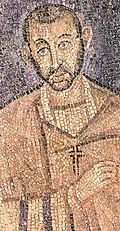 was influenced by Ambrose Roman theologian and Bishop of Milan (c. 340–397)
 -
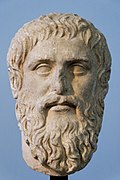 was influenced by Plato 4th-century BCE Greek philosopher
 -
_1352_150cm%2C_treviso%2C_ex_convento_di_san_niccol%C3%B2%2C_sala_del_capitolo.jpg/120px-Tommaso_da_modena%2C_ritratti_di_domenicani_(vescovo)_1352_150cm%2C_treviso%2C_ex_convento_di_san_niccol%C3%B2%2C_sala_del_capitolo.jpg) influenced Albertus Magnus German-Dominican friar and saint (c. 1200–1280)
influenced Albertus Magnus German-Dominican friar and saint (c. 1200–1280) -
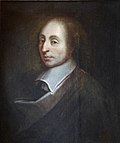 influenced Blaise Pascal French mathematician, physicist, inventor, writer, and Christian philosopher (1623-1662)
 -
 influenced Boethius Roman senator and philosopher of the early 6th century (480–524)
 - influenced Franciscus van den Enden Flemish Jesuit, Neo-Latin poet, physician, art dealer, philosopher and teacher of Baruch de Spinoza (1602-1674)
-
.jpg/120px-Christoph_Bernhard_Francke_-_Bildnis_des_Philosophen_Leibniz_(ca._1695).jpg) influenced Gottfried Wilhelm Leibniz German mathematician and philosopher (1646–1716)
influenced Gottfried Wilhelm Leibniz German mathematician and philosopher (1646–1716) -
.jpg/120px-Hannah_Arendt_auf_dem_1._Kulturkritikerkongress%2C_Barbara_Niggl_Radloff%2C_FM-2019-1-5-9-16_(cropped).jpg) influenced Hannah Arendt German-American political theorist and philosopher (1906–1975)
influenced Hannah Arendt German-American political theorist and philosopher (1906–1975) -
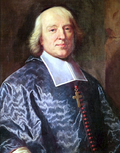 influenced Jacques Bénigne Bossuet French bishop and theologian (1627-1704)
Show all 14
-
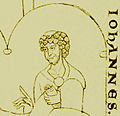 influenced Johannes Scotus Eriugena Irish Catholic philosopher and theologian (c. 800 – c. 877)
 -
 influenced John Calvin French Protestant reformer (1509–1564)
 -
.jpg/120px-Lucas_Cranach_d.%C3%84._-_Martin_Luther%2C_1528_(Veste_Coburg).jpg) influenced Martin Luther German priest and theologian (1483–1546)
influenced Martin Luther German priest and theologian (1483–1546) -
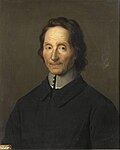 influenced Nicolas Malebranche French philosopher
 -
 influenced Thomas Aquinas Italian Dominican friar, philosopher, Catholic priest, and Doctor of the Church (1225–1274)
Sources
Sources and evidence
Where every statement on this page comes from, and how each one stands.
15 statements on this record
- 6 Has references The statement cites something outside Wikimedia. That citation has not been checked here.
- 9 Imported Taken from Wikidata as it stands. Nobody here has read it. 2 of them cite only Wikipedia: one source, counted once.
Only this record’s own statements. What other records say about it is counted on theirs.
Three layers, three licences
- Text
- Wikipedia · CC BY-SA 4.0, quoted, not merged
- Pictures
- Wikimedia Commons · each file’s own terms
Review
Not yet read by an editor here. Every relationship on this page is an import.
Disagreements are kept, not resolved, and a count of sources is not a confidence score.


Keep exploring
More from Christianity
Its branches, councils, saints, offices and buildings — and where they stopped recognising each other.