

Figure Greek and Roman
Aristotle
Ἀριστοτέλης grc Aristoteles la
Greek philosopher
- Child of Nicomachus
- Married to Pythias
- Dated 384 BCE – 322 BCE
A life on the record,
dated by its sources.
Roles, not beliefs
Family
The family of Aristotle
Parents, spouses and children as the records give them.
Documented family only. A teacher, a successor or a patron is never drawn in this tree.
The family as a list · 7
Family 7
What this means
A documented human family relationship. Not a succession mechanism, and not religious transmission.
Does not imply a right to an office · transmission of a teaching · a marriage · a shared religious affiliation
Imported from Wikidata unless a tile says otherwise. Nothing here has been read by an editor.
- child of (child) Nicomachus father of Aristotle
- parent of (father) Nicomachus ancient Greek philosopher, son of Aristotle
- parent of (child) Pythias daughter of Aristotle
- partner of Herpyllis Aristotle's lover
- sibling of Arimneste sister of Aristotle
- sibling of Arimnestus brother of Aristoteles
- married to Pythias Greek biologist and embryologist
Transmission
Teachers and students
Teaching passed from one person to another, in the direction of the arrows — not ancestry, and not succession.
What this means
In the direction the records give it. This is not biological ancestry and it is not institutional succession: a student who inherited no office still received the teaching, and an heir who received the office may have been taught by someone else entirely. It does not imply that teacher and student agreed.
Studied under 1
 Aristotle Greek philosopher
 Taught 12
-
.jpg/120px-Alexander_the_Great_mosaic_(cropped).jpg) Alexander the Great king of Macedonia and conqueror of Achaemenid Persia (356–323 BC) Has references
Alexander the Great king of Macedonia and conqueror of Achaemenid Persia (356–323 BC) Has references -
 Theophrastus Greek philosopher (c.371-c.287 BC) Has references
 -
 Aristoxenus 4th century BC Greek Peripatetic philosopher and musicologist Has references
 -
 Eudemus of Rhodes ancient Greek philosopher Has references
 -
 Dicaearchus 4th-century BC Greek philosopher and geographer Has references
Show all 12
- Phaenias of Eresus 4th-century BC Greek philosopher
- Clearchus of Soli 4th-century BC Greek philosopher Has references
- Chamaeleon ↗ Greek Peripatetic philosopher (c.350–c.275 BC)
- Neleus of Scepsis ↗ ancient Greek philosopher
- Clytus of Miletus ↗ pupil of Aristotle Has references
- Hipparchus of Stagira ↗ philosopher and associate of Aristotle
- Meno ↗ ancient Greek physician, disciple of Aristotle
Connections
How Aristotle connects
Grouped by the kind of relationship, because a successor is not a son and a shared symbol is not an influence.
Affiliation 1
What this means
Association with a tradition or school. Traditions branch, overlap and re-merge; this is not a clean single-origin tree.
Does not imply that the culture was religiously uniform
Imported from Wikidata unless a tile says otherwise. Nothing here has been read by an editor.
.JPG/120px-Sicily_Selinunte_Temple_E_(Hera).JPG)
Documented influence 36
What this means
A transmission argued from evidence. Not shared symbols, and not a short path through a database.
Does not imply shared symbols as evidence · a short path through a database
Imported from Wikidata unless a tile says otherwise. Nothing here has been read by an editor.
-
 was influenced by Anaximander pre-Socratic Greek philosopher
 -
 was influenced by Democritus Greek philosopher (c. 460–c. 370 BC)
 -
 was influenced by Empedocles 5th century BC Greek philosopher
 -
 was influenced by Epicurus ancient Greek philosopher
 -
 was influenced by Heraclitus Greek philosopher (late 6th/early 5th-century BC)
 -
 was influenced by Hippocrates Greek physician (c. 460 – c. 370 BC)
 -
.jpg/120px-Busto_di_Parmenide_(cropped).jpg) was influenced by Parmenides late 6th/early 5th century BC Greek pre-Socratic philosopher
was influenced by Parmenides late 6th/early 5th century BC Greek pre-Socratic philosopher -
 was influenced by Plato 4th-century BCE Greek philosopher
 -
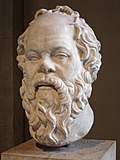 was influenced by Socrates 5th-century BCE Greek philosopher
Show all 36
-
%2C_RP-P-1907-4495.jpg/120px-Portretbuste_van_Zeno_van_Elea_Paradigmata_graphices_variorum_artificum_(serietitel)%2C_RP-P-1907-4495.jpg) was influenced by Zeno of Elea Greek philosopher (c. 495 – c. 430 BC)
was influenced by Zeno of Elea Greek philosopher (c. 495 – c. 430 BC) - influenced Al-Jubba'i Arab philosopher (died c. 915)
- influenced Alexander the Great king of Macedonia and conqueror of Achaemenid Persia (356–323 BC)
-
 influenced Averroes Arab Andalusian Muslim writer and philosopher (1126–1198)
 -
 influenced Avicenna Persian polymath, physician and philosopher (c. 980–1037)
 -
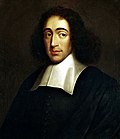 influenced Benedictus de Spinoza Dutch philosopher (1632-1677)
 -
 influenced Boethius Roman senator and philosopher of the early 6th century (480–524)
 -
 influenced C. S. Lewis British writer, lay theologian, and scholar (1898–1963)
 -
 influenced Carl Schmitt German jurist, political theorist and professor of law (1888-1985)
 -
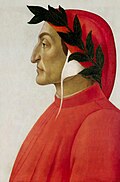 influenced Dante Alighieri Florentine poet, writer, and philosopher (c. 1265–1321)
 -
 influenced Farabi 10th century Persian philosopher and jurist
 -
 influenced Georg Wilhelm Friedrich Hegel German philosopher and theologian (1770–1831)
 -
.jpg/120px-Christoph_Bernhard_Francke_-_Bildnis_des_Philosophen_Leibniz_(ca._1695).jpg) influenced Gottfried Wilhelm Leibniz German mathematician and philosopher (1646–1716)
influenced Gottfried Wilhelm Leibniz German mathematician and philosopher (1646–1716) -
.jpg/120px-Hannah_Arendt_auf_dem_1._Kulturkritikerkongress%2C_Barbara_Niggl_Radloff%2C_FM-2019-1-5-9-16_(cropped).jpg) influenced Hannah Arendt German-American political theorist and philosopher (1906–1975)
influenced Hannah Arendt German-American political theorist and philosopher (1906–1975) - influenced Hasdai Crescas Spanish Jewish philosopher and teacher (c.1340–1410/11)
-
 influenced Henri Bergson French philosopher (1859–1941)
 -
 influenced Henry David Thoreau American essayist, poet, and philosopher (1817–1862)
 -
.jpg/120px-Iohannes_Buridanus_(Paris_ca._1370%2C_Krak%C3%B3w_cod._BJ_1771%2C_fol._142v).jpg) influenced Jean Buridan medieval philosopher (ca. 1300-1358)
influenced Jean Buridan medieval philosopher (ca. 1300-1358) -
 influenced Leo Tolstoy Russian author (1828–1910)
 -
 influenced Moshe ben Maimon Medieval Jewish philosopher from Spain (1135–1204)
 -
 influenced Proclus 5th-century Greek Neoplatonist philosopher
 -
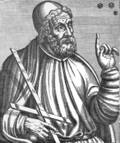 influenced Ptolemy 2nd-century Roman mathematician, astronomer, geographer
 -
 influenced René Descartes French philosopher, mathematician, and scientist (1596–1650)
 -
_-_(cropped).jpg/120px-S%C3%B8ren_Kierkegaard_(1813-1855)_-_(cropped).jpg) influenced Søren Kierkegaard Danish theologian, philosopher, poet and social critic (1813–1855)
influenced Søren Kierkegaard Danish theologian, philosopher, poet and social critic (1813–1855) -
 influenced Thomas Aquinas Italian Dominican friar, philosopher, Catholic priest, and Doctor of the Church (1225–1274)
 -
.jpg/120px-Thomas_Hobbes_(portrait).jpg) influenced Thomas Hobbes English philosopher (1588–1679)
influenced Thomas Hobbes English philosopher (1588–1679) -
 influenced William of Ockham English Franciscan friar and theologian (c.1287–1347)
Sources
Sources and evidence
Where every statement on this page comes from, and how each one stands.
31 statements on this record
- 14 Has references The statement cites something outside Wikimedia. That citation has not been checked here.
- 17 Imported Taken from Wikidata as it stands. Nobody here has read it.
Only this record’s own statements. What other records say about it is counted on theirs.
Three layers, three licences
- Text
- Wikipedia · CC BY-SA 4.0, quoted, not merged
- Pictures
- Wikimedia Commons · each file’s own terms
Review
Not yet read by an editor here. Every relationship on this page is an import.
Disagreements are kept, not resolved, and a count of sources is not a confidence score.


Keep exploring
More from Greek and Roman
The Olympians and their Roman equivalents, the mystery cults, and the poets whose accounts disagree.