

Figure Christianity
Alfonso VI of León and Castile
King of León (1065 to 1109), of Castile (1072 to 1109), and of Galicia (1071 to 1109)
- Child of Ferdinand I of León and Castile and Sancha of León
- Married to Bertha of Leon, Agatha of Normandy, Agnes of Aquitaine, Queen of León and Castile and 4 more
- Dated June 1040 CE – 1 July 1109 CE
A life on the record,
dated by its sources.
Roles, not beliefs
Overview
From Wikipedia, quoted unmodified under CC BY-SA 4.0; the article’s history is its list of authors.
Life
Roles and affiliation
Holding an office is not parentage and not discipleship.
What this means
As the records give them: every row is a third party’s statement, not a self-description, and a role or an affiliation is often held for one period of a life only. An affiliation is not a belief, and this site does not ask anyone about theirs. For an office: which one, for how long, and where the records give an ordinal or the holders either side. Recognition of a tenure is never universal: contested lines appear as overlapping tenures rather than as one corrected sequence.

Offices held 3
- 13 October 1072 CE – 1 July 1109 CE Monarch of the Kingdom of Castile Succeeded Sancho II of León and Castile · Succeeded by Urraca of León
- 13 October 1072 CE – 1 July 1109 CE Monarch of the Kingdom of León
- 1073 CE – 1 July 1109 CE Monarch of Galicia
Family
The family of Alfonso VI of León and Castile
Parents, spouses and children as the records give them.
Documented family only. A teacher, a successor or a patron is never drawn in this tree.
The family as a list · 21
Family 20
What this means
A documented human family relationship. Not a succession mechanism, and not religious transmission.
Does not imply a right to an office · transmission of a teaching · a religious affiliation held by the whole house · continuous rule · a shared religious affiliation
Imported from Wikidata unless a tile says otherwise. Nothing here has been read by an editor. 1 more point at records with no English name, and are not shown.
-
 child of (child) Ferdinand I of León and Castile King of Castile, then León and Castile (c.1015-1065) (r. 1035-1037 then 1037-1065)
 -
 child of (child) Sancha of León Queen of León
 -
 of the house Jiménez dynasty noble family
 - parent of (child) Elvira of Leon Queen of Sicily
- parent of (child) Sancho Alfónsez Infante of Castille and Leon
- parent of (child) Theresa of León Countess-Queen of Portugal
- parent of (child) Elvira of Castile Countess of Toulouse
- parent of (child) Sancha of Castile
-
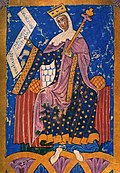 parent of (father) Urraca of León Spanish queen
 -
 sibling of Elvira of Toro Lady of Toro
 -
 sibling of García II of Galicia King of Galicia
 -
.jpg/120px-Sancho_II_de_Castilla_(Ayuntamiento_de_Le%C3%B3n).jpg) sibling of Sancho II of León and Castile King of Leon and Castile
sibling of Sancho II of León and Castile King of Leon and Castile -
 sibling of Urraca of Zamora Leonese infanta
 - married to Beatrix of Poitiers
- married to Isabella, Queen of Leon
- married to Bertha of Leon Queen consort of Leon
- married to Constance of Burgundy Queen consort of León and Castile
- married to Agnes of Aquitaine, Queen of León and Castile
- married to Zaida of Seville
- married to Agatha of Normandy daughter of William the Conqueror and Matilda of Flanders
Connections
How Alfonso VI of León and Castile connects
Grouped by the kind of relationship, because a successor is not a son and a shared symbol is not an influence.
Succession in office 1
What this means
Who held an office after whom. Not parentage, not discipleship, and not universally recognised — offices are contested.
Does not imply parentage · discipleship · an explanation of why the succession happened
Imported from Wikidata unless a tile says otherwise. Nothing here has been read by an editor.
Sources
Sources and evidence
Where every statement on this page comes from, and how each one stands.
28 statements on this record
- 4 Has references The statement cites something outside Wikimedia. That citation has not been checked here.
- 24 Imported Taken from Wikidata as it stands. Nobody here has read it. 16 of them cite only Wikipedia: one source, counted once.
Only this record’s own statements. What other records say about it is counted on theirs.
Three layers, three licences
- Text
- Wikipedia · CC BY-SA 4.0, quoted, not merged
- Pictures
- Wikimedia Commons · each file’s own terms
Review
Not yet read by an editor here. Every relationship on this page is an import.
Disagreements are kept, not resolved, and a count of sources is not a confidence score.


Keep exploring
More from Christianity
Its branches, councils, saints, offices and buildings — and where they stopped recognising each other.