

Figure Buddhist traditions
1st Dalai Lama
དགེ་འདུན་གྲུབ་པ། bo 杰·根敦珠巴 zh ダライ・ラマ1世 ja
Dalai Lama of Tibet (1391-1474)
- Child of Gonpo Dorjee and Jomo Namkha Kyi
- Dated 1391 CE – 1474 CE
A life on the record,
dated by its sources.
Roles, not beliefs
Overview
From Wikipedia, quoted unmodified under CC BY-SA 4.0; the article’s history is its list of authors.
Life
Roles and affiliation
Holding an office is not parentage and not discipleship.
What this means
As the records give them: every row is a third party’s statement, not a self-description, and a role or an affiliation is often held for one period of a life only. An affiliation is not a belief, and this site does not ask anyone about theirs. For an office: which one, for how long, and where the records give an ordinal or the holders either side. Recognition of a tenure is never universal: contested lines appear as overlapping tenures rather than as one corrected sequence.
Belonged to


Offices held 1

Family
The family of 1st Dalai Lama
Parents, spouses and children as the records give them.
Documented family only. A teacher, a successor or a patron is never drawn in this tree.
The family as a list · 2
Family 2
What this means
A documented human family relationship. Not a succession mechanism, and not religious transmission.
Does not imply a right to an office · transmission of a teaching
Imported from Wikidata unless a tile says otherwise. Nothing here has been read by an editor.
Transmission
Teachers and students
Teaching passed from one person to another, in the direction of the arrows — not ancestry, and not succession.
What this means
In the direction the records give it. This is not biological ancestry and it is not institutional succession: a student who inherited no office still received the teaching, and an heir who received the office may have been taught by someone else entirely. It does not imply that teacher and student agreed.
Studied under 11

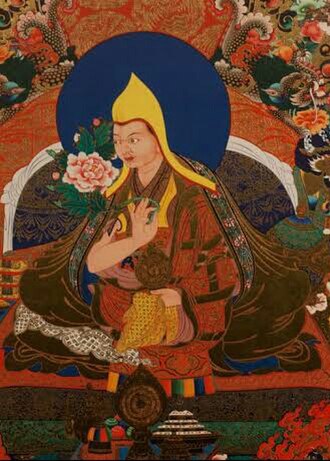 1st Dalai Lama Dalai Lama of Tibet (1391-1474)
 Taught 19
- Mönlam Legpa Lodrö ↗ Tibetan monk, abbot of Ganden and Drepung monasteries Has references
- Chokyi Shenyen ↗ Tibetan spiritual leader, 13th Ganden Tripa Has references
- Jetsün Chökyi Gyeltshen ↗ tibetan scholar and logician (1469–1544) Has references
- bla chen kun dga' rgyal mtshan ↗ Has references
- Dawa Zangpo ↗ Has references
Show all 19
- Dul Dzin Palden Zangpo ↗ Has references
- Dul Karwa Lodrö Bepa ↗ Has references
- Khedrub Norzang Gyatso ↗ Has references
- Khenchen Drakpa Sherab ↗ Has references
- Khenchen Sherab Gyaltsen ↗ Has references
- Khenchen Zöpa Pal Drub ↗ Has references
- Künga Delek Rinchen ↗ Has references
- Künga Döndrub ↗ Has references
- Lobzang Nyima ↗ Has references
- Lodro Rinchen Sengge ↗ Has references
- Penchen Lung Rik Gyatso ↗ Has references
- Penchen Sangpo Trashi ↗ Has references
- Penchen Yeshe Tsemo ↗ Has references
- Sherab Dar Lekpai Lodro ↗ Has references
Religious context
What the records tie them to
Founded, supported, associated with — as third parties recorded it.
What this means
A founding is an attribution, usually contested, and not a claim that the tradition began fully formed. Patronage is an act, not a belief: it says nothing about the religion of a population, and nothing about the patron’s own practice in every period of a life. Domains are as sources record them — for a saint, usually a patronage — rarely exclusive, and not the same in every account.

Sources
Sources and evidence
Where every statement on this page comes from, and how each one stands.
37 statements on this record
- 33 Has references The statement cites something outside Wikimedia. That citation has not been checked here.
- 4 Imported Taken from Wikidata as it stands. Nobody here has read it.
1 recorded statement points at a record with no English name anywhere, so it is counted here rather than drawn.
Only this record’s own statements. What other records say about it is counted on theirs.
Three layers, three licences
- Text
- Wikipedia · CC BY-SA 4.0, quoted, not merged
- Pictures
- Wikimedia Commons · each file’s own terms
Review
Not yet read by an editor here. Every relationship on this page is an import.
Disagreements are kept, not resolved, and a count of sources is not a confidence score.


Keep exploring
More from Buddhist traditions
Theravāda, Mahāyāna and Vajrayāna, their figures, sutras, lineages and monasteries.