
Event Christianity
Reformation in Denmark–Norway and Holstein
The 16th century transition to Lutheranism in the realms ruled by the Copenhagen-based House of Oldenburg
- Dated 30 October 1536 CE
An occasion
on the record,
and who recorded it.
Each date on its own clock
Overview
From Wikipedia, quoted unmodified under CC BY-SA 4.0; the article’s history is its list of authors.
More
More events in Christianity
The events this collection holds nearest in date, in their order.
What this means
Listed because they are events in Christianity, as this one is, dated close to it — not because either record names the other. Being on the same shelf is not a connection, an influence or a sequence.
- 6 January 1528 CE – 26 January 1528 CE
Bern Disputation
event establishing the Protestant Reformation in Bern, Switzerland -
 9 December 1531 CE – 12 December 1531 CE
The apparition of the Virgin Mary in Tepeyac
Marian apparitions of Our Lady of Guadalupe in 1531 in Mexico (New Spain), Tepeyac Hill -
.jpg/250px-Angrogna_Chanforan_Monument_(01).jpg) 1532 CE
1532 CESynod of Chanforan
-
.jpg/250px-Pope_Paul_III_with_a_nephew_(by_Sebastiano_del_Piombo).jpg) 11 October 1534 CE – 13 October 1534 CE
11 October 1534 CE – 13 October 1534 CE1534 papal conclave
1534 gathering of cardinals to choose a new pope -
 1538 CE – 7 November 1550 CE
Icelandic Reformation
religious schism in the middle of the 16th century, when King Christian III of Denmark imposed Lutheranism on the Icelanders -
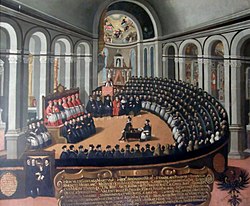 13 December 1545 CE – 21 February 1563 CE
Council of Trent
19th Ecumenical Council of the Catholic Church
Sources
Sources and evidence
Where every statement on this page comes from, and how each one stands.
1 statement on this record
- 1 Imported Taken from Wikidata as it stands. Nobody here has read it.
Only this record’s own statements. What other records say about it is counted on theirs.
Three layers, three licences
- Text
- Wikipedia · CC BY-SA 4.0, quoted, not merged
Review
Not yet read by an editor here. Every relationship on this page is an import.
Disagreements are kept, not resolved, and a count of sources is not a confidence score.


Keep exploring
More from Christianity
Its branches, councils, saints, offices and buildings — and where they stopped recognising each other.