

Deity Greek and Roman
Tyche
Τύχη grc
Greek goddess of fortune
A god is known
by the accounts
that name it.
Accounts kept apart
Family
The family of Tyche
Parents, consorts and children as the accounts give them. Choose a consort to see the children the stories give the two.
Accounts differ about a god’s family. Where they name different parents, the tree sets them side by side instead of choosing one.
The family as a list · 6
Kinship in an account 6
What this means
Parentage as a named source tells it. Not an independently established biological relationship, and different accounts disagree.
Does not imply an independently established biological relationship · agreement between accounts · marriage as a legal institution · exclusivity, or a single canonical pairing
Imported from Wikidata unless a tile says otherwise. Nothing here has been read by an editor.
-
 child of (child) Aphrodite Greek goddess of love, beauty, pleasure, and procreation
 -
 child of (child) Hermes Olympian god in Greek religion and mythology; the emissary and messenger of the gods; the god of trade, heraldry, merchants, commerce, roads, thieves, trickery, sports, travelers, and athletes; the son of Zeus and the Pleiad Maia
 -
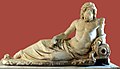 child of (child) Oceanus ancient Greek god of the earth-encircling river, Oceanos
 -
.jpg/120px-Tethys_(%C5%98eck%C3%A1_mytologie).jpg) child of (child) Tethys ancient Greek mythological figure; mother of the river gods and the Oceanids
child of (child) Tethys ancient Greek mythological figure; mother of the river gods and the Oceanids -
 child of (child) Zeus Greek god of the sky and king of the gods
 -
 partner of Agathodaemon mythological serpent
Connections
How Tyche connects
Grouped by the kind of relationship, because a successor is not a son and a shared symbol is not an influence.
Identification 1
What this means
One figure treated as another in some context. Not literal identity in all contexts, and usually a claim by a third party.
Does not imply literal identity in all contexts · that either tradition made the identification
Imported from Wikidata unless a tile says otherwise. Nothing here has been read by an editor.
%2C_KBS-FRB_03.jpg/120px-Charles_Samuel%2C_La_Fortune_(1894)%2C_KBS-FRB_03.jpg)
Sources
Sources and evidence
Where every statement on this page comes from, and how each one stands.
7 statements on this record
- 2 Has references The statement cites something outside Wikimedia. That citation has not been checked here.
- 5 Imported Taken from Wikidata as it stands. Nobody here has read it. 1 of them cite only Wikipedia: one source, counted once.
Only this record’s own statements. What other records say about it is counted on theirs.
Three layers, three licences
- Text
- Wikipedia · CC BY-SA 4.0, quoted, not merged
- Pictures
- Wikimedia Commons · each file’s own terms
Review
Not yet read by an editor here. Every relationship on this page is an import.
Disagreements are kept, not resolved, and a count of sources is not a confidence score.


Keep exploring
More from Greek and Roman
The Olympians and their Roman equivalents, the mystery cults, and the poets whose accounts disagree.