

Deity Trimurti
Shiva
शिवः sa शिव hi சிவன் ta
One of the principal deities of Hinduism, the Supreme Being in Shaivism and transformer within the Trimurti
A god is known
by the accounts
that name it.
Accounts kept apart
Family
The family of Shiva
Parents, consorts and children as the accounts give them. Choose a consort to see the children the stories give the two.
Accounts differ about a god’s family. Where they name different parents, the tree sets them side by side instead of choosing one.
The family as a list · 10
Kinship in an account 10
What this means
Parentage as a named source tells it. Not an independently established biological relationship, and different accounts disagree.
Does not imply an independently established biological relationship · agreement between accounts · marriage as a legal institution · exclusivity, or a single canonical pairing
Imported from Wikidata unless a tile says otherwise. Nothing here has been read by an editor.
-
 parent of (father) Ashokasundari goddess
 -
 parent of (father) Ayyappan Hindu deity
 -
 parent of (father) Ganesha God of good luck, prosperity and well being in Hinduism; First worshipped God; Son of Shiva and Parvati
 -
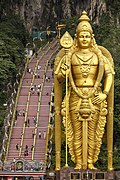 parent of (father) Kartikeya Hindu deity, god of war, son of Shiva and Parvati
 - parent of (father) Śāstā Hindu deity
-
 partner of (spouse) Chandi Goddess in Hinduism
 -
 partner of (spouse) Chandraghanta third form of Durga
 -
 partner of (spouse) Kālī Hindu goddess associated with death and destruction, in the 21st century adopted as symbol of feminine empowerment
 -
 partner of (spouse) Parvati Hindu goddess of fertility, motherly love and devotion
 -
_(cropped).jpg/120px-018_Sati_Immolation_(39572160495)_(cropped).jpg) partner of (spouse) Sati first consort of the Hindu god Shiva
partner of (spouse) Sati first consort of the Hindu god Shiva
Connections
How Shiva connects
Grouped by the kind of relationship, because a successor is not a son and a shared symbol is not an influence.
Affiliation 2
What this means
Association with a tradition or school. Traditions branch, overlap and re-merge; this is not a clean single-origin tree.
Does not imply a fixed roster · that every account of the tradition knows this figure · personal belief at every point in a life · the practice of a population
Imported from Wikidata unless a tile says otherwise. Nothing here has been read by an editor.
.jpeg/120px-UgrataraTemple2_(cropped).jpeg)
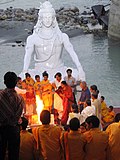
Identification 3
What this means
One figure treated as another in some context. Not literal identity in all contexts, and usually a claim by a third party.
Does not imply literal identity in all contexts · that either tradition made the identification
Imported from Wikidata unless a tile says otherwise. Nothing here has been read by an editor.

.jpg/120px-078_Isvara%2C_14c%2C_Sukhothai_(34443558853).jpg)

Attribute 1
What this means
A domain, symbol or epithet as sources record it.
Does not imply an exclusive domain · the same association in every account
Imported from Wikidata unless a tile says otherwise. Nothing here has been read by an editor.

Sources
Sources and evidence
Where every statement on this page comes from, and how each one stands.
9 statements on this record
- 3 Has references The statement cites something outside Wikimedia. That citation has not been checked here.
- 6 Imported Taken from Wikidata as it stands. Nobody here has read it. 2 of them cite only Wikipedia: one source, counted once.
Only this record’s own statements. What other records say about it is counted on theirs.
Three layers, three licences
- Text
- Wikipedia · CC BY-SA 4.0, quoted, not merged
- Pictures
- Wikimedia Commons · each file’s own terms
Review
Not yet read by an editor here. Every relationship on this page is an import.
Disagreements are kept, not resolved, and a count of sources is not a confidence score.
.jpeg/960px-UgrataraTemple2_(cropped).jpeg)
.jpeg)
Keep exploring
More from South Asian traditions
Hinduism and its schools, Jainism, Sikhism, and the Vedic material behind them.