
Deity East Asian traditions
Shangdi
上帝 zh 天帝 ja 상제 ko
The High God, the supreme or single God of ancient Shenism, some salvationist religions like Yiguandao, and Protestant Christianity in Chinese translation
- Also called Shang Ti, Shang-ti, Shangzhu
A god is known
by the accounts
that name it.
Accounts kept apart
Connections
How Shangdi connects
Grouped by the kind of relationship, because a successor is not a son and a shared symbol is not an influence.
Identification 16
What this means
One figure treated as another in some context. Not literal identity in all contexts, and usually a claim by a third party.
Does not imply literal identity in all contexts · that either tradition made the identification
Imported from Wikidata unless a tile says otherwise. Nothing here has been read by an editor.
- identified with Allah Arabic word for God
- identified with Caelus Roman god of the sky
-
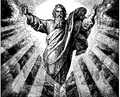 identified with God principal object of faith in monotheistic religions, a divine entity that created and typically supervises all existence
 -
 identified with God in Christianity Christian conception of God
 -
 identified with God in Islam Islamic conception of God
 -
 identified with Jade Emperor the highest god of many Taoist sects, overseeing the universe through administration of a celestial bureaucracy mirroring ancient and medieval China's
 -
 identified with Jehovah Latinate transliteration of יהוה (YHWH) with the vowel points of Adonai
 -
.JPG/120px-0_Jupiter_-_Louvre_MR_254_-_Louvre-Lens_(2).JPG) identified with Jupiter chief deity of Roman state religion
identified with Jupiter chief deity of Roman state religion -
 identified with Perun Slavic supreme god of the sky and war
Show all 16
-
 identified with Tengri chief deity of Turko-Mongolic religion
 - identified with Tian The Chinese conception of Heaven as a cosmic force, a high god under the Zhou, and the realm of the Taoist celestial bureaucracy
- identified with Tianzhu The Abrahamic God YHWH in Chinese translation sanctioned by the Catholic Church
-
 identified with Tinia Etruscan god
 -
.jpg/120px-Ekman%2C_Lemmink%C3%A4inen_tulisella_j%C3%A4rvell%C3%A4_(sketch).jpg) identified with Ukko god of the sky, weather, harvest and thunder in Finnish mythology
identified with Ukko god of the sky, weather, harvest and thunder in Finnish mythology -
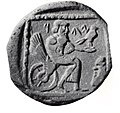 identified with Yahweh national god of ancient Israel and Judah kingdoms, god of monotheistic Judaism and Abrahamic religions
 -
 identified with Zeus Greek god of the sky and king of the gods
Sources
Sources and evidence
Where every statement on this page comes from, and how each one stands.
15 statements on this record
- 15 Imported Taken from Wikidata as it stands. Nobody here has read it.
Only this record’s own statements. What other records say about it is counted on theirs.
Three layers, three licences
- Text
- Wikipedia · CC BY-SA 4.0, quoted, not merged
Review
Not yet read by an editor here. Every relationship on this page is an import.
Disagreements are kept, not resolved, and a count of sources is not a confidence score.


Keep exploring
More from East Asian traditions
Daoism, Confucian practice, Chinese folk religion, Shinto and Korean tradition.