

Deity Greek and Roman
Nyx
Νύξ , Nýx grc
Greek goddess of the night
A god is known
by the accounts
that name it.
Accounts kept apart
Family
The family of Nyx
Parents, consorts and children as the accounts give them. Choose a consort to see the children the stories give the two.
Accounts differ about a god’s family. Where they name different parents, the tree sets them side by side instead of choosing one.
The family as a list · 49
Kinship in an account 49
What this means
Parentage as a named source tells it. Not an independently established biological relationship, and different accounts disagree.
Does not imply an independently established biological relationship · agreement between accounts · marriage as a legal institution · exclusivity, or a single canonical pairing · shared parentage in every account · descent from the same generation in a single tree
Imported from Wikidata unless a tile says otherwise. Nothing here has been read by an editor.
- child of (mother) Caligo Roman deity
-
 child of (child) Chaos Greek primordial deity
 - parent of (mother) Achlys primordial deity in Greek mythology
-
 parent of (mother) Aether primordial Greek deity, personification of the upper air
 -
 parent of (mother) Amicitia personification of friendship
 -
 parent of (mother) Apate minor goddess in Greek mythology, personification of deceit
 -
 parent of (mother) Atropos one of the Fates of Greek Mythology
 -
.jpg/120px-Sabouroff_Painter_ARV_846_196_Hermes_leading_a_deceased_to_Charon_(02).jpg) parent of (mother) Charon ferryman of Hades in Greek-Roman mythology
parent of (mother) Charon ferryman of Hades in Greek-Roman mythology -
 parent of (mother) Clotho one of the Fates of Greek mythology
 - parent of (child) Contentio daughter of Erebos in Greek mythology
-
_-_Day_(1884).jpg/120px-William-Adolphe_Bouguereau_(1825-1905)_-_Day_(1884).jpg) parent of (child) Dies personification of day, and the Roman counterpart of the Greek goddess Hemera
parent of (child) Dies personification of day, and the Roman counterpart of the Greek goddess Hemera - parent of (mother) Dolos deity
- parent of (child) Dumiles unintelligibly-named child of Nox and Erebus in Hyginus's mythological description
- parent of (mother) Eleos Greek deity of pity & compassion
- parent of (mother) Elpis Greek mythological personification and spirit of hope
- parent of (child) Epaphus son of Erebos in Greek mythology
- parent of (mother) Epiphron daimon in Greek mythodology
- parent of (child) Erinyes three mythical avenging deities
-
 parent of (mother) Eris Greek goddess of discord
 -
 parent of (mother) Eros Greek god of love and sex
 - parent of (child) Euphrosyne daughter of Erebos in Greek mythology
- parent of (mother) Fraus Roman goddess and personification of treachery and fraud
-
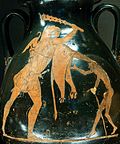 parent of (mother) Geras son of Night and personification of Old Age in Greek mythology
 -
 parent of (mother) Hemera ancient Greek goddess of the day
Show all 49
- parent of (child) Hesperides nymphs in Greek mythology
- parent of (child) Hesperis Greek mythological figures
-
_(14782112392).jpg/120px-Zeus_-_a_study_in_ancient_religion_(1914)_(14782112392).jpg) parent of (mother) Hybris personification of Outrage in Greek mythology
parent of (mother) Hybris personification of Outrage in Greek mythology -
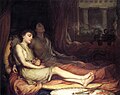 parent of (mother) Hypnos personification of sleep in Greek mythology
 -
 parent of (mother) Kakia ancient Greek goddess
 - parent of (child) Keres Greek spirits haunted battlefields to drink the blood of the dying, personifications of doom
-
_06.jpg/120px-Puteal_de_la_Moncloa_(M.A.N._Madrid)_06.jpg) parent of (mother) Lachesis one of the Fates of Greek Mythology
parent of (mother) Lachesis one of the Fates of Greek Mythology -
 parent of (mother) Lyssa Greek spirit of mad rage and frenzy
 -
 parent of (child) Moirae personifications of fate in Greek mythology
 -
 parent of (mother) Momus the personification of satire and mockery in Greek mythology
 - parent of (mother) Moros Greek spirit of doom
-
 parent of (mother) Morpheus Greek deity associated with sleep and dreams
 -
 parent of (mother) Nemesis goddess of Greek mythology
 - parent of (mother) Oizys goddess of misery in Greek mythology
- parent of (mother) Oneiroi minor gods in Greek mythology, Dreams
-
 parent of (mother) Phantasos deity
 - parent of (mother) Philotes Greek goddess of affection, friendship, and sex
- parent of (mother) Phobetor deity
-
 parent of (mother) Phthonus ancient Greek deity personifying jealousy and envy
 -
 parent of (mother) Thanatos personification of death in Greek mythology
 - partner of (spouse) Erebos primordial deity in Greek mythology
- sibling of Erebos primordial deity in Greek mythology
- sibling of Eros Greek god of love and sex
-
 sibling of Gaia Greek primordial deity, the personification of the Earth
 -
 sibling of Tartarus deep abyss, place of punishment, in ancient Greek mythology
Connections
How Nyx connects
Grouped by the kind of relationship, because a successor is not a son and a shared symbol is not an influence.
Identification 2
What this means
One figure treated as another in some context. Not literal identity in all contexts, and usually a claim by a third party.
Does not imply literal identity in all contexts · that either tradition made the identification
Imported from Wikidata unless a tile says otherwise. Nothing here has been read by an editor.

Text 1
What this means
A work, its editions and its witnesses are distinct; their dates are not interchangeable.
Does not imply that the work is the only account · that the work is contemporary with what it describes
Imported from Wikidata unless a tile says otherwise. Nothing here has been read by an editor.
Attribute 1
What this means
A domain, symbol or epithet as sources record it.
Does not imply an exclusive domain · the same association in every account
Imported from Wikidata unless a tile says otherwise. Nothing here has been read by an editor.
Sources
Sources and evidence
Where every statement on this page comes from, and how each one stands.
48 statements on this record
- 10 Has references The statement cites something outside Wikimedia. That citation has not been checked here.
- 38 Imported Taken from Wikidata as it stands. Nobody here has read it. 3 of them cite only Wikipedia: one source, counted once.
Only this record’s own statements. What other records say about it is counted on theirs.
Three layers, three licences
- Text
- Wikipedia · CC BY-SA 4.0, quoted, not merged
- Pictures
- Wikimedia Commons · each file’s own terms
Review
Not yet read by an editor here. Every relationship on this page is an import.
Disagreements are kept, not resolved, and a count of sources is not a confidence score.


Keep exploring
More from Greek and Roman
The Olympians and their Roman equivalents, the mystery cults, and the poets whose accounts disagree.