

Family
The family of Echidna
Parents, consorts and children as the accounts give them. Choose a consort to see the children the stories give the two.
Accounts differ about a god’s family. Where they name different parents, the tree sets them side by side instead of choosing one.
The family as a list · 30
Kinship in an account 25
What this means
Parentage as a named source tells it. Not an independently established biological relationship, and different accounts disagree.
Does not imply an independently established biological relationship · agreement between accounts · marriage as a legal institution · exclusivity, or a single canonical pairing
Imported from Wikidata unless a tile says otherwise. Nothing here has been read by an editor.
-
_(14751100312).jpg/120px-Pictura_loquens%3B_sive%2C_Heroicarum_tabularum_Hadriani_Schoonebeeck%2C_enarratio_et_explicatio_(1695)_(14751100312).jpg) child of (child) Callirhoe Oceanid of Greek mythology
child of (child) Callirhoe Oceanid of Greek mythology -
.jpg/120px-Loutrophoros_con_Perseo_e_Adromeda%2C_inv._19.M325-1.7_-_Marta_-Mitomania_(11).jpg) child of (child) Ceto Greek sea goddess
child of (child) Ceto Greek sea goddess -
 child of (father) Chrysaor mythical character
 -
 child of (child) Gaia Greek primordial deity, the personification of the Earth
 - child of (father) Peiras Greek mythical character, father of Echidna
-
 child of (child) Phorcys Greek sea god
 -
_Stroom-_en_waternimfen_(serietitel)_Nimpharum_oceanitidum%2C_ephydridum_potamidum_naiadum_(serietitel)%2C_RP-P-1898-A-19943.jpg/120px-Riviernimf_Styx_Stix_(titel_op_object)_Stroom-_en_waternimfen_(serietitel)_Nimpharum_oceanitidum%2C_ephydridum_potamidum_naiadum_(serietitel)%2C_RP-P-1898-A-19943.jpg) child of (child) Styx Greek divinity of the river Styx
child of (child) Styx Greek divinity of the river Styx -
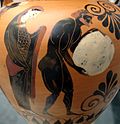 child of (child) Tartarus deep abyss, place of punishment, in ancient Greek mythology
 - parent of (child) Aethon eagle from Greek mythology
- parent of (child) Agathyrsus son of Heracles
-
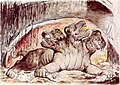 parent of (mother) Cerberus three-headed dog that guards the underworld in Greek mythology
 -
 parent of (child) chimera mythical or fictional animal with parts taken from various animals
 - parent of (child) Colchian Dragon bestiary, monster (Ther) / Drakones
- parent of (child) Crommyonian Sow mythical pig
- parent of (child) Gelonus son of Heracles
- parent of (child) Gorgon mythical monster
-
 parent of (child) Hydra ancient serpent-like chthonic water monster, with reptilian traits, that possessed many heads, in Greek mythology
 -
 parent of (child) Ladon Greek mythological serpent
 -
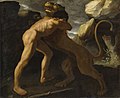 parent of (child) Nemean lion the lion killed by Hercules
 -
 parent of (mother) Orthrus mythical dog of Geryon
 -
 parent of (mother) Scylla nymph transformed into a sea monster by Circe in Greek mythology
 - parent of (child) Scythes son of Heracles in Greek mythology
-
 parent of (mother) sphinx mythological creature with the head of a human and the body of a lion
 -
 partner of (spouse) Typhon deadly monster of Greek mythology

Family 5
What this means
A documented human family relationship. Not a succession mechanism, and not religious transmission.
Does not imply a right to an office · transmission of a teaching
Imported from Wikidata unless a tile says otherwise. Nothing here has been read by an editor.
- child of (child) Chrysaor mythical character
- parent of (mother) chimera mythical or fictional animal with parts taken from various animals
- parent of (mother) Hydra ancient serpent-like chthonic water monster, with reptilian traits, that possessed many heads, in Greek mythology
- parent of (mother) Ladon Greek mythological serpent
- parent of (mother) Nemean lion the lion killed by Hercules
Connections
How Echidna connects
Grouped by the kind of relationship, because a successor is not a son and a shared symbol is not an influence.
Documented influence 2
What this means
A transmission argued from evidence. Not shared symbols, and not a short path through a database.
Does not imply shared symbols as evidence · a short path through a database
Imported from Wikidata unless a tile says otherwise. Nothing here has been read by an editor.

Sources
Sources and evidence
Where every statement on this page comes from, and how each one stands.
26 statements on this record
- 17 Has references The statement cites something outside Wikimedia. That citation has not been checked here.
- 9 Imported Taken from Wikidata as it stands. Nobody here has read it.
Only this record’s own statements. What other records say about it is counted on theirs.
Three layers, three licences
- Text
- Wikipedia · CC BY-SA 4.0, quoted, not merged
- Pictures
- Wikimedia Commons · each file’s own terms
Review
Not yet read by an editor here. Every relationship on this page is an import.
Disagreements are kept, not resolved, and a count of sources is not a confidence score.


Keep exploring
More from Greek and Roman
The Olympians and their Roman equivalents, the mystery cults, and the poets whose accounts disagree.